
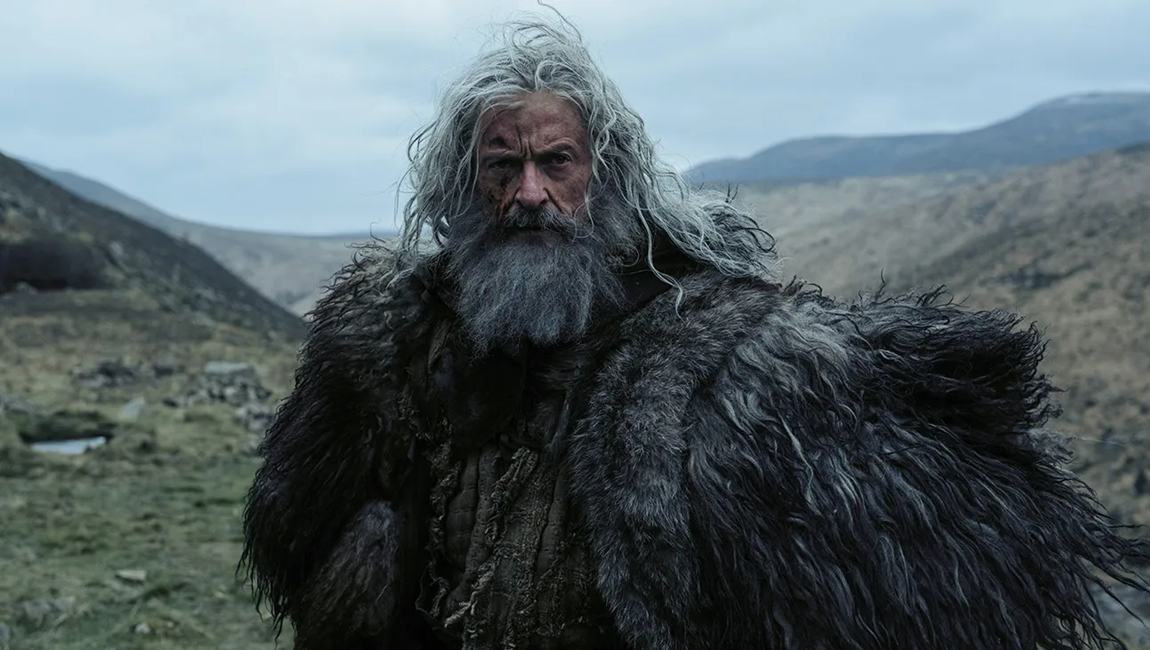
In Michael Sarnoski’s The Death of Robin Hood, the titular outlaw of English folklore spends his final years wandering the moors of 13th-century Britain, trying to shed the legend he helped foster and the seemingly legion of sworn enemies he’s created over his lifetime — finding little success at either. A million miles removed from the swashbuckling, heroic incarnations of the character portrayed by the likes of Errol Flynn and Kevin Costner, this version of Robin Hood is a mean old bastard who thinks nothing of firing an arrow into the skull of a fleeing child. A thief and an unrepentant murderer played by Hugh Jackman under a burly beard and long flowing gray locks, years earlier, Robin (although the character mostly travels under the name Randolph so as not to draw attention to himself) burnished an image of roguish benevolence; he stole from the rich and gave to the poor, or so the story goes. But it was all in service of manipulating other lost souls into joining his criminal cause. Now, Robin would tell you that he was little more than a road agent and a cutthroat who enriched no one more than himself. Those days are past him, or they would be if only people would stop seeking him out in search of vengeance. But bloodshed only begets further bloodshed, and every person he murders gives rise to two more who slither out from the shadows in search of satisfaction. Robin desperately wants to break the chain, but he’s much too proficient at killing for that to ever happen.
It’s a familiar tale, even if you divorce it from the “Robin Hood of it all.” The craggly killer, being reluctantly dragged back into a world of brutality, is downright archetypal in American Westerns. Whether it’s John Wayne in The Shootist, Clint Eastwood in Unforgiven, or even Jackman himself in Logan, it’s a rite of passage for actors of a certain age to grapple with their onscreen legacy of living by the sword (as it were), indulging in much hand-wringing on the nature of violence, only to shake off the moral morass in time to go out in a blaze of glory that proves the old man’s still got it. So Sarnoski deserves a measure of credit for bucking the trend, to a certain extent anyway. Pokey and frustratingly withholding of conventional thrills in its efforts to embody its professed values, The Death of Robin Hood attempts to earnestly explore what breaking the cycle of violence means in a world where killing comes as easily as breathing. It’s a film about laying the bow and arrow down and keeping it down while accepting that pistols at dawn (again, as it were) doesn’t actually solve anything. Meditative and elegiac when audiences have been conditioned to expect something that quickens the pulse, The Death of Robin Hood is a film that’s easier to admire than embrace, particularly as we’ve already seen this filmmaker handle similarly tricky subject matter with greater success.
The story proper begins with Robin being sought out by the erstwhile Little John (an unrecognizable Bill Skarsgård, proving to be a modern-day man of a thousand faces), the last surviving member of the ironically named Merry Men. Going under the assumed name of Edward — nearly every male character in this film employs a pseudonym at one point or another — John, we learn, has forced his way into a family of farmers, murdering the patriarch, taking on the dead man’s identity, and installing himself as head of the household. He even serves as a husband to the woman he made a window and father to their little girl, Margaret (Faith Delaney). After the dead farmer’s kin rises up and expels him, John calls upon his old marauding buddy, Robin, for one final favor in order to reclaim the stolen (and then re-stolen) land. However, in the ensuing siege, John’s wife is slaughtered, his home is burned to the ground, and Robin is gravely wounded. Dumped off at an island-set priory, Robin is cared for by Sister Brigid (Jodie Comer), a nun whose tragic past Robin played no small role in bringing about.
Serving as an elysium of sorts where Robin frequently crosses paths with those he’s harmed over the course of his life — the film certainly doesn’t discourage the reading that everything that happens in its second half is set in the afterlife — the character slowly heals, against his own wishes that he simply die already, contending with a legend that is a millstone around his neck. Yet rehabilitation comes in many forms; amid the woods and orchards that surround the isolated monastery, Robin ponders a life of peace, especially once a traumatized and now fatherless Margaret washes up on the shores. Robin takes the rudderless little girl under his wing, teaching her how to hunt and crafting a bow for her while pondering whether allowing his ward to believe the happy lie about his and Little John’s past exploits might provide more lasting comfort than the awful truth. But that truth can’t stay buried forever: an injured young man going by the name Arthur (Noah Jupe), who viewers will surely recognize from earlier in the film as a relative of one of Robin’s victims, appears on the island. Is it merely a coincidence? Can his claims of ignorance be taken at face value, or is this boy the latest in a long line of those out for revenge against Robin? And if the latter, is there any means of Robin extricating himself that isn’t kill or be killed?
Back in 2021, just as adventurous filmgoers were finally starting to return to theaters after the pandemic, Sarnoski released a small gem of a film called Pig, and, when viewed in a certain light, The Death of Robin Hood appears to iterate on many of that film’s motifs. A quietly devastating subversion of a genre film — essentially, a porcine-centric riff on John Wick that finds our wronged main character on a rescue mission as he navigates the gourmand underworld of the Pacific Northwest — Pig upends expectations by genuinely embracing the notions of grace, being unable to reclaim the past, and healing oneself from the inside out. It was a film about finding the strength to turn the other cheek while recognizing that trading one life for another doesn’t actually fill the emptiness within you. A lot of those same tendencies are evident in this film (and not just the hirsute appearance of both films’ leading men), but whereas Pig was thrillingly specific, The Death of Robin Hood traffics in myths which are broad and malleable by design. The film front-loads its most stomach-churning violence — in its opening moments, we watch Jackman bury a knife in the temple of a waif who made the mistake of trying to assassinate Robin while downwind — so we understand this isn’t your father’s Robin Hood. Yet the film still saddles the character with a sage-like leper (Murray Bartlett, hidden behind head-to-toe bandages) who serves as the character’s conscience, and an adorable moppet to bring forth Robin’s paternal instincts. Further, Jackman’s innate affability is working against the conception of the character as truly irredeemable; just like in those ubiquitous X-Men movies, he might project “grumpy son of a bitch,” but we recognize that deep down he’s kind of a softie.
It’s hard to quantify what’s considered a spoiler in something entitled The Death of Robin Hood, but it’s fair to say that the film takes on increasingly funereal qualities — ironically, the film’s final act recalls another recent film starring Comer — that has the tendency to play like a slow march to the grave. Shot in Northern Ireland on 35mm by Sarnoski’s regular cinematographer, Pat Scola, the film is handsome-looking but inert. Scenes are enveloped within rolling fog or are set against a beautiful yet unforgiving landscape — an early sequence finds Jackman being smothered in the mud while in the background a farmhouse burns to the ground — but The Death of Robin Hood settles into a series of anticlimaxes and lightly philosophical debates on the value of stories and their capacity to inspire greatness as much as distort reality, which comes across as a little self-aggrandizing. Robin argues that the stories of his supposed heroism are like a wounding blade, only for Sister Brigid to gently counter that “a knife can also cut bread,” which sounds an awful lot like this film’s take on “print the legend.”
Referencing The Man Who Shot Liberty Valance is instructive — even the films’ titles feel like they’re in conversation with one another — as the Ford film deconstructs the idea of heroism and the need for conventional avatars for valor, but it does so primarily through the actions of its characters. By comparison, The Death of Robin Hood is a more sober and stately affair, where its themes are foregrounded in the dialogue. Sarnoski defies expectations — the roiling conflict at the film’s center is ultimately resolved through conversation, albeit one that takes the form of a thinly veiled threat — but his approach here borders on the hermetic. Even in its early brutality, the film is often painterly and quite still, with its beautiful compositions serving as visual accompaniment to solemn rumination on the nature of violence and the need for heroes. The ideal version of The Death of Robin Hood is as a coffee table book; as the film is being released by the niche merchandise experts at A24, we can assume one is in the offing.
DIRECTOR: Michael Sarnoski; CAST: Hugh Jackman, Jodie Comer, Bill Skarsgård, Noah Jupe, Murray Bartlett; DISTRIBUTOR: A24; IN THEATERS: June 19; RUNTIME: 2 hr. 3 min.
Comments are closed.