
“They say that long ago, on hilly Crete,
the Labyrinth contained a weaving course
among blind walls and countless twisting paths,
impossible to trace or comprehend.” — Virgil
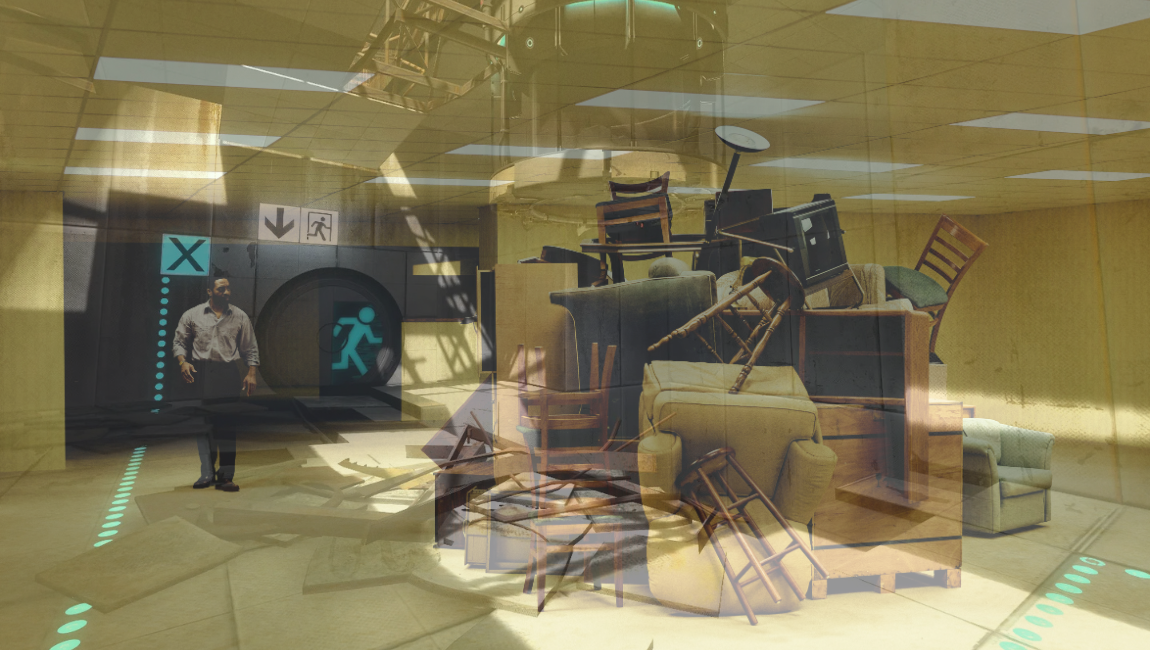
All days were balmy in 2013, the sun always shone, and there existed no madness nor evil in the world. It was in that year that Valve, the parsimonious video game developer, first began to prod at film adaptations of their gleaming IP hoard. JJ Abrams was at one point linked to a film adaptation of Portal, a sentence-clause that boggles the mind. There is, nonetheless, some sense in the ambition. Portal remains one of the great achievements of the video game. It is one of those artworks that is so defining of its form that to extract it outwards — to rewrite it in a different medium — would be the height of folly. There is no catnip like the unfilmable. The game features a protagonist with no lines, no background, and no discernible characteristics. She is accompanied by two other characters: one, a psychotic, monologuing AI; the other, an inanimate (though comforting) cuboid. The sequel introduces a few more speaking roles, though nothing that approaches the structure of a feature film. It is, by definition, a puzzle game: a series of increasingly complex logical and physical puzzles, which require the player to navigate rooms with the primary purpose of exiting them. Admittedly, this precis could define the objective of most video games, but none so nakedly as Portal.
The game, debuting in 2007, came with a strapline: Now you’re thinking with portals. In some respects, this is the thematic meat of the project: the game introduces a topsy-turvy mechanic (a portal gun, which allows the player to create an A-B personal wormhole between two surfaces), and teaches the player how to integrate this form of navigation into their basic thought. At the game’s beginning, the player will tread nervously into this blue-rimmed window, often disoriented at where and how they emerge on the other side; by the game’s end, players are fluently gavotting through a multiplex of changing portal positions to harness various paradoxes of borrowed potential energy to fling themselves, and other such objects, hither and yon. The experience of entering a room as Portal begins and Portal ends is fundamentally altered; the room, its opportunities, and its physical dimensions are no longer the same. The finale of the second game goes so far as to reconfigure how we consider the surface of the Moon, portal-wise. But we need not get so cosmic: it is right enough to say that Portal is a game about rooms. Very recently, the first-ever feature film adapted from a single photograph of an empty room achieved the largest original horror debut in history. The room-director, Kane Parsons, later revealed his dream project: to direct a film of Portal. I’m about to argue that he already has.
But perhaps it is inaccurate to say that Backrooms is an adaptation of a photograph. After all, the film is looped into a multi-year YouTube series, created by Parsons, that he began at age 16. And the mythology developed in that series was not completely original but rather a set of increasingly convoluted variations based on a 4chan creepypasta posted in 2019, with which the photograph first went viral. If Backrooms is not, therefore, the first feature film adapted from a photograph, it is certainly the first film adapted from a 4chan post — there are virtues in every atom of existence. Nonetheless, the photograph in question has had a powerful influence on the world around us, so much so that the phrase “the backrooms” has become a form of cultural shorthand for, or subcategory of the decades-long obsession with, “liminal spaces.” That latter phrase has a long history, to the beginning of the 20th century, but more recently it has been widely applied to a very particular kind of generally unsettling (or eerie, as Mark Fisher has it) interior space, generally one which is either defined by, or made disturbing by, the dint of being empty. The classic example in the first category is a hallway in a hotel: a somewhat featureless tunnel of modern architecture lined by a series of anonymous doors, one corridor indistinguishable from the next, or the next. A recurrent childhood experience, or nightmare, is finding oneself lost, on holiday, in such a maze of corridors, with no referent as to where one is, or where one ought to be. The second category refers rather to the interior life that modernity has sculpted, and the strange feeling in seeing these places deserted: malls, which roofed over and coiled up the high street into a multistorey Barbican; office towers, in which prefabricated blocks, desks, dividers repeat in upward tessellation; or the underground carpark, the inverse skyscraper, slabs of concrete down and down. The Shining achieves much of its effect in combining the two: an empty, or seemingly empty, hotel.
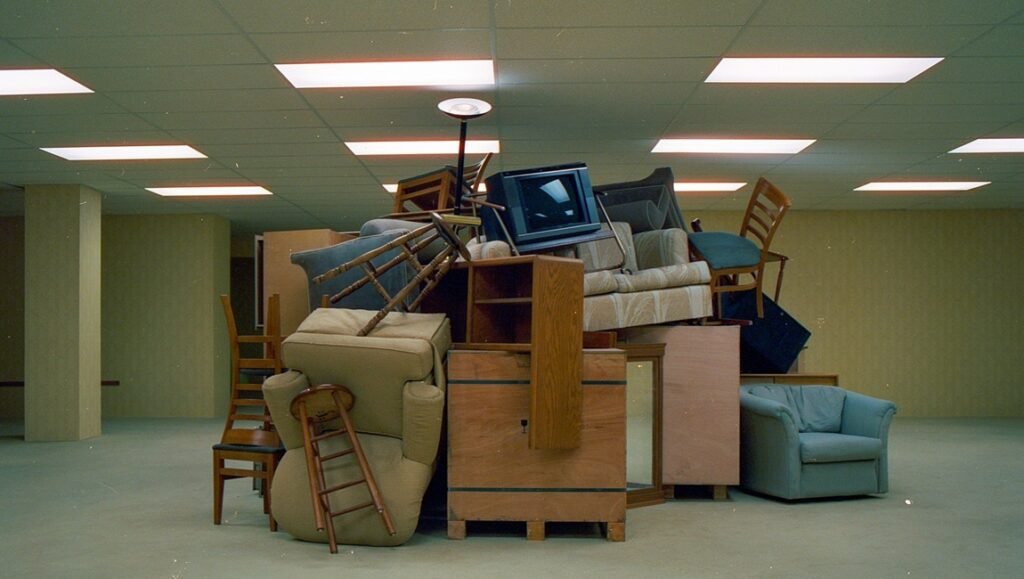
But a liminal space is not, in so being, a “backroom.” The backroom has an additional requirement of prohibition: it must be out-of-bounds, or restricted, or staff-only. Most businesses and public buildings have a backroom or several; places where boilers hum, where stock is kept, where cabals meet. This latter function has been an artistic subject for centuries — the room behind the bookcase — and drives, to take an example at random, the conspiracy of Suspiria. This concept can be exploded into a more profound, existential idea. What if the entire world, reality as we know it, had a “backroom”? In The Truman Show, Truman exists in a fabricated island-town, controlled from a backroom-style control deck; in The Matrix, the entire world is fabricated, and the “backroom” is the “true” reality that governs the simulation. More recently, the Marvel series Loki posited a vast, winding office complex that manages multiple realities simultaneously. Severance, in which white-collar workers find themselves penned in a labyrinth of windowless offices, compounds the issue: here, there are backrooms within backrooms. Dan Erickson, creator of Severance, cited the viral backrooms sensation as a direct influence on his work, which tends toward the increasingly surreal: and this is the missing link.
In the original 4chan post, the anonymous user advises that the reader be careful, or they might “noclip out of reality.” To noclip is video game nomenclature for phasing through the boundaries established by the developer (where “clipping” would usually prevent such a thing). Having noclipped (by accident or by guile), the player can view the inverse architecture of the game world; some developers hide delicious or obscure secrets in this out-of-bounds area to reward the intrepid. Noclipping is most commonly experienced as walking through a wall or falling through the floor. Here, the pixel-thin realities of most video game design become evident: buildings seem like sketched-out mazes with no visible exterior; these structures are themselves contained in an infinite void. The illusion of verisimilitude is broken, though in its stead is a deep sense of the uncanny: of being outside of the world, of being where one should not be. Sometimes areas removed from the game are visible; sometimes areas in which developers had “tested” various aspects of the game have survived into the final build. These rooms sometimes have a strange, unfinished, or looming quality. Bugs in video game telemetry can create clipping errors in traditional assets during normal gameplay: one might encounter a chair halfway through the floor, or a weapon aggressively jiggling while stuck inside a lamppost. These effects create a similar impression, in one sense humorous or bizarre, though a little disconcerting.
The aesthetic presence of these objects is unique to video games: one object perfectly phased through another, the pixels surrendering their pretense to physical reality. A chair can slide through a wall and remain there; the wall itself will not crack or bend: it will remain in total, unaffected stasis. This mood, and this range of aesthetic possibility, is therefore inherent to the backrooms idea. Indeed, it was in video games that the idea was first adapted. Using Valve’s famously flexible Source engine, via its playground of madcap invention — Garry’s Mod — various enthusiasts built replicas of the viral photograph, and some portion of the six hundred million square miles of backrooms implied by the original post. The floaty movement, flat lighting, and comparatively low-polygon assets of the Source engine gave something to the already unheimlich atmosphere of the yellow-papered corridors. But we should not imagine such corridors as originating with the backrooms; they are not the consequence, but the inspiration. A decade before the 4chan post, 19-year-old Davey Wrenden published a Half-Life 2 mod (again using the Source engine) called The Stanley Parable (remade as an independent game with William Pugh in 2013), an experiment in narrative video gaming that situated the player in “The Office.” What begins as a seemingly abandoned office block — nervy enough as it is — morphs as the player persists through the game: rooms begin to repeat, corridors loop impossibly back, and the architecture can change completely when the player isn’t looking. The strange liminality of the empty office space transforms into the surreal, oppressive texture of the backrooms. It will surprise no one to hear that Kane Parsons began his creative career fooling around with Source in Garry’s Mod; or that his original Backrooms videos were not live-action footage, but digital animation very clearly inspired by video game corridors. It will surprise even fewer to hear that the original Portal was also developed on the Source engine.
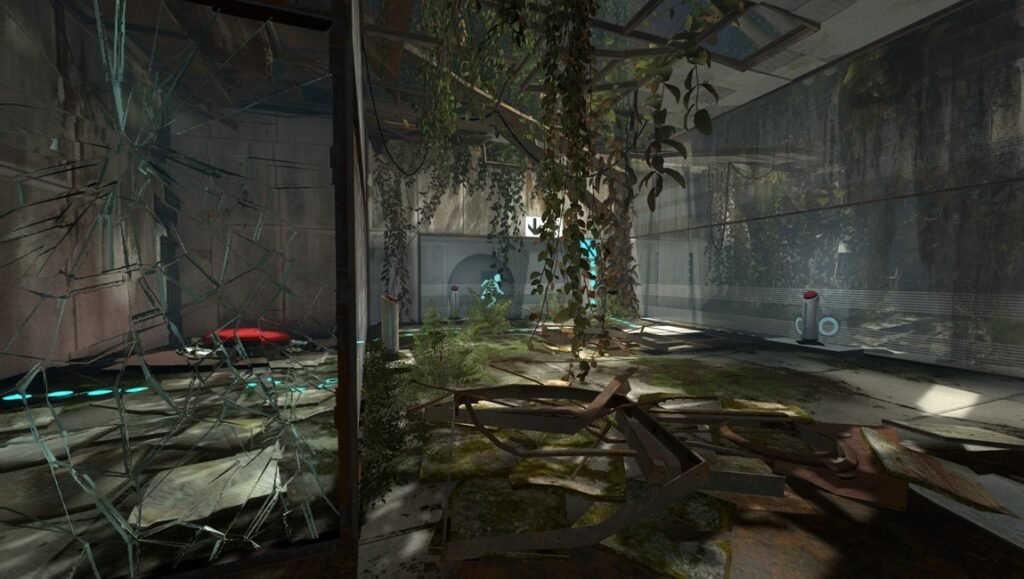
If The Stanley Parable is a key influence on the backrooms idea in general, it is evident that there is no greater influence on The Stanley Parable than Portal itself. (The remake, built using the Source 2 engine also used for the Portal sequel, even teleports the player directly into a Portal level.) In narrative terms, the connection is obvious. Both are built around the dark comedy of a single, intervening narrative voice. Both rely on the player following the commands of this voice and, at crucial intervals, not following those commands, destabilizing what seemed to be the conventional “follow your instructions” structure inherent to most video games. But the most important inheritance from one to another is a similar mood in their spatial design. Portal appears to take place in a hyper-modern testing facility, branded by the murky corporation Aperture Science, with stark white walls and a series of modern amenities: automatic doors, glowing red buttons, and cube dispensers. In various rooms, there are fluted glass panels clearly designed for observation; CCTV cameras will follow the player as she navigates different areas, and she will frequently stumble upon coffee mugs, spanners, and radios in the course of her testing procedure. But as the game continues, there is something obviously missing: other people. Observation areas, which can sometimes be accessed, are populated only by clipboards. Sometimes a door or panel will be conspicuously damaged or nonfunctional. Some of these broken panels allow the player to slip by, into a rusted crawlspace, where they will find unusual messages scrawled on the wall. One memorable repetition is frequent: The cake is a lie.
As the perfection of this facility begins to unravel, and as the arrant AI, GLaDOS, becomes increasingly irate in her narration, the player is unnerved: this is not the abstract “game world” of an ingenious puzzle mechanic — And why not? Tetris has no lore — but the site of some strange, probably malevolent, history, utterly cut off from the outside world. But it is toward the end of the game, in which GLaDOS’ murderous tendency becomes fully evident, that the game really accesses the mood of its descendants. The player escapes the “closed system” of test chambers into what can only be described as the backrooms. A series of administrative or mechanical chambers and corridors, of abstract design and purpose, marked by an industrial decay and intervening office rooms. We are where we ought not to be; we have slipped out of the game itself. But this exterior is even more threatening than the clinicism of the test route — there is no telling what you might encounter here. The final objective is not to understand, but to escape: into the outer world. So much of the game is contained not in its puzzle structure, or its dialogue, but in its architectural construction: in the increasingly isolated, abstract dimensions of these empty, labyrinthine chambers. They are not, on reflection, a pleasant place to be.
This mood is the backbone of Kane Parsons’ Backrooms, a film that possesses a plot, and characters, and some kind of thematic arc, but really needs none. The point of featuring characters — who seem in themselves flimsy, or incomplete — is solely vehicular: as a vessel to transport an audience into this warren of yellow-carpeted chambers, each of which is designed to evoke some feeling of unease, each abstracting away from “useful” spaces into vaguely recognizable scrambles of familiar architecture. Much of the drama while in the backrooms is that of navigation, like Portal: figuring out how to leave one chamber and enter the next; figuring out the illogic of this parallel realm without ever understanding its cause or purpose. Parsons has fundamentally created a mood piece, and it is a mood piece that does not relate solely to the sinister rooms of the film’s otherworld, but indeed all rooms. Cinemas themselves tend to be patterned with liminal areas — long staircases and corridors between cavernous chambers. Having seen Backrooms immediately prior, these places become strangely charged; suddenly, rooms and buildings are not those neutral constructs that mark out our reality, but suspicious entities. A vast array of doors that lead… somewhere. The backrooms first came to prominence during the COVID pandemic — during which business evacuated the city block. A vast industrial emptiness. But we are looped into a video game logic: we are looped into a notion of walls behind walls, of sudden, inexplicable constructions, of a fragile reality whose edges are — at certain points — permeable. In the traditional formation of the “backroom,” we discover a place that explains our world — that governs it. But these rooms only ambiguate and disturb. The rules that determine the function of life, or the progress from one test chamber to the next, are flung aside. The game, in one instance, or reality in the other, encounters a fundamental change that alters all comprehension. Some spirit of decay prevails. What can one do, having fallen through the world? Escape it — and then what?
Comments are closed.