
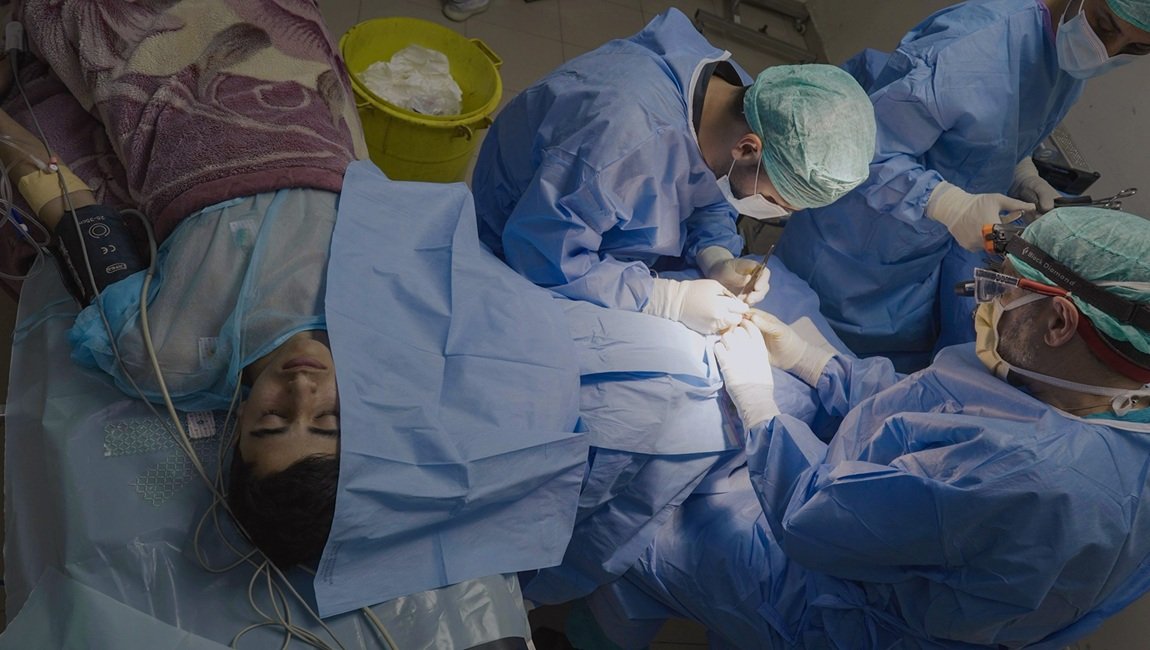
Documentarian Poh Si Teng’s directorial debut American Doctor follows three American physicians who traveled to Gaza to practice medicine at Nasser Hospital at various points in 2024 and 2025, with particular emphasis on a period that encompassed the March 2025 ceasefire and its expiration. Teng also follows these men in their quotidian lives in the U.S., scenes in which one can perceive their cognitive dissonance on returning to the world’s wealthiest nation after witnessing first-hand the relentless bombardment of Gaza using their own tax dollars. An exchange between Teng and Dr. Mark Perlmutter in his North Carolina home, which Teng places early in the film, functions as a thesis statement. Perlmutter shows Teng a photograph of young children in Gaza who had been killed by Israeli bombs, and Teng replies that she intends to blur the image for the film, expressing an intention of protecting the children’s dignity. Perlmutter counters the filmmaker forcefully: “Israel took away their dignity… you have the responsibility to tell the truth.” Teng follows Perlmutter’s directive faithfully; what follows is an unflinching depiction of the horrors inflicted on the people of Gaza through the lens of the film’s subjects, and their ongoing efforts to convince the American public and elected officials to confront the genocide that their government has funded.
The three subjects of the film are Perlmutter, Dr. Thaer Ahmad, and Dr. Feroze Sidhwa. Perlmutter is an orthopedic surgeon, Ahmad an emergency physician, and Sidhwa a general and critical care surgeon. Teng emphasizes their distinct cultural backgrounds and how they have impacted their work in Gaza: Perlmutter is Jewish and had lost friends due to his outspoken, righteously angry advocacy; Ahmad is Palestinian-American and had been turned away from multiple attempts to provide medical care in Gaza by Israeli authorities; and Sidhwa is a secular Pakistani-American who views his lack of cultural or religious affiliation with Israel or Palestine as an asset in communicating the reality of the conflict to the American public.
Teng spends time with each of them in their homes, at work, and doing advocacy work in the U.S., allowing each to speak for themselves and share their moral convictions with absolute clarity. Though their temperaments are starkly different (most notably, Perlmutter runs as hot as Sidwha runs cool), each possess a steely, fervent commitment to doing everything in their power to care for the besieged Gazan population and to turn the tide of violence.
The scenes of the doctors in the U.S. are compelling in their own right and offer necessary context for the subjects as individuals, but the scenes of their work in Gaza are remarkable: the ravaging violence they depict is as horrifying as the doctors’ deep conviction and capability is galvanizing. (The sequences in Nasser Hospital, it should be said, are shot by cinematographer Ibrahim Al-Otla, who Teng shared with this publication was “starving” and struggling to feed his children while he worked on the film.) While Ahmad was turned away by Israeli authorities before he could enter Gaza, Perlmutter and Sidhwa arrived during a ceasefire — while both are quick to point out that Israeli violence had not actually ceased, the city of Khan Younis, which houses Nasser Hospital, was not actively being bombed. Alongside their Gazan colleagues, they operate with extremely limited supplies on grievously ill and injured adults and children. Perlmutter and Sidwha are both precise and pragmatic, yet they are not resistant to emotion. There is an overwhelming scene in which Perlmutter weeps while listening to a colleague describe the death of his 10-month-old daughter; his account lays bare the human cost of the genocide on the Gazan healthcare workers who, after all, had been enduring unspeakable violence and deprivation themselves while they cared for patients.
The ceasefire expires during Perlmutter and Sidhwa’s time in Gaza, and Teng does not shy away from the horrors that ensue. Scores of patients, many of them children, arrive with gruesome injuries from bombings; of those who survive, many require amputations. During this time, Israel bombed the second floor of the hospital, which, in addition to a patient targeted by the military, killed a teenage boy recovering from surgery. The boy was Sidwha’s patient, and Sidwha stoically remarks that he could have been killed as well had he been changing his patient’s bandages at the time of the bombing. Israel’s relentless bombing of hospitals is discussed and condemned extensively throughout American Doctor; this episode shows the impact of violence against healthcare facilities on-the-ground.
Teng and her collaborators — particularly those operating under impossible conditions in Gaza — accomplish a vital feat of documentation in American Doctor, displaying the agonizing reality of providing healthcare while under the constant threat of bombardment without embellishment or downplaying. Drs. Perlmutter, Sidwha, and Ahmad are compelling subjects, and their testimonies, grounded in empathy and expertise, could provide windows of opportunity for thus-far resistant Americans to acknowledge the reality of Israel’s genocide in Gaza, and the central role of the United States government in perpetuating it. The film, too, is formally strong, with gripping editing and astute selection of powerful material, with only minor slips in effectiveness (most notably, given the film’s focus on Nasser Hospital, Teng’s choice to end the film with a montage of newsworthy events related to Gaza feels like a missed opportunity to focus more specifically on how the situation has evolved at the hospital since the time of filming). American Doctor, though, is a film for which form and aesthetics function purely as means to depict the politically and morally urgent footage of healthcare in the face of unceasing violence. It is a profoundly difficult watch, but the doctors’ willingness to act in the face of danger exemplifies the importance of confronting morally unacceptable realities, rather than turning away.
DIRECTOR: Poh Si Teng; CAST: Thaer Ahmad, Mark Perlmutter, Feroze Sidhwa; DISTRIBUTOR: Watermelon Pictures; IN THEATERS: August 14; RUNTIME: 1 hr. 33 min.
Comments are closed.