
On August 11, 1994, major league baseball stopped. The scores on the big beaming boards standing above the outfield wall remained blank, robbed of their majesty, as the summer sweltered and days dragged by, the hot golden sun ascending skies and exhaling its lovely light on grass and dirt that went untrod for weeks, months. Stadiums sat sad and empty, seeming so tiny with the absence of fans, and unbreathed air eddied about the vacuous behemoths. Without lungs to fill, Zephyrus grieved. The unpopulated diamonds looked unnatural. Urban din went unmuffled in the parking lots that should have been replete with grumbling cars and angry drivers honking their horns and yelling and trying to maneuver their way past other drivers also honking their horns and yelling and trying to maneuver, a great messy loud congestion. (Did they think they’d ever miss that?) And fans — neophytes for whom the game was still fresh and now already tainted, and the old-timers with memories of Stargell and Mantle and Hammerin’ Henry (he did not like being called Hank) still in their heads — were stricken by a chagrin never before felt, betrayed by their beloved game, this country’s pastime now emblematic of the country’s greed. In September, when the division races should have had fans thrumming with excitement, and with The Expos a real genuine contender for the first time, the playoffs looming and that elusive gleaming trophy ready to be hoisted like a religious idol, you could watch Melrose Place at 8:00 PM, followed by Party of Five. There was Fortune Hunter and Martin and Living Single, too.
The strike is a low point for the game, a blotch on its storied history. They said baseball was dead. Robert Lipsyte even wrote an “In memoriam” on the front page of the New York Times. Baseball’s executive council went as far as approving the use of replacement players so the 1995 season would begin without a hitch. At the end of March, the league announced the season would be abbreviated to 144 games, down from the usual 162. On April 2, 1995, just a day before the replacement players were set to take the field, the strike ended, after 232 days and countless fans lost in the process. With fans so soured and the game besmirched, it makes sense that Tony Scott’s The Fan (1996), a nasty anxiety attack of a thriller about a superstar player struggling during the first year of his mega contract and his lunatic number one supporter going to murderous lengths to show his team spirit — a film sudorifically paced and laceratingly cut in that distinct Scott style — would bomb.
Robert De Niro plays Gil Renard, a floundering labile knife salesman and psychopathic Giants fan, and Wesley Snipes plays Bobby Rayburn, who, with his career batting average over .300 (something baseball has lost in the age of strike out-prone sluggers), has signed for historic bucks with the San Francisco Giants. With Rayburn on the team, beloved centerfielder Juan Primo (Benecio del Toro) has to shift to left field to accommodate Rayburn, which vexes some fans, and Bobby’s insistence on getting his old number 11 — Primo’s number — makes him seem like a prima donna, selfish and egotistical, concerned with the wrong parts of the game (though baseball players do tend to be superstitious), which further vexes fans. But he’s one of the best in the game; surely it’s all worth it. Before his first game, an ailing child asks him to belt a homer, and he does; but the child dies before getting to see it. Life is cruel. Then Bobby tells his agent (John Leguizamo) a miserable secret: the home run was a fluke, he never saw the pitch. He swung blindly and by a stroke of luck clobbered it. Early in the game, he collided with Primo chasing down a flyball and hurt himself, but he stayed in anyway. He tried to man up. Bad decision. In subsequent games, he flails and hacks and hits air. The fans turn on him. Well, most fans. Not Gil. Not yet.
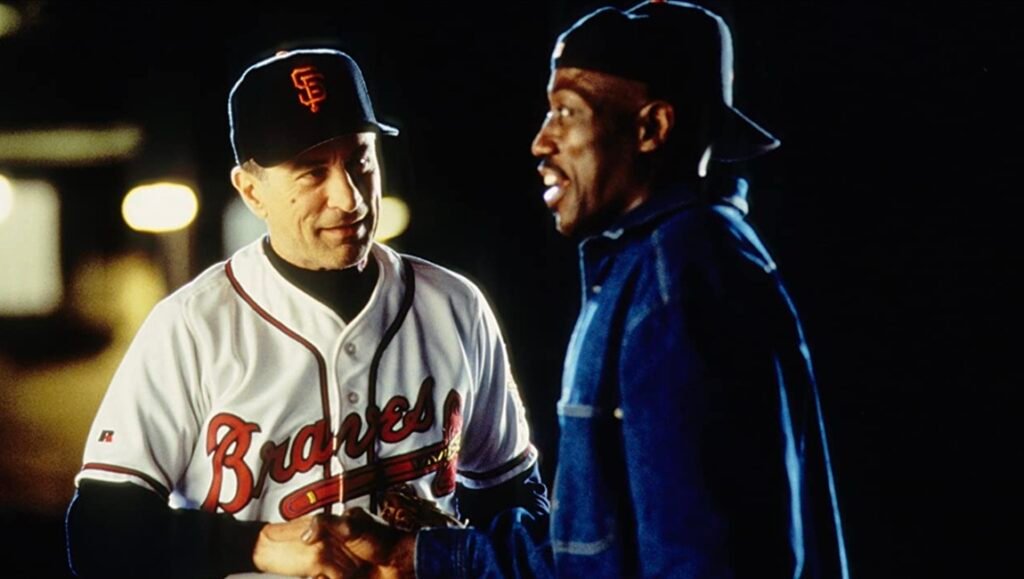
Rayburn was based in part on Barry Bonds, who, after the 1992 season, entered free agency and left the Pittsburgh Pirates to sign a six-year contract worth a then-record $43.75 million with the Giants. (Rayburn signs for $40 million.) His father played the first seven years of his career with the Giants, and his godfather, Willie Mays, the Say Hey Kid, played for them for 21 of his 22 years, both in New York and San Francisco when the team moved there in 1958. Bonds came home. Like Bobby Rayburn. In 1993, his first year with the Giants, Bonds won his third MVP in four years, tying the all-time record. He put up a 9.9 WAR (Wins over replacement), leading the league with 46 home runs, 123 RBIs, an on-base percentage of .458, and a slugging of .677. Look at his OPS+, a stat that has become popular in recent years, favored by sabermetrics (people who analyze baseball through numbers, empirical and objective, if a little too cold to capture the poetry of the game), which is one of the best stats for analyzing a player. We can apply retroactively. The average is 100, so anything higher means the player is better than average; Bonds had an OPS+ of 206, meaning he was 106 percent better than everyone else. Before he ever touched a steroid. The Giants won 103 games that year, a record for the team that stood until 2021, but they lost the pennant to the Braves. And like Rayburn, Bonds had a tempestuous relationship with the media. (Also, Rayburn led the Braves to a championship the year before signing with the Giants, a fun little detail for baseball fans.) The dynamic duo Rayburn and Primo are likened to Willies Mays and McCovey, who combined for three MVPs. Mays was arguably robbed four times, McCovey twice, though the latter won in 1969 with a staggering OPS+ of 209, the highest a Giant had until Bonds’ otherworldly 259, which came when he broke the single-season home run record with 73 in 2001.
In 1993, the San Francisco Giants sold 2,606,354 tickets, a per-game average of 32,177; in 1996, after the strike and mass exodus of fans, it was down to 1,413,922 tickets, a per-game average of 17,243. The Fan also lost money, with a $42 million box office against a budget of $55 million. But the film is a sick fantasy, with the stadium chockablock with bodies garbed in jerseys and heads topped with hats, fans trembling with intense ardor, cheering, booing; the Giants sell out every game, even with Rayburn performing far below what Bonds did. In reality, people wouldn’t pay to watch real baseball, and they certainly wouldn’t pay to watch fictional baseball.
While The Fan was under the delusion that baseball was still popular in 1996 and consequently suffered at the box office, it also understands the game in ways more popular and affable movies like Major League and Field of Dreams don’t quite. Baseball is beautiful and imbues fans’ souls with that wonderful faithful piety, a passion transcending age and time yet singularly able to capture any and every epoch, distinguish them, find the connections between them; it’s the inimitable subject of a mass love that, however diversely directed, unifies. But it’s also rooted in ugliness, in cruel capitalist avarice. It’s a game — an essential part of life — that those faithfully pious fans will callously turn on when their team isn’t doing well. And when one player is slumping as hard as Rayburn, the boos and jeers suffuse the stadium, bellicostic howls of “You suck!” and maleficent, sibilant hisses. One example of authenticity while also playing fantasy: John Kruk, built like a bruiser but one of the great contact hitters of his time (and an uproarious commentator after retirement), appears. He belts moonshots, which Kruk wasn’t known for, and it works in the film. His technique and presence lend credibility, especially important because Snipes’ form at the plate is, well, pretty poor. His stroke is too long, his follow through awkward, his core not engaged properly, and he doesn’t keep his eye on the ball all the way through. But the energy Snipes brings to the performance vibrates true. The joy with which he hypes himself up, the anguish when he’s slumping, dolorous when the fans hate him, self-hating, the sharp jealousy toward his thriving teammate/foe, the authenticity of his superstitions — Snipes finds the humanity in the mythical ballplayer brought down hard to earth. We hold up star players like Gods, and when they are proven mortal, it hurts, it enrages, it makes us question our belief systems.
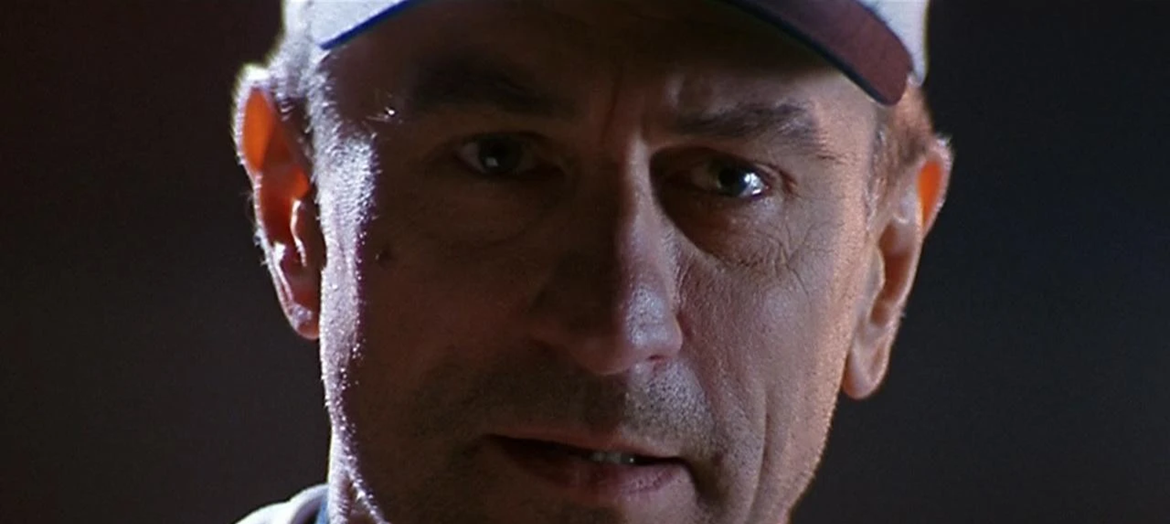
So what does Gil believe in? Is Gil a fan of the game? Of The Giants? Of Bobby? Or does he just long, in the sad, painful way of the sick, to feel important? The fragility of his ego rivals Rayburn’s. He’s the stalker in the stands, desperately seeking something he thinks Bobby will give him; but what is it? He claims to have once been a player of great promise before his “arm went south,” but nothing the man says can be trusted. (But what if some of it can?) When on a stalking mission, after he saves Bobby’s son from drowning, he convinces the grateful star to play a little with him. Gil pitches to Bobby, reliving fantasies of glory. But things take a turn. Their badinage about the game, its significance, and the significance of Primo’s death, all of which Bobby downplays — it’s just a game; he got better when he stopped caring; he isn’t happy that Primo is dead — digs up in Gil an existential despair, like his (demented) worldview has been shattered. He needs validation. He is so sure of the righteousness of his actions. He throws harder, a little chin music. Gil’s psychopathy becomes vivid when he kills Primo (as Nine Inch Nails blasts and the screen goes crimson), and then more when he kidnaps Bobby’s son and dog and Hummer and Bobby finds a chunk of Primo’s skin emblazoned with “11” in his freezer. No more posturing: Gil no longer hides his greatness because he wants some goddamn respect.
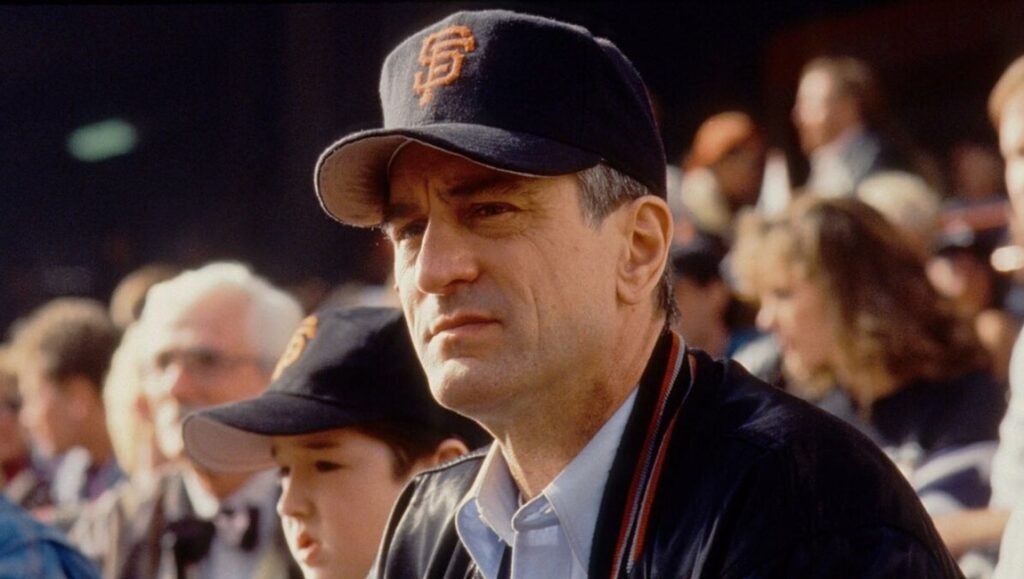
De Niro has done this sociopath thing before, and it never gets old because he never quite repeats the same tricks. (Even if this isn’t the first De Niro movie to prominently feature “Gimme Shelter.”) He has a preternatural ability to adroitly tap into the inner seething tumult of the American male. In them, he finds violence; in violence, he finds a sad, acrimonious ontology, and in taking life, a way to live. The contorted countenance of these cruel men, the posture insinuating a hurt and a willingness to hurt, the sensation of reliable unpredictability they emit, the twisted relationship of love and hate, and the deranged but sincere integrity of whatever they believe in — all of this reveals the souls of his characters, from Travis Bickle (cleaning the scum from the streets) to Rupert Pupkin (desperate like Gil for respect, though his violent tendencies are gentler, more pathetic), and Al Capone and Jimmy Conway and especially Max Cady, the character most akin spiritually and in aesthetic depiction to Gil. Biblical notions of vengeance fuel Cady, and for Gil, baseball is a religion. Both believe deeply, devoutly in their own sure convictions. Both are acting on behalf of true faith.
Being a Tony Scott film, The Fan has a rapturous, intricate visual style, bombastically flashy and carefully detailed and far denser visually and aurally than anyone would expect from a baseball blockbuster. Scott and cinematographer Dariusz Wolski capture Gil’s soul, baleful and lonesome, the adoration inseparably entwined with anger, with deviously beautiful lighting and 2.35 compositions, a grandiosity to match the way Gil views his own significance. When the pathetic Gil sits in his boss’s office of amber and wood, in a chair nicer than he can never afford, leaning forward as if ready to strike but knowing he is in this moment powerless, and is unceremoniously fired, the slats of treacherous pale sunlight glow like white hot rage on his face. You watch him get emasculated, and you fear him. And look at those stadiums full of quavering, pulsating bodies, smiles and scowls, and grass so green, a verdant paradise between tall authoritative foul poles where a small white ball with 216 red stitches smacks leather, cracks stentoriously against swung wood, where uniforms get dirty and childhood dreams are realized. Or shattered. Not everyone can win.
The Fan‘s imagery evokes heaven under balmy blue skies and then hellish interiors when Gil goes bad, all in tandem with the editing of Claire Simpson (who won an Oscar for her work on Platoon) and Christian Wagner, who worked on John Woo’s Face/Off and was one of Scott’s regular cutters (often paired with Chris Lebenzon), from Revenge and Days of Thunder in 1990 to Domino in 2005. Quick and precise and violent cuts, but also sometimes lingering like the swoony gaze of a boy at his first game.
Baseball and Tony Scott both bounced back grandly in 1998. Scott released Enemy of the State, a film of intense and more conventional suspense and perdurable relevancy about the surveillance state and the craven power of conservative ideology. A subject as American as baseball. It made over $250 million, Scott’s biggest hit since Beverly Hills Cop II in 1987. The film captures the time — and what a scary time it was — and has yet to age, presciently capturing every age since — and what scary ages we have suffered. At the same time, Mark McGwire and Sammy Sosa embarked on an epic odyssey, chasing Roger Maris’ single season home run record of 61, set in 1961. Big Mac and Slammin’ Sammy clobbered pitches like He-Men, launched them in glorious parabolas deep into the stands. Fans dig the long ball, and came back in droves.
Comments are closed.