
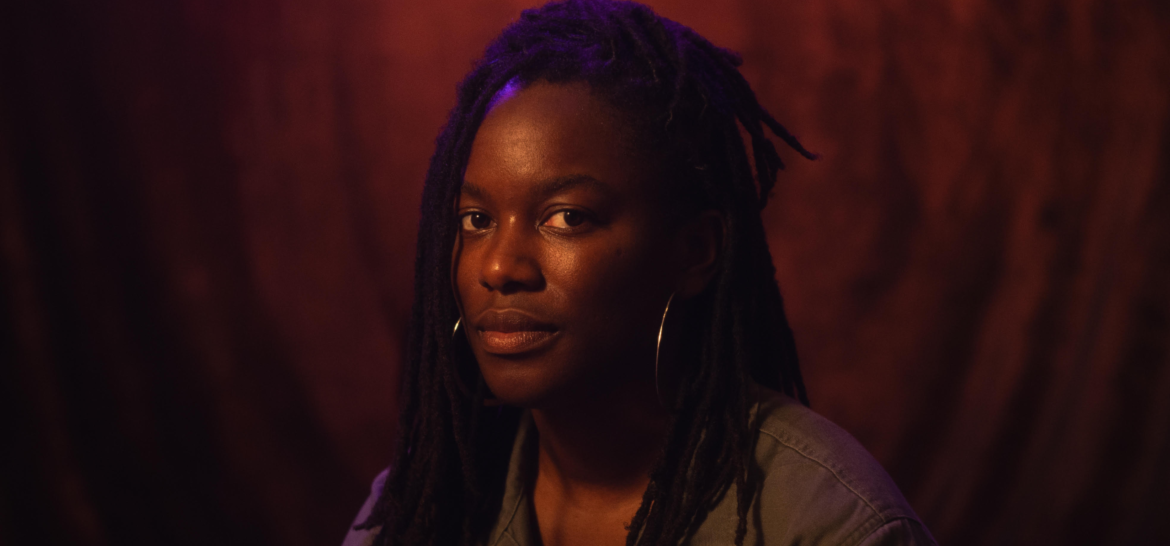
Shatara Michelle Ford is one of the unsung forces in American Independent cinema. Their debut feature, Test Pattern, was a quiet yet seismic announcement of a voice with so much to say and exactly how to say it. Following a Black woman who’s been assaulted as she and her white partner try to find a rape kit, the film delicately unspools the unspoken dynamics of power and race within an already fraught relationship. It’s a stunning debut and made Ford a filmmaker I’d follow anywhere. You’d think following that up with a sprawling road trip across many states and even national borders wouldn’t be the obvious follow-up, but Ford’s predilections are perfect to dissect across America.
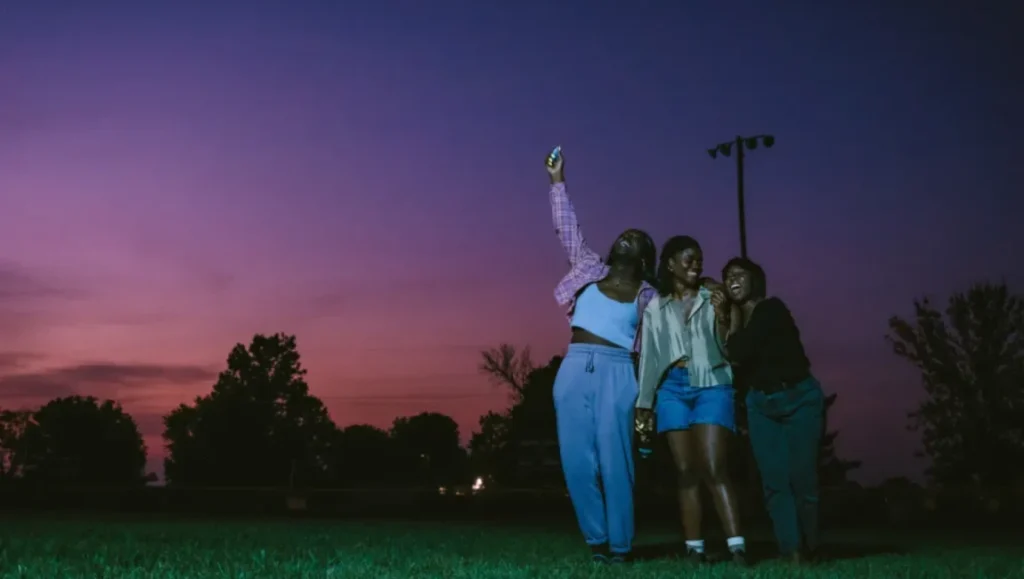
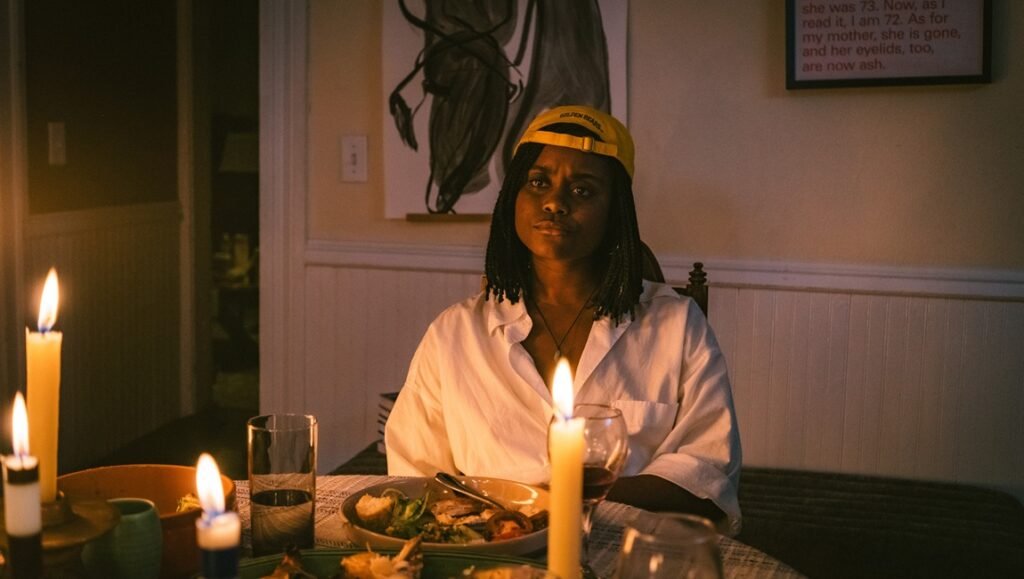
Following four Black femmes, Dreams in Nightmares tracks their journey across the American Midwest as they search for a friend, Kel (Mars Storm Rucker), whom they’ve fallen out of touch with. Along the way, they catch a drag performance in Pittsburgh, run into an old friend, Sabrina (Jasmin Savoy Brown), in Iowa City, and even make a stop at Kel’s parents’ for dinner. As they make their way to Oaxaca, Mexico, the group’s interactions oscillate between sensual and alive or genuinely unnerving. In a lesser filmmaker’s hands, these latter moments might fall into over-the-top horror, but Ford plays them with their patented restraint and humor. Ford only allows the film to uncork when the pressure cooks at just the right moment. Sabrina’s white partner materializing out of thin air is treated as a very funny jump scare, while Kel’s parents frequently misgendering them becomes one of the film’s only explosive moments of rage. It’s a genuine pot-boiler with Ford deploying catharsis when they want it, not when you think you deserve it. Operating from the belief that you (the white majority) aren’t owed explanations about gender or identity, Ford’s authorial voice shines brightest when their characters get to live and love freely, unconcerned with how they present.
Shot across the country, Dreams in Nightmares is as ambitious a production as indie cinema gets. Knowing they’d have limited resources and people to work with in each location, Ford employed a set of Community Guidelines to ensure a safe set with mutual respect and understanding. Many of the rules might read as common sense, but if you’ve ever been on a film shoot or read about their horror stories, you’ll know that these are as essential as it gets.
Ahead of the film’s release in NYC, I sat down with Ford to discuss the film, its massive scope on a limited budget, and how to navigate a sprawling shoot as a Black, queer filmmaker.
Brandon Streussnig: This is such a wild jump from Test Pattern in terms of scope. The film is sprawling and ambitious, and I’m interested in how you approached such a production. What was your mindset in deciding to take on something of this scale, knowing you might not have the budget to fully support it?
Shatara Michelle Ford: I think there are a couple of things that run concurrently, which is that if you’ve ever been involved in production or [worked as] a producer, best-laid plans never come to fruition. You can prep and prep and prep and anticipate, but there will always be chaos on the day. So there’s that, and that smashes together with the fact that I’m a wildly ambitious person. I don’t like to admit this, but I think it makes a lot of sense for the process I have and the types of things I make. I was that kid who loved Magnolia, and I watched that documentary that PTA’s assistant made, That Moment, I think it was called, or something like that, where you just kind of saw how this project kept getting bigger and bigger and bigger and more complex, but how, in Paul’s mind, the whole time he knew that was going to happen.
There are issues with that. I want to be really clear about my position and my own criticisms of that kind of behavior. I have many of them, but there’s also something I admire greatly about a person who saw the thing very clearly and knew that the resources he had in front of him weren’t really going to get him there, but he was going to keep pushing until the last absolute minute, until he couldn’t anymore. I don’t necessarily value the arrogant approach that fueled that, but I respect the ambition. I think another really important contextual positioning thing for me is that I’m also the kid who grew up watching music videos and aspired to be a music video director. Making the Video on MTV was a great gift to me because it showed me what film sets look like. It showed me what production was. I grew up in the era of million-dollar music videos, and I was recognizing the scope. These projects tended to have cinematic kind of engines behind them and structures, and so I think all of those things kind of fed into me knowing that there’s more beyond what I have access to, and the only way that I’m going to get there is if I act as if [I do] up to a point.
Then I was fortunate enough to be on, at the time, James Gray’s most ambitious project, The Lost City of Z. I was watching an indie director who I admired sit with a very large budget and a very complex production schedule that was also dealing with the navigation of historical accuracy, building things that are very intricate. That impressed upon me what is possible.
So yeah, unfortunately, I carry all of that with me on my very, very meager budgets. Also [with] a production background, I’m recognizing where I can push and what I can do. So that’s the overview. Now I’m going to tell you, in practice, every single day was so fucking hard and harder than what I anticipated, what I wanted for myself. It was so fucking hard. I think there were little things that I feel like I set myself up really well with Test Pattern where the limitations of just a story that’s so intimate, focused on really a couple of days, meant that pushing the limits of what is achievable inside of that is quite easy comparatively. My producing partner and I really set ourselves up for success in that way.
Honestly, I think I got a little cocky or something, and I’m not going to lie, I was kind of like, “I did that. I can keep going.” I think on top of it, it wasn’t just the cockiness, it was a bit of naivete around the fact that simply by having quadruple the size of cast, my directing style has become exponentially more complex, as in if we’re finding scenes with each other on the day after doing rehearsal offscreen separately or split up in units, that’s already a complicated soup to start melding together. That just made every single production day really tough because there were a lot more elements I had to navigate, and it scared the shit out of me for the first couple of days. I was like, “What did I do?”
BS: You’re so up front about budget in a way that most indie filmmakers aren’t. You talk about it extensively in the press notes.
SMF: I’m not really afraid to talk about the budget. I believe it’s important to talk about budget because I recognize that when we obfuscate that kind of thing, it almost devalues the modes of production, the inputs, and the people power it takes to make a thing. I originally was trying to make this movie for $850,000. This is in 2023. One of the things that immediately takes a lot of money out of that budget is shooting in Mexico, which automatically pushes you into the tier of SAG that makes it a union production. I don’t mind that, I respect that, I think that’s okay, and the expectations and protections inside of SAG make sense for their membership. I was recognizing that that ate a shit-ton of my budget, just honoring that. It was too important to shoot in Mexico. We thought about faking it and shooting in Arizona or someplace in Texas or something. That was just dumb.
I’m a director who values place and what place does to a person, and I’ve been privileged enough to be on sets where I witnessed that when you’re on location, and you’re immersed in an environment, it does change the performance for the better. I also think that there’s something really nice and magical that happens when you force everyone to go on location. I think the focus is different, but you also have these really special kinds of creative input from the environment itself and the people who inhabit it, so it was important for me to keep that. So I was just like, “We have to do it.” It just made the thing more expensive and meant it took days off our prep schedule. It took days off of rehearsal and just the pressure. I didn’t make the movie simpler. I didn’t change its structure to accommodate that. I just kind of was like, “Okay, we’re going to work with it.”
BS: You speak of place and how important it is to you, and it made me think about how much the film opens up and becomes so much warmer when you get to Oaxaca. There’s obviously a narrative reason for that, but you can feel as a viewer that this place means something to you. Tell me about that.
SMF: It’s a great question, and I don’t get to talk about this part enough. But if we rewind all the way back six years ago when we were all in lockdown and taking stock of our lives, and simultaneously, I think as a country, we were reckoning with police violence and Black American death at the hands of our institutions. I have been an adult for the entire arc of the Black Lives Matter movement, or the inverse of the movement of Black Lives, whatever you want to call it, the Defund the Police, the Trayvon Martin of it all. I’ve been here alive and old enough to reckon with it. I’m also from St. Louis, so Ferguson and Michael Brown mean a lot to me. I understand what’s happening there.
This is stuff that my friends and I, my Black American friends and I, have talked about. “When do we leave? Do we leave? Are we leaving? Why haven’t we left?” Simultaneously in the early 2020s, there was this significant movement of Black people, mainly Black women, who were moving to Latin America and Mexico specifically, and Oaxaca happens to be a city where there are a shit ton of Black American expats, Canadians, and people from all of North America. There are Caribbean expats there too. Someone told me about this, and I was like, “I kind of have to see it for myself.”
So I went, and I was amazed. I also fell in love with Oaxaca as a place, and I kind of understood the raw ingredients for why Black Americans would want to go there, especially single Black women, often queer Black women, what that was about. Then I spent time with the expat group, the really active community-based aspect of the expat group, and I just started interviewing them. I have a sociology background. I can’t help but turn everything into some sort of qualitative process. I started just talking to them, spending time, and even questioning myself: is this something I wanted to do? The answer was always no. Despite that, I understood why they all did, and I wanted to make a movie about what it means to be an ethnically Black American, a Black person with a history of enslavement on both sides of their family that has only known racial injustice and death as a feature of being part of the state, but also so ingrained in the culture. We have created the culture; we are part of the culture; we are stewards of the culture and the institutions and foundations of this country.
So there’s this complicated thing. I’m very, very, very American and yet America’s always trying to put me in a different place. The pop culture of America, the mainstream of America, often places me as an afterthought even though I’m very much of it. So I think a lot of my work is constantly reckoning with that anyway, and so I wanted to explore America in these very traditional, well-trodden American movie narratives or genres, this being the road movie and maybe even the Western, and place that inside of the current Black American millennial experience, which means that someone is going to end up not being there.
BS: In the other locations, you’re also exploring these pockets of America that are nominally progressive but can be deeply racist. That’s something I always recognized in Pittsburgh, where I’m from.
SMF: Oh yeah? Which part?
BS: I grew up in Oakmont but lived much of my adult life in or around Squirrel Hill.
SMF: Oh wow, I spent a year living there when I was at CMU (Carnegie Mellon University).
BS: What a small world. Were there different approaches, though, to the different cities you filmed in? I imagine some places were more permissible than others when you were driving through. What was that process like?
SMF: That’s a really great question. No one has asked me this, and I really, really appreciate you asking. Again, I wrote this in January or conceived of it in January 2023 when there were all these tiny little rumblings, random state bills regarding bathroom bans, and a trans friend of mine who was traveling to a conference, I can’t even remember the state. I don’t want to accuse Florida, but that would track. He was there specifically for a conference, an LGBTQ conference, and got there, knew the rules, knew the law, and kind of approached the bathroom and got scared. He didn’t know which one to go to, and he felt really weird about it. The conference organizers were white, and he checked in with them about what to do. No one had thought it through in this way.
I share that because there’s the nuance of also being a Black person, a dark-skinned person, a person that’s already being paid attention to maybe a little bit more than they should be. I knew that having a whole bandwagon full or a caravan full of Black people going through incredibly white small towns might attract attention. So it was thoughtful. It wasn’t like, oh, we’re just going to go, and it’s going to be fine. We really thought about how we keep people safe. That’s where the community guidelines came from: I wanted people to feel safe speaking up when they needed to and asking for certain things when they needed to. The hiring process was quite extensive as well, and the fact that we had to ask people, “How do you feel about stepping in? Are you aware of how subtle forms of racism could show up on a film set, on location? Do you feel comfortable stepping in and supporting someone? Especially if you happen to be a white man.” We had white men on our set. They knew that that was a part of the job.
We scouted very carefully for places. I grew up in the Midwest, I went on road trips all the time. My parents and my family, we stopped, and sometimes those places were kind of sketch, but we did it anyway, and we had a vigilance about us. I say all that to say that I’m comfortable in these situations. When we were scouting, I had no problem walking up to a proprietor of a place that was very small and very white and kind of getting a feel for it just by saying, “Hi, I’m interested in shooting in your establishment.” Just seeing what the vibe was. Thankfully, there are always lovely people everywhere, and I think that’s also the point of the film: there are Black people everywhere, and we find ways to coexist with whatever is going on. So yeah, I wanted to honor that, but it was definitely carefully planned and well thought-out, and I had no problem calling people out, firing people, doing what I needed to do to make sure we were all looked after properly.
BS: I like that you mentioned the firing part. There’s a line in the community guidelines that really struck me: you’ll speak to people with understanding, but there’s also an acknowledgment that this is an indie film set, that tensions might arise, and that everyone has to approach that with grace. I just like the pragmatism of saying, “Hey, guys. We might get mad at each other, and it’s going to be okay.”
SMF: Again, this is probably coming from being on so many film sets coming up, but it’s like shit can get toxic fast if there’s no clear hand of leadership, or if this is how we’re going to behave here. Because tensions will get high. It’s an emotional thing. You never have enough time, you never have enough resources. People are going to step on each other’s toes, under-communicate, over-communicate, yell at each other, and none of that inherently means that someone is being disrespectful, oppressive, abusive, whatever. So it’s first taking a moment to pause and breathe and be like, where could this be coming from? Then recognizing that we’ve created the conditions for conversations to be had, for accountability to emerge, for some level of process of a way through. Maybe this is also me practicing transformative justice and the basic tenets of community care, which I also think are present in the film.
I wanted to make sure that every theme of the movie gets richer and more felt on screen if it’s something practiced within the space. I think that audiences sense falseness, even if they’re not sure where it’s coming from — something thematically or just even relationally on screen — I think we can sense that. So my job, again, is to cultivate the conditions, to facilitate the best conditions for the thing that I want to have happen. I appreciate the recognition in the statement because, yeah, I think it’s paramount to making something joyful and sincere.
BS: You’re so very good at showing intimacy on screen, which I think is a lost art. There are so many incredible moments of intimacy, whether it’s sex or kissing, it’s all of a piece. Something else I found really lovely is the prolonged sequences of people practicing their art: pottery, poetry, even drag at one point. What draws you to craftspeople, and why did you want to center so many segments of the movie on people performing their craft?
SMF: I love humans. I’m the ultimate humanist. I’m obsessed with humanity. I have a romantic relationship with people. I think that what I’ve loved witnessing as an artist who collaborates with artists, as a maker, as a tinkerer who collaborates with other makers and tinkerers, there’s nothing more beautiful or sexy to me than watching a person do the thing that they love to do when they’re just in their bag. I think that as craftspeople and technicians, there’s something sometimes about the work that gets mechanized because it’s just a process. There’s so much panache and beauty even in how an individual goes through the process. Maybe that’s just the thing that I pay most attention to, and it’s definitely the thing that turns me on, but also makes me just fall really in love with a person. It’s just seeing how they do their thing.
BS: This is a silly thing to end on, but you made me think of it earlier. You haven’t made a music video yet, but you said you grew up watching MTV and thinking about how you’d want to do that one day. What would your dream music video look like? Who’s that artist you’d love to collaborate with?
SMF: Oh my God. I mean, again, great question, but I think that’s a hard question. I’d have to think about it. There are people I’d love to work with. I’d love to work with Doechii. I’d love to collaborate with her because I think something really rad would come out. I thought a lot about the visual accompaniment to Solange’s “When I Get Home.” There are these really graceful, beautiful, ethereal things that are just performance art pieces in themselves, and I would love that. I mean, I can’t deny, again, as I try to be really low-key about my love of old PTA, but the “Paper Bag” music video — that really dark and sad collaboration between Fiona Apple and PTA lives rent-free in my head. I’m real basic in some ways too. I loved growing up with Hype Williams music videos. The master.
BS: I mean, Belly is a great film.
SMF: Belly is a great film.
Comments are closed.