
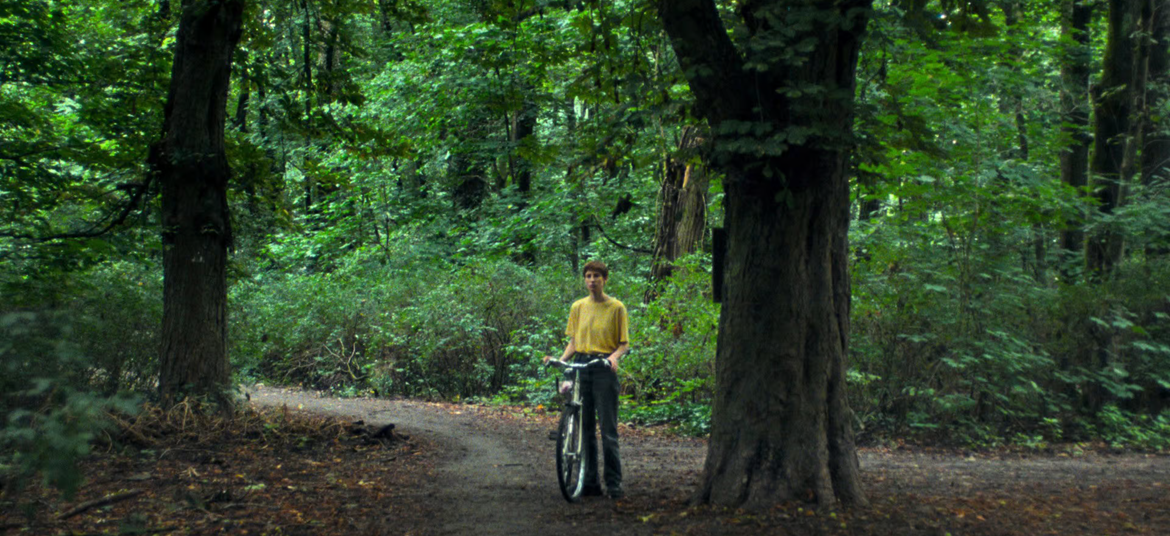
Breathing in Angela Schanelec’s world may be one of the most ineffable experiences still available to us in contemporary cinema: the sensation of drifting among bodies, faces, hands, sounds, memories, open and enclosed spaces, within a world that conceals its outward connections while internally constructing a dense network of relations and echoes. For this reason, meaning in Schanelec’s cinema is less something to be decoded than something to be felt. Her images are fields of experience before they are vessels of meaning; meaning settles later, through the contact between body, time, space, sound, and memory. This sensibility was already discernible in Schanelec’s earliest films and in her place within the first generation of the Berlin School. What linked her to Christian Petzold and Thomas Arslan was less a shared style than a common suspicion of some of cinema’s most entrenched habits: explanatory psychology, guiding music, editing that organizes the spectator’s gaze in advance, images whose meaning has effectively been determined before they have even been seen. Silence, pause, omission, and distance are not ends in themselves in this cinema; they are consequences of trust in the capacities of the image.
Schanelec has continually radicalized this logic over the course of her career. From Marseille and Afternoon through The Dreamed Path, I Was at Home, But…, and Music, what has been destabilized is not only narrative information but the very hierarchy separating what is conventionally considered important from what is treated as incidental. A major event may occur outside the frame while the movement of a body, a pause after a sentence, or the emptiness of a room remains onscreen for far longer. The point has never simply been to strip narrative away. The deeper shift is in what can constitute a cinematic event in the first place. My Wife Cries occupies a strange position within this trajectory because, on the surface, it appears considerably more legible than Schanelec’s three previous films. In The Dreamed Path or Music, even the most basic temporal and narrative certainties could fall away. Here, the central event becomes clear relatively early on. Carla tells us about the emotional relationship that developed after Thomas withdrew from their dance class: about the man who replaced him as her dance partner, the intimacy that grew between them, a brief trip, and the accident that killed him. The information is there. What remains inaccessible is the experience itself.
In this respect, the film is both a direct continuation of Schanelec’s late work and a kind of return to the relationships, houses, circles of friends, and extended conversations of her earlier films. But after Music, such a return can no longer be simple. Having spent years breaking narrative apart, hollowing out stretches of time, and granting increasing autonomy to bodies and spaces, Schanelec returns to something resembling a relationship drama. The most consequential change is the return of language. People talk in My Wife Cries — sometimes at great length, and about things that in many of Schanelec’s other films might have remained outside the frame altogether. Yet an abundance of words does not produce greater transparency. The more these characters speak, the more palpable the distance between speaking and experiencing becomes. The long scene in which Carla and Thomas walk together is at the center of this tension. Carla tells him almost everything, and rather than fragmenting her confession into close-ups and reaction shots, the camera allows her speech to unfold alongside the movement of their bodies, the street, the traffic, and the changing light. The event itself happened some time ago and is never shown. What exists now are words leaving Carla’s body and arriving in Thomas’s.
When Thomas finally sinks down beside a tree and says that his head is exploding, language has become a physical event. A truth has passed from one body into another and changed its nature along the way. What exists in Carla as memory, desire, loss, and perhaps guilt registers in Thomas as shock, jealousy, humiliation, and finally physical collapse. The same fact becomes two different things in two different bodies. In Schanelec’s cinema, the body does not usually “show” emotion; it carries it. Much of the longstanding misunderstanding surrounding the supposed “coldness” of her work begins here. When the face refuses expressive exaggeration, when music does not tell us what to feel, and when editing does not immediately deliver a character’s reaction, it is easy to confuse distance with an absence of emotion. But in Schanelec, feeling is displaced from the face and distributed across the entire field of the image: in a way of walking, the distance between two bodies, a pause before a sentence, a minor gesture, or the silence that lingers after a conversation has ended.
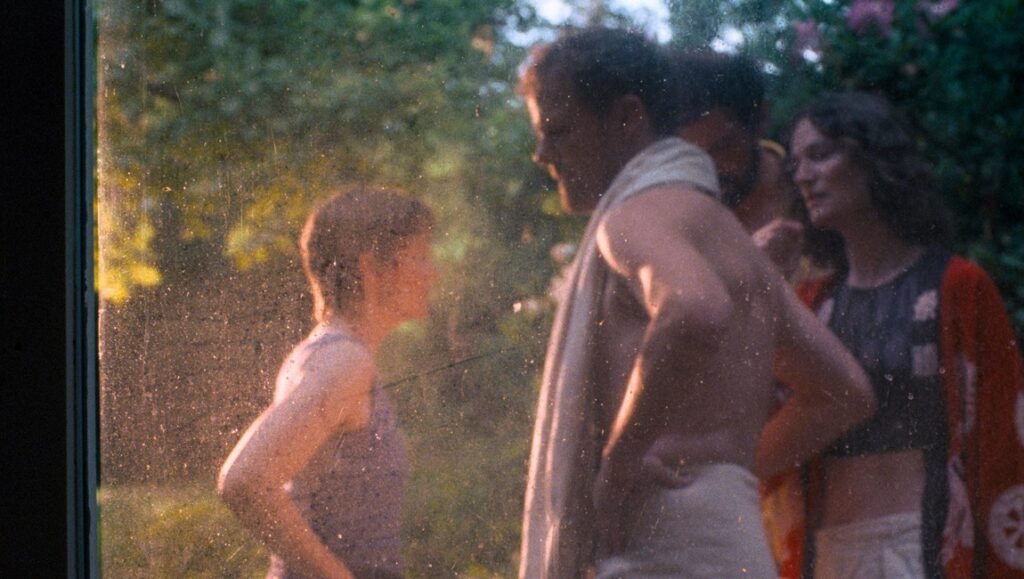
This logic has taken different forms from Marseille through Music. In The Dreamed Path, the omission of reactions and intermediate stages allows the distance between two bodily states to stand in for years of lived time. I Was at Home, But… begins after an event we have not witnessed and concerns itself less with the absence itself than with the traces it leaves on bodies and relationships. Music radicalizes this principle further: years can disappear between two images, while a body, a movement, or a song performs work that conventional cinema would usually entrust to narrative explanation. Schanelec’s new film continues along the same path but changes the question: if a body can carry something without words, can words themselves acquire a body? The title already contains this distance: My Wife Cries. The act of crying is named from the position of someone who sees it. Thomas can observe his wife crying, but seeing is not the same as having access to her experience. He can hear the reason for her tears, but knowledge does not close the distance either. The film gives us more information than many of Schanelec’s recent works without making her world substantially more legible.
The accident that kills the man Carla had fallen in love with is never shown either. In another kind of film, such an event might have constituted its great dramatic set piece; Schanelec removes it and leaves behind its effects instead: Carla’s body, Thomas’s body, a relationship forced to redefine its own past, and words attempting to reconstruct something that can no longer be reconstructed. Omission in Schanelec is therefore never simply absence. When an event is withheld, its weight migrates elsewhere. When guiding music disappears, environmental sound assumes greater importance. When psychology is not explained, the distance between bodies or the direction of a gaze begins to carry what would usually be entrusted to dialogue. Omission does not impoverish the world; it redistributes attention.
Speech, likewise, functions less as a vehicle for information than as material within the mise-en-scène. The sentences often sound written, measured, even slightly unusual, while the world around them continues with complete indifference. Cars pass. Traffic noise falls across words. Rain begins. Music drifts in from somewhere in the distance. The world does not fall silent for these characters’ confessions. This is one of the most beautiful qualities of Schanelec’s cinema: she can release the most artificial speech into the most material world imaginable without requiring either to authenticate the other. A sentence belongs to the world as fully as the car passing through the street or the wall against which a body stands. This is why the film’s monologues, for all their directness, never quite become explanatory psychology. What matters is the physical act of speaking itself: breath, hesitation, pronunciation, the duration of a sentence, a voice leaving the mouth and dispersing into public space.
After Music, a film that largely stripped language away, My Wife Cries almost seems to move in the opposite direction. There, the body carried the weight of what could not be said; here, language returns and acquires a body of its own. A sentence, too, can become a gesture. This quality is equally decisive in the performances. The film’s narrative materials can be intensely melodramatic: betrayal, death, desire, jealousy, separation, suicidal thoughts, old loves that have never entirely disappeared. But Schanelec refuses to allow this raw melodramatic material to settle into the conventional language of melodrama. Emotional intensity remains contained within a system of controlled performance, and the contradiction often increases rather than diminishes the pressure of a scene.
Bresson’s presence here is unmistakable, but reducing Schanelec to “Bressonian acting” misses something essential. The issue is less the removal of emotion than its relocation: from face to body, body to space, space to editing. Even one of the film’s most explicit and funniest sexual images pushes this logic toward a kind of cinematic joke; the Bressonian fragmentation of the body, with its emphasis on hands, objects, and actions, is suddenly displaced onto a sexual organ, as though the logic of Pickpocket had veered, for a few seconds, from theft toward sexual desire. Yet the world of My Wife Cries belongs to no single lineage. At one moment Bresson is palpable; elsewhere, the film’s dialogue with Straub/Huillet becomes more pronounced in the materiality of speech, the resistance of space to becoming mere background, and the presence of history without history necessarily becoming the explicit subject of a scene. This heterogeneity is part of the film’s fascination. Its architecture is made from things that do not seem as though they should belong together: Bresson, bodies, speech, a construction site, a house, bicycles, rain, war, friends, a poet, a sexual organ — and then, suddenly, Leonard Cohen.
This apparent dispersal extends to the editing. The relations between scenes are not always causal, but neither are they arbitrary. Instead of narrative continuity, the film constructs a kind of emotional continuity. A movement may continue in another scene, a sentence reverberate through another relationship, one absence become connected to another. From this perspective, Andrée and Esteban, along with the other friends surrounding the central couple, are not simply “subplots.” The film gradually produces something like a collective body: a group of people whose relationships, histories, and failures accumulate beside one another without any one of them being required to explain the rest. Esteban speaks of a life he no longer seems capable of continuing; Thomas tells a story about an old relationship and, out of the past, constructs a narrative that also defines his position in the present. Everyone narrates the past, but there is no neutral narration of it.
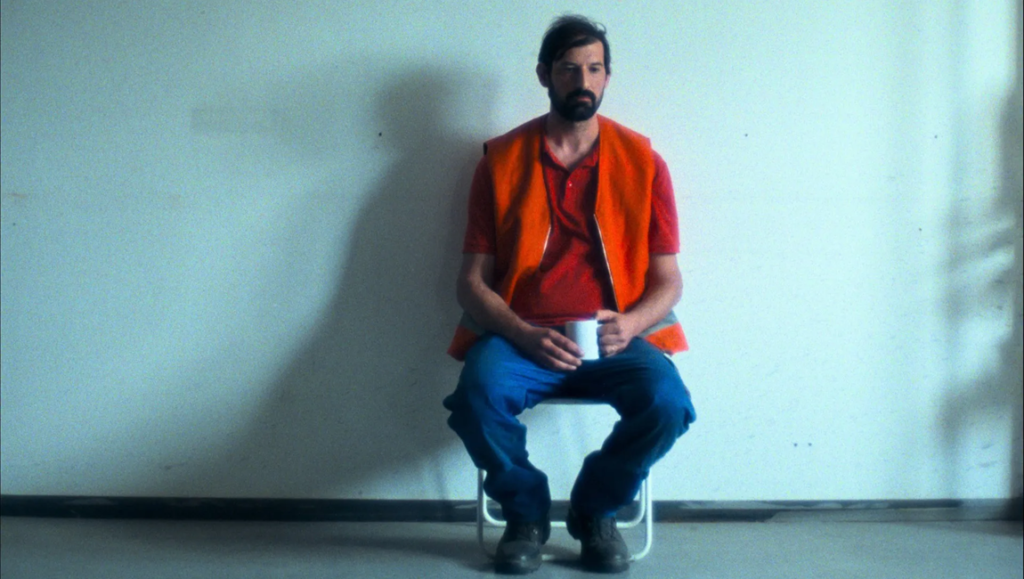
For all its apparent compression, the film’s temporality is not especially simple either. Unlike the vast leaps of Music or the fractures of The Dreamed Path, chronological time is clearer here, but emotion does not move at the same speed as time. Days pass; people go to work, eat, and meet again, but pain obeys no equivalent logic. A relationship may have ended and still remain lodged in the body of the present. Time in Schanelec is less a line than a material through which different bodies move at different speeds. Space enjoys a similar independence. The construction site, the houses, the street, the bicycle route, or the room in which several people gather are not simply containers for scenes. Architecture becomes part of the experience of relation itself. One building is still being constructed; elsewhere, another space has been emptied of its former function; the people, too, continually occupy states somewhere between construction and collapse. These images invite metaphor, but Schanelec usually retreats just before the metaphor becomes too neat. The building is not simply a “symbol of the marriage”; things are themselves before they become signs.
This resistance to the rapid conversion of images into symbols is one reason Schanelec’s compositions linger so stubbornly in the mind. A body may occupy only a fraction of the frame while a wall, a window, light, or empty space assumes comparable weight. The human has not been removed from the image; it has simply lost its absolute privilege within it. The world surrounding these characters remains independent of their private drama. This is also what gives the images of the war in Gaza playing on a screen at Thomas’s workplace their significance, particularly because the film refuses to turn them into a tidy moral analogy. The war is not a metaphor for the couple’s crisis, nor does the couple’s crisis acquire importance through its proximity to war. They simply coexist within the same historical time. The characters’ private suffering is not the whole world.
And it is precisely in such a film that “Lover Lover Lover” can arrive with such force. The moment feels like a rupture in the film’s texture. Speech that has accumulated inside bodies suddenly becomes rhythm and movement. People dance, and a cinema so often associated with silence, distance, and control gives itself over, without embarrassment, to the pleasure of a song. This use of music also extends something from Music. Schanelec’s rejection of guiding, nondiegetic music has never amounted to a distrust of music itself. On the contrary, music is at its most powerful here precisely when it is not required to tell an image what it means. “Lover Lover Lover” does not interpret the scene; it enters it and, for a time, produces a different relation among bodies.
In this respect, the film is one of the richest examples of what is so often, and too easily, called Schanelec’s “minimalism.” There is very little in this cinema that is actually minimal. The image is dense with information; what has disappeared is the conventional hierarchy among its elements. A major event is not necessarily more important than a minor movement. A face is not more important than a hand. Dialogue is not more important than traffic noise. A character is not more important than architecture. And knowing what happened is not more important than experiencing it. From here, Schanelec’s famous “coldness” begins to turn almost into its opposite. The film is not devoid of emotion but saturated with it; it simply refuses to make emotion immediate and consumable. Crying matters, but it is not turned into a guaranteed close-up designed to secure our empathy. Death matters, but the scene of death is removed. Betrayal matters, but the film does not turn itself into a courtroom charged with determining guilt.
This refusal may be the most continuous line running through Schanelec’s entire career: how can cinema show another human being without pretending to understand them completely? From the unstable relationships of the early films to estranged bodies and figures that re-emerge after years have been swallowed by ellipsis, Schanelec repeatedly finds new forms for preserving what remains unknown in the other person. For all the talking in My Wife Cries, it is more deeply concerned than many of her quieter films with the limits of language’s claim on experience. This does not mean that language fails and silence is somehow more truthful. Language is itself part of experience: it can touch, wound, remain in memory, or turn into music. But no sentence can ever fully take the place of something that happened to another body.
This is the distance the entire film inhabits: between event and narration, speaking and hearing, my body and another’s, the image we see and the experience that can never be fully surrendered to that image. Schanelec does not abolish this distance; she builds the film’s architecture inside it. And perhaps this is why the best way to encounter her world is still to breathe rather than decode: moving among bodies, hands, sounds, walls, memories, and gaps until things that initially seemed to bear no relation to one another gradually begin to construct a world that cannot be completely explained, but can be lived in.
Comments are closed.