
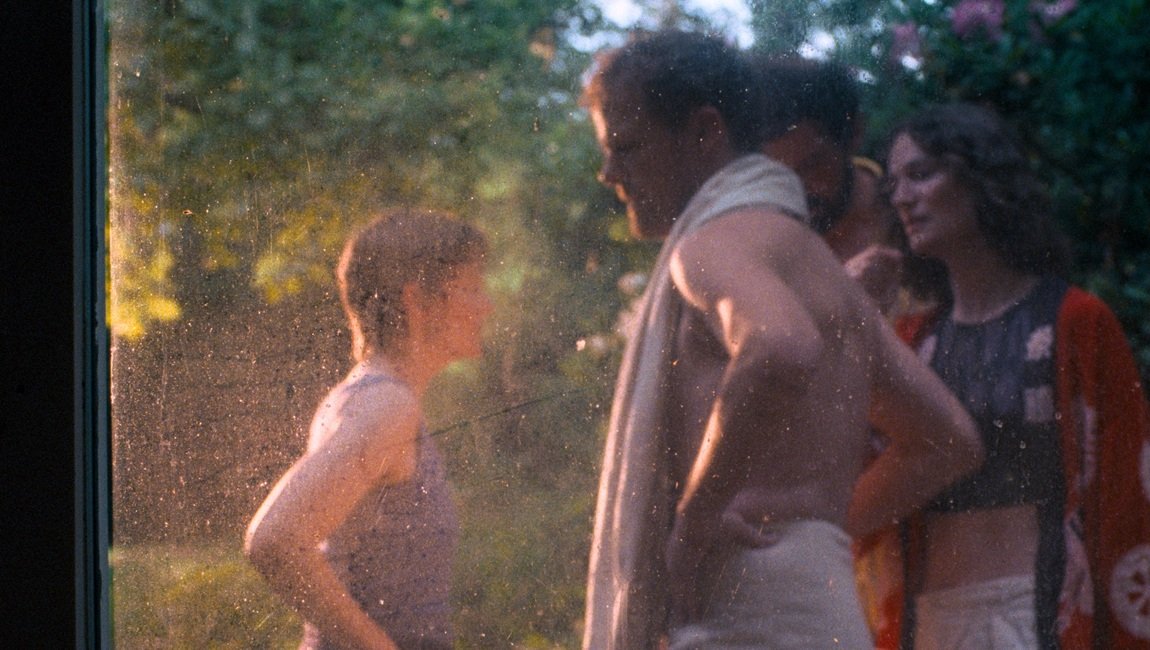
For a viewer who is familiar with Angela Schanelec’s cinema, in particular the three films she has made over the last 10 years, My Wife Cries should come as a bit of a surprise. Initially, it appears to be as stark and austere as those previous films — The Dreamed Path (2016), I Was at Home, But (2019), and Music (2023) — as it opens with a rather stilted conversation between a crane operator, Thomas (Vladimir Vulević), and two women who work in the office adjacent to the construction site where Thomas works. Positioned in a chair against a nearly blank wall, Thomas is slumped, sips his coffee, and tries to reach his wife Carla (Agathe Bonitzer) by phone following a missed call.
But those recent films have been characterized by a defiant lack of explanation, leaving the viewer uncertain as to what events have even transpired, much less their consequences for the rest of the action. By contrast, we learn very quickly what the emotional stakes of My Wife Cries actually are. When Thomas finds Carla crying on a park bench, he has trouble getting her to explain what has happened. But in a long single shot of the two of them walking home, Carla unburdens herself in an extended monologue. She and Thomas took a dance class, which they enjoyed, but Thomas didn’t want to take the intermediate follow-up course, making Carla feel abandoned and betrayed. Taking the class alone, she ended up paired with David, another solo student. She describes the pleasures of dancing with David, and her growing feelings for him. Although the two of them never consummated an affair, Carla’s description makes it evident that things were heading in that direction. She embarks on a spur-of-the-moment car trip with David, during which a semi-truck rolls over on David’s vehicle, killing him.
Upon hearing all of this, Thomas feels faint and collapses against a tree. “My head is exploding,” he says, and with this, My Wife Cries establishes the fundamental existential crisis that will consume its running time. Unlike a film such as The Dreamed Path, whose jagged, elliptical editing style disrupts our understanding of the film’s basic timeline, we generally know exactly what has happened in My Wife Cries. While the earlier film explores montage as a tool for obscuring awareness and altering our perception of time, this new film focuses on the problem of point of view. Our sympathies may reside with Carla, who has undergone a major trauma, but we are formally aligned with Thomas. (This is My Wife Cries, after all, not I Am Crying.) The film’s primary dramatic event has happened offscreen, and we are forced to react like Thomas, based on reportage rather than direct experience.
In this way, Schanelec draws from her work in the theater, where cataclysmic events often occur offstage, a convention dating back to the Greeks and cut to the measure of the material realities of what kinds of scenarios can practically be mounted before a live audience. And while cinema provides a wider array of effects with which a director can stage a catastrophe for the camera, My Wife Cries reminds us that even if we saw the accident, we would only be seeing a simulacrum of such an event. By contrast, film can provide something existentially closer to the emotional events that such an accident provokes — Carla’s shame, anger, and loss, and Thomas’s sense of betrayal combined with a dutiful desire to comfort his wife. Acting bears a more tangible connection to human emotion than most other filmed phenomena.
In a secondary plot, Andrée (Birte Schnöink), who also works in the construction office, is separated from her husband Esteban (Thorbjörn Björnsson), with whom their daughter lives. We finally meet Esteban in an extended conversation between him and Andrée, in which he confesses that although he will not act on his suicidal feelings, he sees his life as essentially over following the dissolution of their relationship. Eventually, Thomas and Carla also arrive at Esteban’s home, and while Carla sleeps, Thomas delivers an anguished monologue, in broken German, about his relationship with a woman 10 years ago. She became pregnant and cut Thomas from her life shortly thereafter. He explains that her disappearance cemented her in his mind as innocent and pure, whereas “my role in this story was a brutish and implacable one. The beast!”
My Wife Cries is elaborated in long monologues that are simultaneously direct in their emotional content and carefully controlled in their delivery. In this regard, Schanelec’s film seems to be far more transparent than her recent efforts. Those works were largely dependent on temporal disruption as a formal strategy, something that worked against any residual theatrical qualities. Even Music, which drew directly on Sophocles’ Oedipus cycle, tended to use the dramatic material as a ground from which to explore an abstraction of plot and character. But My Wife Cries returns to the more Kammerspiel origins of earlier films such as Passing Summer (2001), Marseille (2004), and especially Afternoon (2007). Those films often resembled a conceptual attempt to reconcile the surface-level affect of Bressonian “models” with the psychological intimacies of Bergman.
My Wife Cries is quite a bit different, though, since the ruptures that befall the film’s heterosexual relationships are highly volatile, the failures of love pushed to behavioral extremes. In a way, this film could be seen as Schanelec’s attempt to bring her Bressonian frame to bear on the sorts of scenarios that might have appealed to Cassavetes. What would happen in Rowlands, Falk, and Gazzara had been directed, per Bresson’s dictates, to engage in emotional “telepathy,” not to show but to hide and to discover “above all, what [the performers] do not suspect is in them”? Schanelec’s bold new film suggests a possible answer.
Comments are closed.