
War is hard to steer away from in the 2026 Venice Film Festival program, where films from Iran (A Bit of Light), Palestine (Citizen Osama), Iraq (No Paradise If You Are Killed by a Woman), Denmark (Woman Unknown), and Japan (Mr. Nelson, Did You Kill People?) all deal, in one way or another, with the aftermath of wars past and present. Even active aggressors Israel (NAZA, The Road to Jericho) and Russia (My Undesirable Friends: Part II – Exile, DAU) are well represented, through works that interrogate — or, in the case of Ilya Khrzhanovsky’s DAU, simply replicate — the fascist totalitarianism of their home countries. In the face of such political gloom, the lack of prominent Ukrainian films feels like a telling omission, one that adds an uncomfortable weight to the few projects that did make it to the Lido: Pavlo Shpegun’s short film Silence and Mykyta Gibalenko’s Venice Days entry Camouflage.
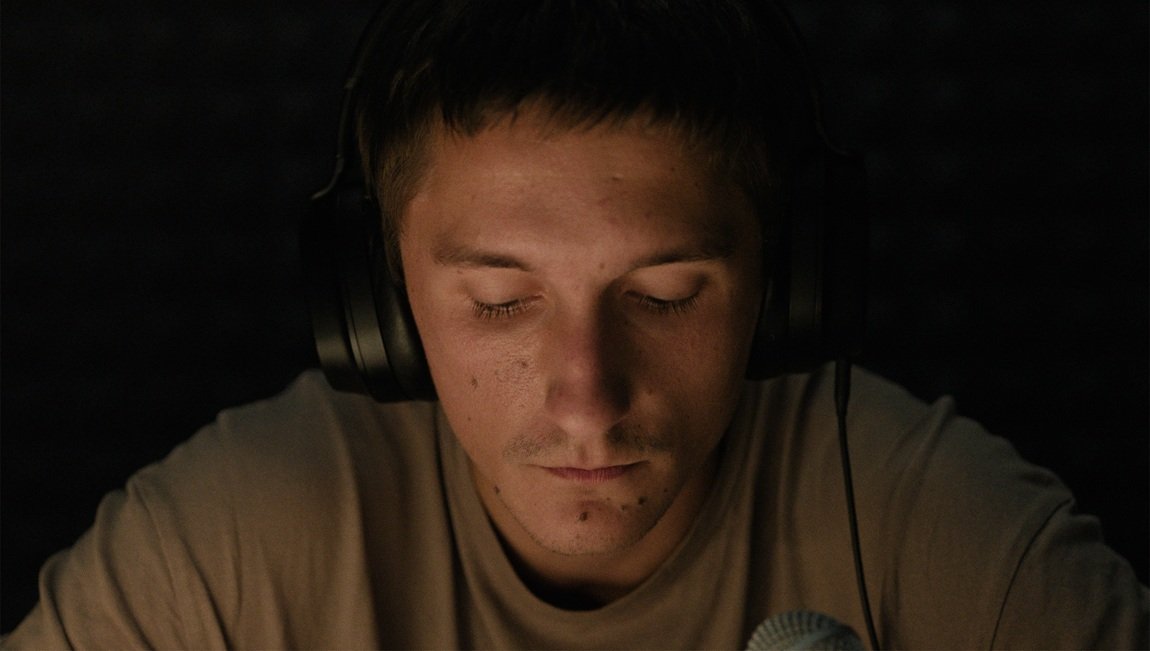
Tellingly, Gibalenko’s debut feature initially refuses to frame itself as just another Ukrainian war film. Penned by the director alongside German performing artist Sharyhan Osman, Camouflage is instead an admirably strange coming-of-age migration drama that opens a year before Russia’s full-scale invasion of Ukraine. Inspired by Gibalenko’s own diasporic experience, the film shows how 22-year-old Vitaly (an arresting turn from emerging actor Arthur Aliiev) secretly plans his jump to Munich, leaving behind his concerned sister Eugenia (Yelyzaveta Tsilyk) and conflicted mother Tetyana (Anna Yaremchuk-Bobalo) in their confused native land.
Confusion is the operative word in Camouflage, an artistically conceived film that thoughtfully explores the difficulty of processing overwhelming emotions. To begin with, there’s the incompatibility of languages, with Soviet-conditioned Tetyana sticking to her Russian mother tongue while the kids have already switched to Ukrainian. Then there’s the challenge of mastering an entirely new one, something Camouflage cannily uses as it peppers the film’s gorgeous electronic soundtrack with Vitaly’s repetitive German exercises. All of it is enhanced by the protagonist’s speech impediment, an awkward stutter that initially seems like one element too many for Gibalenko to chew on but becomes a fine example of how this striking debut strays from well-trodden paths.
With extreme earnestness, Camouflage finds its emotional core in unconventional forms of communication that transcend borders, languages, and even the clichés of narrative plotting. A stand-out scene, for instance, is just a long studio jam: Vitaly belches his idiosyncratic German lingo into the mic, and Eugenia sculpts it into a gorgeous psychedelic techno track. In Western Europe, Vitaly quickly finds his footing when he joins an experimental theatre group and jumps into rehearsals for a mystifying play that involves a lot of running in circles and firing off staccato lines in unison. It’s this artistic milieu that allows the world to shrink to a comfortable microcosm, one in which the migrant drifter can finally find a voice of his own.
Inevitably, though, this emerging sense of belonging has to get uprooted. The full-scale invasion is already foreshadowed during Eugenia’s Zoom call with her love interest, a female journalist covering the Donbas front on occupied territory — a call that eerily halts on a sudden freeze frame. Now a hyper-edited barrage of pixelated war footage floods the screen, as a flurry of Russian missiles strikes down over a jarring percussive soundtrack. Vitaly jumped the gun out of desire; his family followed out of necessity. In the suffocating confines of a Munich apartment Vitaly shares with fellow actor Fiona (Klara Lange), war traumas and old familial wounds soon overwhelm a space too small to carry this much weight.
It’s rare for these types of evacuation stories to shy away from binary thinking. East versus West, past versus present, and freedom versus family tend to oversimplify the depiction of what is an inherently messy story. Displacement is chaos, and chaos is hard to capture cinematically in all its pandemonium, especially for a first-time director. It makes Gibalenko all the more astute, as his diasporic Ukrainian roots allow the complexities and absurdities of life to seep into Camouflage’s frames. German cinematographer Mirko Hans maintains firm control of his tight aspect ratio without resorting to a rigid mise-en-scène. Meanwhile, Arthur Aliiev’s enigmatic face becomes a beautiful mental map of all the misery in the world, at the front, and in a new home built on shaky ground. That the film occasionally veers off for a moment or two only makes sense. It even makes you look at the film with more sympathy, as it helps you to better, more empathetically understand the emotional conundrum Gibalenko set out to convey on screen.
Comments are closed.