
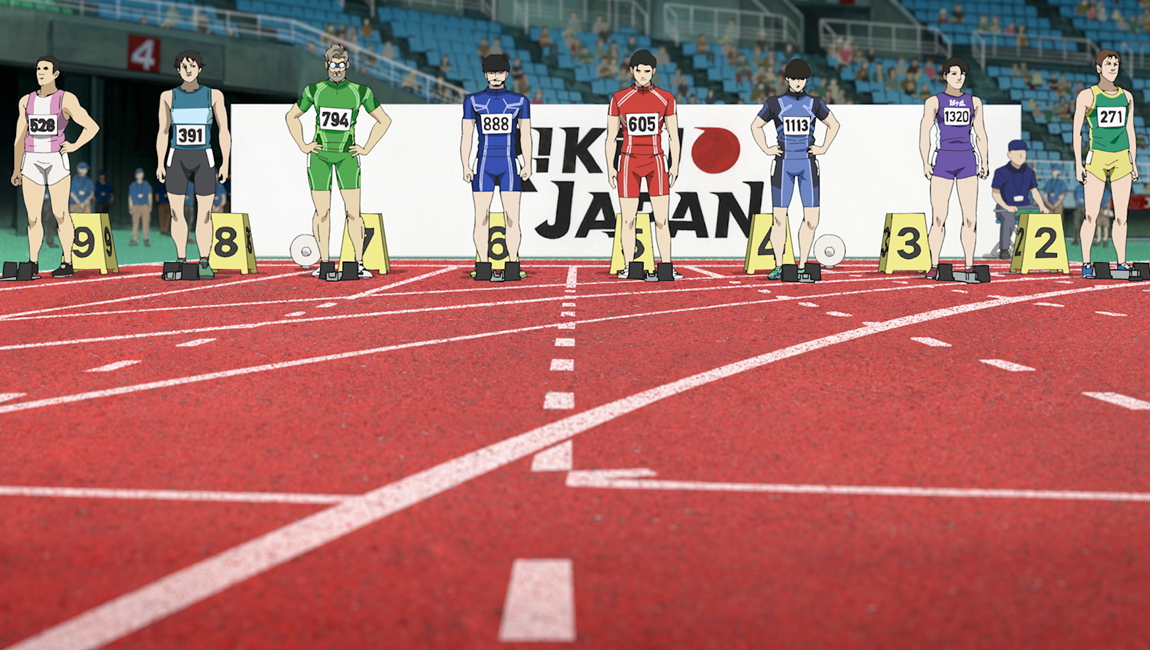
“Why do you want to dance?” a character asks Moira Shearer’s aspiring ballerina in Powell and Pressburger’s The Red Shoes. “Why do you want to live?” she cleverly retorts. “Well, I must,” comes the reply, unsure of how to answer. She affirms the same: “That’s my answer, too.” This existential question of doing and being is examined in depth in 100 Meters, a sports anime directed by Kenji Iwaisawa (previously notable for making a splash with his debut, On-Gaku: Our Sound). Based on a manga by Uoto — whose other most notable work, Orb: On the Movements of the Earth, was also treated to a fabulous anime adaptation earlier this year — 100 Meters charts the journey of two friends, each from different walks of life, as they compete in various 100-meter dashes over the course of a decade, beginning with their first meeting in elementary school. The trials and tribulations of athletes striving to be the best have been covered in plenty of sports-related works before, but what gives 100 Meters a leg up on its competition is its dynamic animation design, as Iwaisawa beautifully blends rotoscoping with the more freewheeling execution of the 100-meter dashes themselves.
Ever since he was a lad, Togashi (voiced by Atsumi Tanezaki as a child, Tori Matsuzaka as a young adult) has always dreamed of being the fastest sprinter alive. A star track-and-field athlete, Togashi excels in the 100-meter dash, handily beating all other grade schoolers who challenge him. Despite races lasting only 10 seconds, Togashi has distilled all of life’s meaning into this short fraction of time, declaring that running a single race is capable of answering all of life’s questions. Transferring into his school is Komiya (Aoi Yuki and Shota Sometani), a quieter boy who also demonstrates a penchant for the dash, even though he clearly was not raised in a similar upbringing as Togashi. (For instance, Komiya arrives at school with taped-up sneakers, hinting that his parents are unable to afford to buy him new ones.) Undeterred by any differences between the two, Togashi immediately takes Komiya under his wing, training with his newfound friend so that they both can dominate the race track together. When his parents’ situation worsens, Komiya is forced to move away, and over the next decade, he and Togashi will cross paths several more times, competing against each other as a friendly rivalry pushes them to be the best, pushing through any grievous injury and psychological toil to do so.
100 Meters’ narrative doesn’t set out to reinvent the sports-drama wheel, but it does take great care to inspect the lives of its dual protagonists and pin down why they want to run. Screenwriter Yasuyuki Muto journeys through key chapters in the boys’ lives, graduating into junior high, high school, and young adulthood, as races are won and lost and memorable new challengers come and go. A few secondary characters are explored, including Nigami (Jun Kasama), a boy a few grades older than Togashi who was once an impressive runner but falls onto hard times, and there are also Asakusa (Rie Takahashi) and Shiina (Yuki Tanaka), a pair of fans of Togami who form a Track-and-Field Club with him in high school. But 100 Meters always returns to Togashi and Komiya, who ponder why they keep returning to the track, even if the answer is as simple as, “Sometimes, the action is the juice.”
But while 100 Meters offers a charming — if familiar — narrative and performances, the film’s real selling point is Iwaisawa’s remarkable animation. The majority of the film utilized rotoscoping to craft its visual design, lending a more naturalistic style to the characters and their movement, not unlike the less active sequences of The First Slam Dunk from a couple of years ago. But much like Togashi and Komiya, Iwaisawa really comes to life during the titular races. For an event that begins and ends across the period of a few blinks, Iwaisawa makes a meal out of the execution, pulling out every stop to deliver a bite-sized force of nature, the sequences leaping off the screen with vein-popping fury. These races in 100 Meters are thrillingly kinetic, and one specifically that is set entirely in rainfall is a contender for the most visually stunning set piece of 2025. Also aiding the cause is composer Hiroaki Tsutsumi, who lends an indelibly propulsive score to help drive the intensity of these sequences. The incredible formal construction of the races is 100 Meters’ raison d’être, and what better compliment could there be than to say these many sequences never lose juice or are less than thrilling to watch. If 100 Meters occasionally dips its toe into formula otherwise, it’s no real matter: come for the races and you’ll walk away having experienced one of the most purely entertaining films of the year.
DIRECTOR: Kenji Iwaisawa; CAST: Tori Matsuzaka, Shota Sometani, Koki Uchiyama, Kenjiro Tsuda; DISTRIBUTOR: GKIDS; IN THEATERS: October 10; RUNTIME: 1 hr. 42 min.
Comments are closed.