
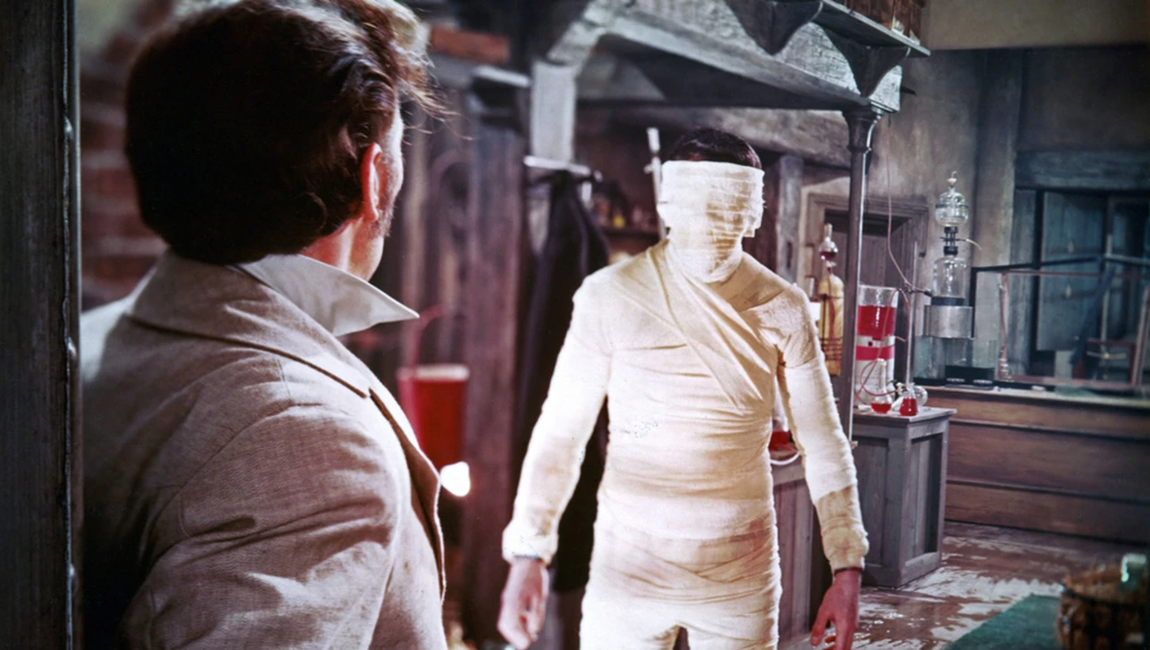
The story often told is that Gothic horror had been hung out to dry in the west by the late 1950s; the Universal horrors of the ’30s had long since reached the point of parody, and the loom of nuclear Armageddon had pushed writers towards sci-fi technophobia and the fun but diminishing return of working out which animal they could mutate into a giant next. Then, as the 1960s loomed, a triumvirate made up of Hammer Horror in England, Roger Corman’s Poe adaptations in the U.S., and Mario Bava in Italy, led an attack on good taste that revitalized the genre, bringing bloody violence, classic Gothic narratives, and overt sexuality to the form. But chronologically it was Hammer who led the charge, and in 1957, three years before Corman or Bava made their first steps into the Gothic, Terence Fisher’s The Curse of Frankenstein kicked off this sea change.
Now, like most histories as neat as this, it’s a sweeping and reductive tale it tells, one that ignores plenty of outliers from all corners of the globe. But from an economic standpoint, it’s hard to argue with. The film made 70 times its production costs at the box office and exposed a desire for the Gothic in a global audience that studios across the world would chase for much of the next decade. However, when revisiting the film itself, its place as the great shift in horror can feel suspiciously slight, less like the finished article and more like a prototype that only nods to what Hammer would perfect with their Dracula adaptation the following year.
In a narrative sense, The Curse of Frankenstein follows Shelley’s novel relatively closely; gifted scientist Baron Victor Frankenstein (the always magnificent Victor Cushing, in a star-making role), along with his tutor Paul (Robert Urquhart), begin to experiment with creating new life; taking to grave robbing, the black market, and eventually murder in pursuit of a breakthrough. When he finally succeeds in bringing his creature (a pre-fame Christopher Lee) to life, it is violent and psychotic, breaking loose and wandering into the world, with Frankenstein having to reckon with his creation.
Like Browning’s Dracula, the film that is credited with starting the early-sound horror boom, The Curse of Frankenstein is a much more staid film than history remembers it as, far less engaged in the tropes that the Gothic has been defined by. Where Browning’s film hovers in an uncanny silence, Fisher’s camera is still, sitting with stagey formal inertia throughout, with less of a sense of action than the Hammer that would follow. In fact, it spends a lot of its time observing the pleasantries of its moneyed characters; there’s easily as much time spent in stuffy drawing rooms as there is in subterranean laboratories. Fisher and screenwriter Jimmy Sangster hone in on these two environments as one of the film’s many dualities, situating the prim exterior of Baron Frankenstein against his nocturnal life rummaging through coffins, sifting through body parts. It’s a duality similarly felt in Frankenstein and his confidant and co-conspirator Paul, who acts as Frankenstein’s conscience, and whose pulling away marks the end of any hope of his salvation.

But it is the monster itself that marks the film’s most pronounced duality. Where Shelley’s novel and James Whale’s film find great tragic beauty in the monster, using him to explore othering and its effects, Fisher’s film is far less interested in such things. Make no bones about it, the monster here is just that: a monster. Violent for the sake of it, his characterization begins and ends with “Grrrr!” If he’d bumped into the little girl from Whale’s film, there would have been no faffing with flowers or sense of tragic accident; she’s getting booted into that pond, no questions asked. You’d hope this simplifying would streamline the film and animate its slightly stodgy pacing, but in fact it makes for a thematic diversion that makes The Curse of Frankenstein far less interesting. Victor’s private reaction to the monster’s violence thematically flips Shelley’s novel. Where in the novel the sympathetic creature and Victor’s relationship is conflicted, here Victor sees opportunity in his brute, using the monster to murder his pregnant mistress in order to maintain his societal standing. The monster here is no longer the ultimate other that has seen lonely teens gravitate toward it for the past two centuries, but is instead a classic Freudian shadow self for Victor, one that frees him from the moralities and airs of Victorian society, a Mr. Hyde with an easier alibi. The thematic conflation of these two characters and the reduction of the monster to an extension of Victor’s moral transgressions serves to make the film a classic bit of English self-flagellation, not particularly concerned with anything beyond chastising oneself.
This makes The Curse of Frankenstein a thematically wonkier fit into the Gothic era that would follow; totally un-supernatural, and less concerned with the weight of history, it doesn’t have the push-pull relationship with sex and violence that is the key to those later films’ magic. Said violence is sparse, and the film is largely chaste compared to what would come. Where the best of the Gothic engages in the seductive power of evil, here there’s still the specter of a puritanical wagging finger. That said, the moment in which scarlet, glossy blood pours out of the creature’s wounded eye still feels like it carries the gasps of its initial audiences within it, and the monster’s drawn-out murder of a blind man shows the seeds of Fisher reckoning with the thematic power of titillation. Still, it wasn’t until the next year’s Dracula adaptation that the rich use of color and hints of violence received the added final ingredients of sexuality and swashbuckling adventure that would define the Hammer formula.
The Curse of Frankenstein is Hammer’s explosion moment, and it will always be historically marked as the film that blew open the doors and set the studio on a decade or so of some of the best and most successful British horrors of their era, as well as laying down the gauntlet that had responses all over the world. But it’s still undeniably a film where its makers are finding their feet, shaking off the old world and pushing forward into something bold and new.
Comments are closed.