
In a city-state as vibrant and fast-paced as Singapore, the encroachment of work into various facets of social life appears inevitable, so much so that conversations around work-life balance have tacitly moved in the direction of seeking, instead, a kind of integrated harmony. The sociological implications of this are rife with possibility and peril; as the subject of Dave Lim and Adar Ng’s documentary feature At Home with Work, it is the home-based worker who assumes a central profile, delineating the unsettled boundaries between spaces of rest and productivity as well as designating the performative aspects of modern work. Crucially, the film’s title posits the home as a site on which work, as baggage and extension, is performed — not the other way round, as workspaces increasingly come under the equally performative aegis of HR-speak and feigned community. There is, then, an expectation placed on its scope to articulate the home both as architecture and as phenomenon, upon which the twin forces of capitalism and the state exert their respective mandates.
At Home with Work fulfils this expectation for the most part, exploring the economy of home-based work through four groups of workers with vastly different motivations and socio-economic backgrounds. A meal-prep business called Cheekies provides a trenchant introduction to work as aching necessity, with its owner Nabill — a former marketing executive — seasoning and grilling chicken breasts with his father in their one-room rental flat to make ends meet. The venture, Nabill tells Lim and Ng, began during the pandemic, whose outsized effects on redefining office spaces also opened up opportunities for struggling families to navigate the social ladder outside traditional corporate strictures. Work as hybrid adaptation, not too differently, takes advantage of the flexibility afforded in the case of streamer and mom-fluencer Esther, whose three young daughters provide significant impetus for her arrangement. Having conceived her eldest while in high school, Esther has faced substantial stigma, something her prospective success in marrying financial and caregiving responsibilities could ostensibly overcome.
Drawing inspiration from a research initiative (“Foundations for Home-Based Work”) led by academic Lilian Chee, At Home with Work grapples with the difficult tensions between government policy and free market exigencies as they bear on individuals’ decision-making, which is at once constrained and creative. While Nabill and Esther both negotiate home-based work as a means to straddle preexisting commitments, somatic healer Yoke Wen and permaculture farming duo Marcus and Alexys use this space to examine the underlying demands of work, consciously interrogating its ideological precepts and contexts. Whereas work takes on a therapeutic dimension in Yoke Wen’s home, its emphasis on breathing and clarity underscoring her reclamation of inner peace from the atomizing chaos of the modern hustle, it heralds greater significance as an avenue for sustenance and sustainability for the farmers. As Lim and Ng train their camera on Marcus, they uncover a less-than-tacit resistance to what he terms “proliferating capitalism”; against the conventions of his parents, who worked stable jobs as accountants, the farming cooperative leader cheers on the practice of “rehabilitating soil,” less to secure a degree of national food sovereignty than it aims to do so for the community and his own.
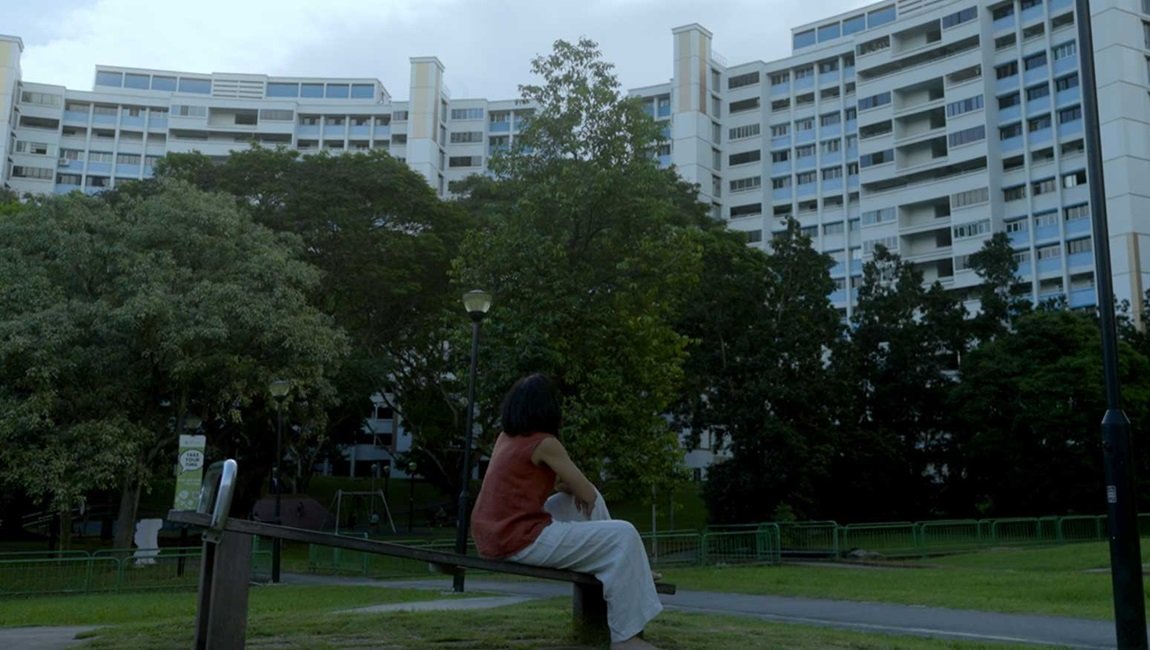
Through their interviews and gentle partial survey of Singapore’s socio-economic strata, the filmmakers produce a work of incisive and intentional ethnography, enunciating through several formal displays the slowness and languidity required of the work to reimagine the very fundamentals of work. Most notably, Lim and Ng saturate the urban landscapes — thick with trees and lush vegetation among concrete pigeonholed apartments — and zoom out from them, impressing a dioramic effect with a defocused 2.39:1 anamorphic lens. The resultant miniatures appear to render the ordinary lives of working Singaporeans even more insignificant, but they also prompt a reassessment of our perception as we distance our attention from the networks of urbanity and turn to ponder the significance of it all. Like Paula Ďurinová’s Action Item, whose thesis relating burnout to activism under a neoliberal order spoke the former’s language to engage with the latter, At Home with Work paves the way for active speculation through its seemingly passive register. In the swirling midst of construction sounds and activity across the island, work and home are a burden and reprieve equally. Might we add an element of play to the mix? Tune out the city for the experimentation of the playground; the rest is just noise anyway.
Published as part of Singapore International Film Festival 2025 — Dispatch 2.
Comments are closed.