
Cannes seems to have settled into a kind of violent habit: slotting a promising film by a female auteur into its tail end. This year’s scheduling felt especially ruthless, specifically with regard to Valeska Grisebach, who piqued critical interest with her Un Certain Regard breakout Western (2017), and now returns nearly a decade later with a 167-minute behemoth. But Cannes scheduling looks all the more unjustifiable when The Dreamed Adventure emerges as the genuine miracle: a wittily political, elegantly feminist, and formally ingenious film with no real peer in the competition.
To grasp the kinesthesia of The Dreamed Adventure, it helps to imagine it as a slightly intimidating and culturally unfamiliar Eastern European ensemble, difficult to resist once it asks you to sit down for a drink. Many at the premiere eventually walked away after politely refusing the invitation a godly number of times. But stay, and Grisebach coaxes you into that forbidding company, which unfolds into a singular cinematic spell, revealing the microcosm of a Bulgarian border town near Greece and Turkey. This is a place that carries an atmospheric residue of post-Soviet exhaustion, with vast highways cut through landscapes of abandoned Stalin-era hotels and eerie roadside bars luminous beneath PVC facades, where chain-smokers guard the entrances with equal measures of menace and melancholy — and it is into this world that the auteur throws us with complete trust. As a point of comparison, where Lukas Dhont’s Coward, which screened in the competition a day earlier, opened with a contextual data of WWI conscription, Grisebach’s fourth feature treats the viewer on terms equal and witty to her own, sitting you down without ceremony at a plastic table with people ready to share some deep lore, and that lore acquires the hypnotic pull of a Disney cartoon.
The film opens like a seemingly familiar social realism story, with an unbothered man named Said (Syuleyman Alilov Letifov) entering the city of Svilengrad. Like a Western hero returning after a long absence, he is tired yet on the twisted lookout for a particular casino, with some illicit business to settle. But when his car is stolen after a night at the motel, he luckily runs into Veska (Yana Radeva), an archeologist mid-dig in the surrounding hills, who is happy to help an old friend without asking any questions. Svilengrad’s smuggling underworld, fueled largely by diesel but far from limited to it, operates as its own entrenched sovereign order, ultimately crowned by the gangster Iliya, a man of golden chain and open shirt on a half-bare torso, with a little daughter he has nicknamed Titka-Banditka.
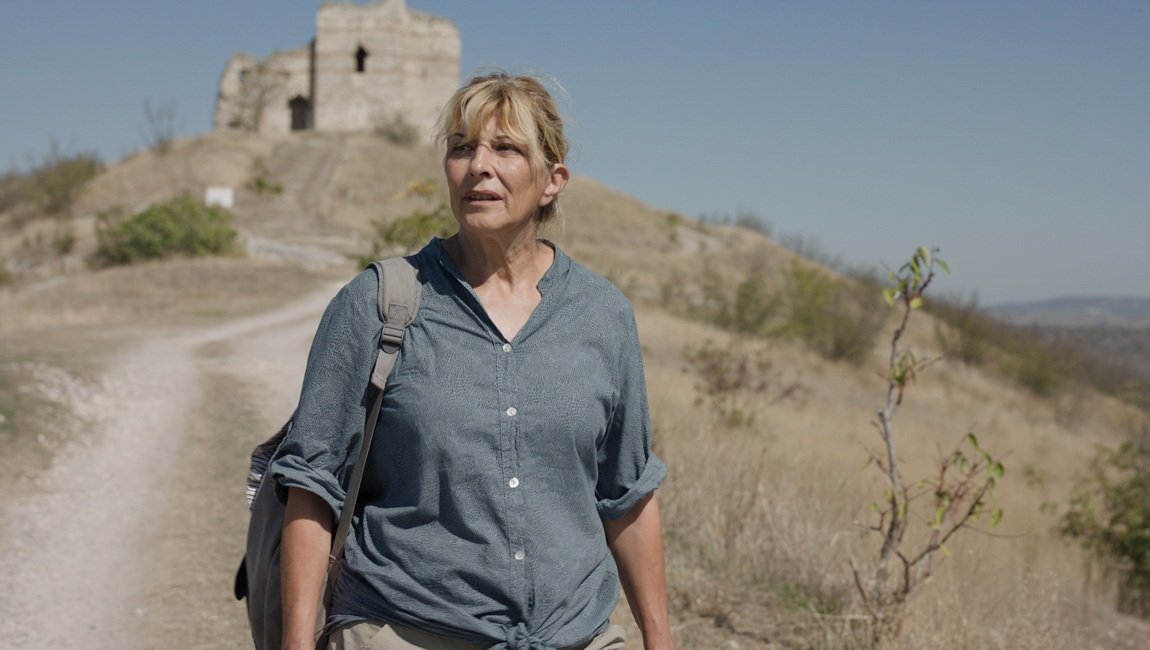
A woman of good morale, Veska lures Said toward her excavations, maybe trying to pull him away from his criminal routines, maybe simply trying to keep him close for the sake of her own desire. But what initially appears to be a hesitant romantic reconnection gradually mutates into something stranger and harder to grasp once Said suddenly disappears, almost imperceptibly transferring the film’s center of gravity to Veska, who takes over his criminal circuitry with startling ease. As Veska shifts from excavating buried civilizations to navigating a much fresher sediment of history, the question of what Grisebach is truly constructing grows increasingly intriguing. But there is transparently something greater here than finance or romance, and the film’s stubbornly unhurried unfolding turns that question of motive into a rewarding puzzle.
The Dreamed Adventure principally consists of chats over liquor at improvised garden tables, orbiting around the unperturbed and endlessly courageous Veska, splendidly played by non-professional actress Yana Radeva. Like a Bulgarian Monica Vitti, she effortlessly drifts through pitch-dark rural streets, bumming cigarettes while seemingly trying to quit, with a dangerous edge tucked beneath her smile as she listens intently to muddy tales from the ’90s that feel barely separable from the currents of the present. That endless flow of revelations and recollections gradually coheres into something far larger than the film’s immediate setting, offering a view into countless liminal spaces like Svilengrad, where shadow economies at large remain more enduring and emotionally legible than the freshly imposed structures of democratic legality. But the haunted past also returns through mutated structures of masculine loyalty, a world women now cautiously infiltrate and destabilize on their own terms.
Borrowing Veska’s seductive evasiveness, the film itself flirts with the anatomy of the crime movie, teasing eruptions of violent acceleration, or even the possibility of magical slippage hovering at the edges of its committed realism. But the film’s true magic lies in the sustained curiosity of its continuum, and the escalation one initially anticipates gradually becomes unnecessary, until eventually its absence comes like a relief. Grisebach’s direction, deceptively raw and weirdly well-crawled, draws its gangster aura and exoticism entirely from landscape and characters, absorbing their idiom into one’s texture and producing a unique audiovisual vernacular. The entertaining treats include an unexpected choice of montage touches from Bettina Böhler, who deploys Kira Muratova-like jump cuts and bizarre tonal dislocations, all of which rhyme with the setting’s abrasive carnivalesque bits. The haunting ’90s of dust and steel, grotesque fashions smuggled through the broken window of the imagined West, and the poverty of these non-places governed by their own economies all feel uncannily organic, and thus uncannily perfect.
The Dreamed Adventure is immensely resourceful material to curate, debate, and (over)analyze, precisely because it refuses to dilute its singularity into something more legible or reassuring. More than many competition titles masquerading under the rhetoric of careful relevance, Grisebach’s film confronts the fractures of contemporary Europe by treating them as forces too deeply embedded to be grasped from the outside, and impossible to render formally any other way. That is what makes the film feel magnetically alive, and why it may be retrospectively remembered as the competition’s most lucid, most idiosyncratic, and most genuinely humanistic achievement.
Comments are closed.