Initially undistributed and reportedly rejected by film festivals such as Sundance and SXSW last year, prior to the acquisition courtesy of rookie distributor Obscured Releasing earlier this year, Elliot Tuttle’s Blue Film may come as a shock to most viewers — though depictions of sex in current cinema almost always seem to be a charged topic regardless of intention or the filmmaker attached to it. But it’s likely less shocking to hardcore fans of perversion cinema, given previous sights it has offered, from David Cronenberg’s Crash (1996) to Pier Paolo Pasolini’s Salò, or the 120 Days of Sodom (1975).
Tuttle’s provocative two-hander, starring Boots sensation Kieron Moore (in his breakout leading role) and veteran actor Reed Birney (who also executive-produced the film), is a chamber drama doubling as a psychosexual study of desire, shame, and trauma spanning generations. It might not be the writ large, instant knockout a director might have aspired to for a feature debut, but it displays a particular daring, especially for an American indie, that might just tip Tuttle’s vision in the direction of a sleeper hit.
Steeped in shades of blue and set entirely in a Los Angeles rental house, Blue Film centers on a gay camboy with disarming braggadocio, Aaron Eagle (Moore), and a convicted pedophile, Hank (Birney), who has anonymously booked him for the whole night in exchange for $50,000. Always game to satisfy his clients’ wildest fantasies, especially when they’re willing to pay him a hefty sum, Aaron obliges, only to discover that perhaps it’s more than what he has signed up for as the client turns out to be his disgraced middle school teacher, who then professes his “love” for him — or, more precisely, the underage version of him. Past and present collide in a film that, owing to its confined environment, feels sensually out of time.
Subterfuge is integral to the language of Blue Film, as the protagonists, two self-proclaimed perverts, play pretend and take pleasure in their attempts to corner each other, stripping both of their precious facades in the process, in much the same way that Tuttle punctuates the proceedings with camcorder footage of a charming boy, whose identity is only revealed near the film’s coda. Though it’s suffocating by design, Blue Film, contrary to initial reviews, is anything but “challenging.” Rather, it’s erotic, introspective, and laced with textures. It holds up a discomfiting mirror to a society that would rather sweep terrible taboos under the rug than confront them head-on. It’s in this transgression that the film lives up to its tricky, seductive promise. It’s a work of considered discomfort, and both Moore and Birney are boldly committed agents of such discomfort. Few filmmakers, in their directorial debuts no less, can claim to be this audacious.
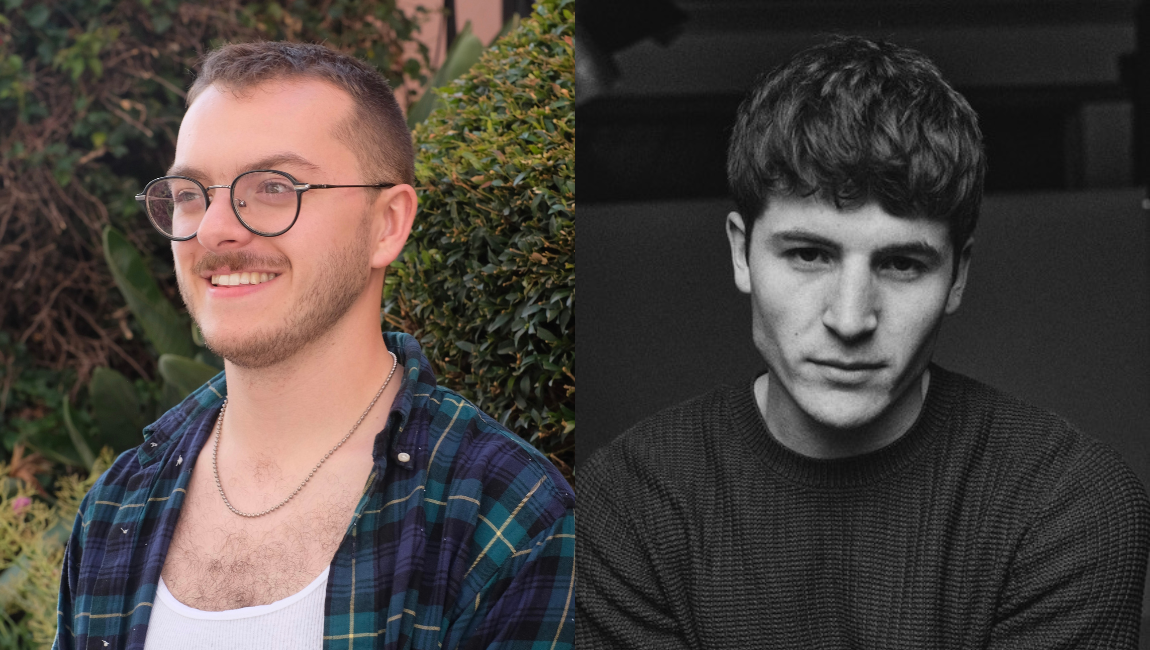
Over Zoom, I spoke with Tuttle and Moore to discuss Blue Film, intimacy coordination, taking risks, and perversion cinema. The following has been edited for clarity and concision.
Lé Baltar: How do you fund a project as perverse and off-kilter as Blue Film?
Elliot Tuttle: Well, it was very inexpensive to make, like by design. I wanted to make something that I knew that I could get made and just kind of by nature of doing a production that’s so inexpensive, I had very little creative overhead. And so that was a way that I knew that I could kind of just make whatever I wanted and not have anybody necessarily barking at me to get their money back. And it kind of felt like I was taking this opportunity, as the only time hopefully in my career, that I could do whatever I wanted to do. So, yeah, I made this.
LB: Did you ever feel like festival programmers or distributors who rejected the film were somewhat blowing things out of proportion? Because when you really watch the film, it’s still pretty tame and restrained, and I don’t say that as a bad thing. Especially when you position the film in the canon of perversion cinema, in that, for instance, the actual scenes of physical intimacy are very limited and not as prolonged as the viewer might have expected.
ET: It was written to be like, yes, the subject matter is kind of a lightning rod, especially at the moment. But it was always written to be like a structured, compelling drama. And so that is how, especially in the edit room, that I just tried to edit it like it was kind of a prestige drama. Like I wanted it to really work as a narrative regardless of the scandalizing subject matter, I guess. And so yeah, that is how I kind of think of the film. Obviously, it deals with some very heavy themes, but it was never meant to be controversial for the sake of controversy, I guess.
LB: And speaking of controversy, I’d like to talk about how morality plays into the film. At first, it’s pretty apparent to the viewer who between the two characters is good or evil. But then as we learn what both of them are willing to veil or unveil, you also start to flout that clear-cut morality. I kind of appreciated that gesture in the film. What draws you to that kind of subversion?
ET: Well, I think that the characters are trying to understand why they are the way that they are. And a necessary part of that arc is them trying to find some greater purpose for them. But in the end, they’re left with just as few answers as they had in the beginning. They’re just kind of left with a way to go forward living their lives. And so it was important to me to include that conversation because I don’t think you could have a film that deals with these themes. These characters would, of course, try to understand their purpose; they feel that they kind of have none in their perversion. And so, of course, it’s a pursuit that they would undertake and that had to be in the film. But just like in the same way that it was inevitable that they would think about those things, it’s inevitable that they also wouldn’t come up with an answer.

LB: Kieron, was that something that factored into your performance or understanding of the psychology of Aaron, in that you had this assumption that you’re playing a supposedly good character? Or did you not view the character in that way at all?
Kieron Moore: I think it’s the responsibility of the actor to never judge the person that you’re playing, really. You’ve got to sort of try to just be them, see the world through their lens. I think Aaron, or Alex, is unique, and I say unique, but I think we see more of it everyday where it’s like he sort of takes pride in this idea that he could be evil, that there is an awareness of his wrongdoing or what makes him himself and it’s quite empowering. And then, as the movie sort of unfolds, we see that that is in itself a facade, a way of healing and coping from his own weakness, or what he thinks is weak, which is his ability to love so intensely, like he did when he shares his secret at the end, I guess.
But yeah, I think me and Elliot bonded over one of our favorite books, which is Nausea by Sartre. The characters and everyone in their life kind of seek this divine meaning from our existence. And, you know, if you’re aware enough, you can kind of come to the conclusion that maybe there is not. And it’s the decisions that we make that sort of define our own meaning. And I think throughout the film, the characters are getting a real sort of a mirror held up to them to sort of find their way to that, you know? And they meet at different points in their life. Hank represents a communal evil. Everyone kind of know he has something inside of him that society would all be like, “this is bad,” you know. Whereas I think Aaron has something that isn’t good, but we all kind of have it in us, you know, which is a mask, which is what we do to get through the day to make ourselves feel better about it.
LB: Like Elliot, this is also your debut feature, and you mentioned in an interview that you read the script around three times in a day and basically fell in love with it. But was there any initial hesitation to play this role and confront a topic that some viewers might find controversial or uncomfortable, especially for a first feature?
KM: I mean, you know, you can’t be brave unless you’re scared, and I know what kind of actor — I don’t want to say actor — what kind of artist I want to be. I want to do work that challenges not only the viewer, but challenges myself and sort of proves I don’t know what actor I am until I get the chance to do it. I, especially at that point in my career, was hungry for the opportunity to sort of see if I can do certain things. The thing that scared me the most about the project was, “Can I do this to a level that it deserves?” I felt immediately that the script was so strong and the characters were like an actor’s dream. If you take away the premise of this movie that everyone is obviously sort of discussing in their own ways, I think every actor would be ridiculous to not want to play characters like this. They’re so complex and real and authentic. And yeah, I guess the fear was nothing in regards to what it was asking of me and Reed. It was more so that I just felt it deserved a great performance, you know, and I wanted to make sure that I was [doing it right]. I did the best I could in that [regard], and, you know, that’s up to the audience to decide. But there were obviously a few hesitations in regards to like, “It’s my first thing.” I’m just paving the way. How will the industry look at me after it? But then, if I worried too much about what the industry thinks, I would never do anything. All of my favorite actors are dangerous. All of my favorite writers are dangerous, like this one, and I think danger is just we mark the pillar for danger. It’s surpassing our own limitations, but, yeah, now I’m so glad.
LB: And I think it also succeeds in that, like Elliot said, it isn’t just about provocation but an actual exploration of the lived experiences or the textures of the lives of these two very complex characters. And given that Blue Film is also a two-hander, it instantly makes it more intimate. And so the level of generosity that you and Reed allow each other as scene partners is quite integral to evoking that kind of connection. How did you go about it or throw yourself into preparation?
KM: I think just authenticity. I think every single one of us cared about it so much. You know, Elliot was great with me immediately and we connected really fast, and Reed’s an icon; like he’s got the chops, you know. So I think we all wanted to kind of impress Reed in a way. We all wanted to be worthy of his time in an interesting sense. But yeah, that was just a case of listening. Everyone wanted it to be as good as it could be. And everyone wanted everyone to be proud of their own work by the end of it. It’s such a collaboration and just, yeah, a desire for it to be what it could be, you know. And I think it’s now starting to have that moment. And I think it’s important with this, for me with Blue Film, like obviously the story takes place through a certain lens and you’ve got extreme versions of characters and what they represent, but everything that unfolds in this movie is universal. We all have our own dealings with shame. We all ask ourselves questions of what it means to be, why we are here. So it was like just, I don’t even want to say vulnerability, the ease of it was to open up, to bring ourselves and all the questions that we might ask of ourselves in our own time. Elliot really created a comfortable space for us to just sort of surrender into that. And, of course, Reed’s got so much experience that he held my hand the whole way through. Very, very grateful for the opportunity.
LB: Was there an intimacy coordinator involved, and how did you approach that intimacy, not just physically but also mentally or emotionally?
ET: Yeah, we had an intimacy coordinator, and I think that it was necessary on our set. We’re asking, especially me kind of speaking for the production, like we’re asking these actors to do some really uncomfortable things; not just, you know, nudity-wise, but emotionally, too. Like they need to feel kind of supported on every level when a production is running around trying to make the day and whatever. Like there needs to be at least one person who’s able to at any given moment make sure that everyone is comfortable. And so yeah, I think it was definitely necessary in our production.
KM: I go as far as to say that it is necessary in every production, you should have the ability to ask, of course. But I think, you know, Elliot grazed the point there, and I think the most intimate parts of the movie aren’t the [physical] intimacy scenes — the most vulnerable parts of the movie happen in the dialogue and in the quiet; if anything, [that’s] because of [Cutter Ray Palacios] our intimacy coordinator, and because of everyone’s sort of willingness and safety element. The intimacy scenes, of course, can be overwhelming and, you know, there’s an element of, “I have to do this thing and there’s a bit of fear,” but once you’re doing it, they’re actually the most methodical, they’re the safest, they’re the easiest things to actually shoot, I would say, because there’s a clear plan, there’s a clear idea, there’s a clear visual setup. The times when you’re the most in danger, which is a beautiful danger, is when action cuts to a scene [where you’re] just trying to get through to each other, you know, as a conversation. That’s where the real sort of humanity comes in. The intimacy scenes are a bit more like a dance, aren’t they? There’s a clear vision of it. But I think, you know, I’ve had intimacy coordinators in every job that I’ve done, and it’s nice to feel looked after and listened to, which is the more important thing. But this set, I think we all just became like such a family, right? Everyone was always attentive. But yeah, it’s super important.

LB: And since this film is also a chamber drama, how did you, Elliot, and cinematographer Ryan Jackson-Healy, approach the camerawork to make the most out of the confined environment where the film takes place?
ET: Yeah, Ryan had worked with Reed previously on Mass, which was a very similarly kind of staged chamber drama. And so I knew that he could shoot around like one location. I knew that he could kind of open it up and make it feel really big. He’s incredible, and we were very prepared and meticulous about every shot that we needed, when we were going to get it, how long we thought we would need it and all of our backup shots. We choreographed so much of the camerawork on that set just ahead of time before any of the actors got there. And a lot of working with Ryan was talking about color. Color was really important to me in making this movie. And so we just kind of very thoroughly decided on a color palette for the film and took our references. Aki Kaurismäki was one, and then some Almodóvar, and then some kind of Caravaggio painting. We really kind of pulled from all over, and that refinement was just as big a process as the staging of the film, too. I really wanted the film to not be afraid of color.
LB: I’m also quite surprised and fascinated that a film as introspective as this, which asserts that memory is crucial in understanding or evaluating accounts of abuse, you’ve managed to not resort or default to flashbacks. What led you to that decision?
ET: The entire film by design kind of felt like you were meant to spend about 90ish minutes in just like an echo chamber of these two kinds of self-proclaimed perverts. And it’s kind of meant to be by design. You have to, I guess, either leave the theater or surrender yourself to listening to what they’re talking about and listen to the film and give yourself up to the experience. And so that to me felt like it would have broken by, on principle, what the film was designed to be.
LB: There is a juncture in the film that I really, really like and quite fixated on, in which Hank is wrestling with the idea of whether there is purity in perversion or whether perversion can be considered a spiritual encounter. And I feel like as a fan of perversion cinema, that really drew me in. Are you essentially saying that what might be considered as monstrous might just be a reality or lived experience that is misunderstood? Of course, I don’t mean to the extent of defending child predators or sexual abusers, but in terms of understanding the lived textures of sex, shame, and sexuality.
ET: Yeah, I think, and to your point, yes, this film is not at all like kind of a humanization of the act of pedophilia. It’s, I think, very explicitly not that, especially for people who have seen the film. What the film is exploring is the humanity of perversion that, you know, perversion can relate to many, many things. And I think all of us are perverse in one way or another. And that is a lot of why I and you love probably going to see perversion cinema. I hope that people walk out of the film not necessarily talking about anything specific, but feeling either moved or seen in some way. That is my hope. That it’s more of a field that is an emotional journey rather than they leave kind of discussing the merits of debating other people’s value of living, you know what I mean? I want people to leave feeling something.
LB: Do you have any films, like both of you, that you consider at the top of your perversion cinema index?
KM: A Serbian Film is the craziest film I’ve ever seen.
LB: Oh, yeah, that is wild.
KM: That’s the craziest film I’ve ever seen. I saw that way too young; well, not way too young.
ET: I kind of like that movie.
KM: I know. I think my favorite thing about that movie is that they thought it was like home video. It was that intense power of cinema, right?
ET: Salò for me, definitely Salò. 36 Fillette by Catherine Breillat is one. Sweet Movie, that’s one.
KM: What’s your favorite?
ET: Yeah, I also want to know yours.
LB: Not as perhaps easily categorized as perversion, but I would say Funeral Parade of Roses.
ET: I love Funeral Parade of Roses.
LB: Yeah, and even Possession. Perversion as an expression of desire. So there’s that. Thank you for your time.
KM: Have a lovely day, well, evening. Sleep well.

Comments are closed.