
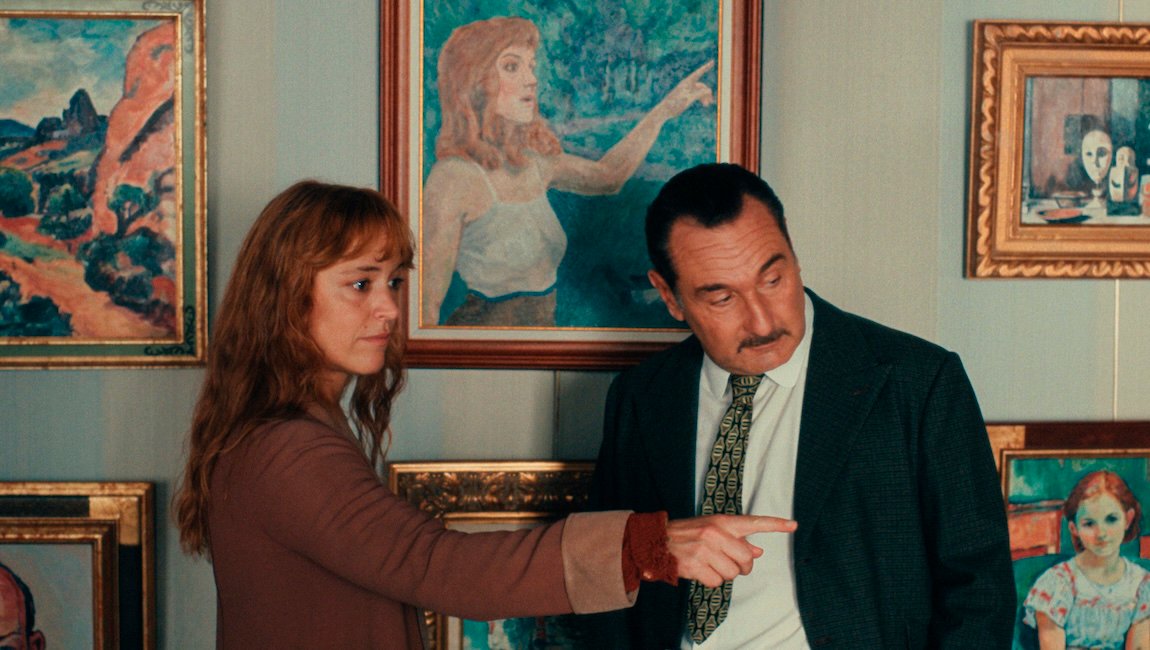
At the risk of sounding hyperbolic, except for Leos Carax’s bizarro musical Annette (2021), the last decade of the Cannes Film Festival has boasted some of the worst opening films available to humanity. And to paraphrase a certain British novelist, it is a truth universally acknowledged that a film festival in possession of a good fortune must be in want of a horrendous opener… Quite notably, Cannes has become the worst offender of this adage among major international tests, and with Pierre Salvadori’s The Electric Kiss (La Vénus électrique), it has managed to double down on its promise of abominable festival kick-offs.
As Salvadori’s period drama opens in French theaters nationwide on the day Cannes shifts into first gear, the selection of such a distasteful film primarily reeks of an opportune distribution deal. “We have Cannes at home!,” the rest of the country can now exclaim as they waste their money on a title that props up the worst tendencies of French cinema all at once. The Electric Kiss is one of those lowbrow films that points at prestigious things like art in the time of Paris’s Roaring Twenties, all to reinforce the obstinate clichés of the troubled painter, the elusive muse, and the spark of genius that true romance can give.
But to get to that point, we must suffer how Salvadori sets the scene. Situated around a carnival that has recently migrated to the capital’s inner city, The Electric Kiss introduces us to a freak-show of vaudeville characters that seemed to have wandered off the set of Tim Burton’s similarly hideous Dumbo (2019). Roaming past the canonical flame swallowers and dagger throwers, we end up at the main attraction: the seductive Electric Venus, who for mere centimes offers a shockingly vibrant kiss by gracing the lips of any man while under a controlled dosage of electrocution. Behind the scenes, Suzanne (Anaïs Demoustier) suffers from this sex work-adjacent persona, seeking refuge in a stash of opium hidden in the cabinet of the obligatory vaudeville clairvoyant. Here, a highly convoluted plot kicks off, as a drunk man confuses her for the spiritualist, desperately demanding a seance from her to make contact with his deceased wife Irène (Vimala Pons).
This Antoine (Pio Marmaï) turns out to be a troubled painter, who blames himself for his wife’s passing and has since renounced his supposedly genius craft. By some twists of fate, Suzanne is then commissioned by Antoine’s art dealer Armand (who else but Gilles Lellouche?) to keep invoking the spirit of the dead woman, all to steer Antoine back to life and behind the easel again. Now we find ourselves in parallel timelines, with flashbacks to Irène’s life that Suzanne retraces via the diaries she stole from Antoine’s palatial mansion. This near-coherent plot outline by no means testifies to the actual mangled narration of The Electric Kiss, which has the kind of amateur storytelling you’d rather find in erotic fanfic. Surprisingly enough, the original story was conjured up by relatively solid French auteurs Rebecca Zlotowski and Robin Campillo, and then sculpted into a barely passable screenplay by Salvadori, assisted by two middling journeymen of contemporary French slop.
To come back to Dumbo, Salvadori’s eleventh feature is shot with a similarly jarring digital sheen as Burton’s live-action catastrophes for Disney. All of it is also churned through aggressive color-correction presets, resulting in pictures that seem suspiciously AI-generated and literally fly in the face of all the grand allusions to high art on display here. Primarily a director of comedic dramas, children’s films, and episodes for French TV series, Salvadori is the type of filmmaker that solely serves a local audience with frictionless titles uncomfortably sitting in the gray area between arthouse and commercial. To call this a misfire then would give too much praise to his prior work, and yet the often insipid staging of The Electric Kiss still signals a sharp decline in Salvadori’s ability to be a people-pleaser. The worst offender is undoubtedly the fateful scene in which Irène finds her demise beneath a Paris tram car. The stilted mise-en-scène and wooden acting of a moment that should register as tragedy negate any drama you could possibly squeeze out of the many romantic foibles still to follow.
As such, the 79th edition of Cannes opens with a historically awful film that mostly functions as a metaphor for the inherent tension existing in a film festival that facilitates a disorienting clash of cinematic artistry and shameless mercantilism. In that sense, Salvadori has delivered an honest and revealing work that is destined to fade into the rearview mirror the very second the festival commences proper.
Comments are closed.