
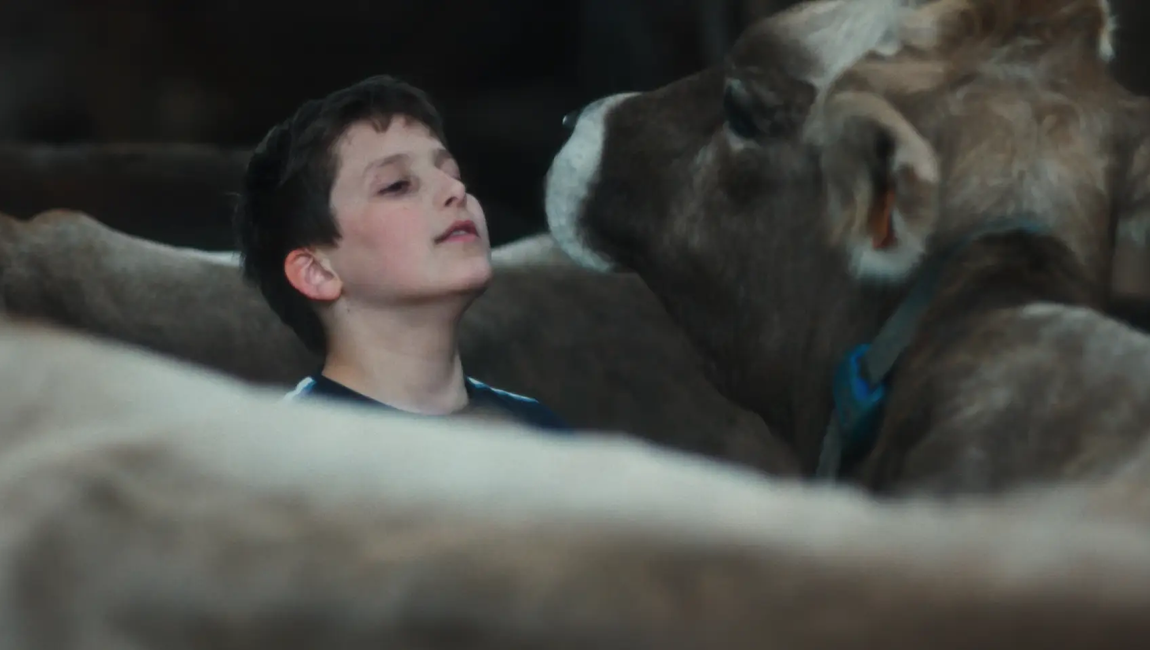
Character-driven documentaries place their subjects in a vulnerable position, allowing filmmakers to construct the version of life that will remain attached to them forever. In his feature documentary debut, Maxence Voiseux adroitly conquers this exacting task through a 10-year observation of a boy in rural Northern France, where one’s future seems to be prescribed — though no one can fully suppress the unpredictable detours of a young man’s dreams. Gabin, or simply “Gab,” as he first introduces himself in voiceover at the age of eight, is the son of devoted agricultural laborers. His mother works on a farm tending Brown Swiss cows, somewhat recalcitrant but also very gentle animals, while his father runs a butcher’s shop, working relentlessly and largely unseen. This tension, set against an otherwise deep father-son bond, is something Voiseux grasped long ago, when he first identified the agricultural landscape of Northern France as his cinematic terrain and grew close to the Jourdel family, a closeness that would later become his mid-length debut The Heirs. One scene from that short effectively teleports into the opening of Gabin. Over a shot from a truck racing through the night, a yappy voice asks his father whether he would mind him becoming a farmer instead, and the father jokes back that if Gabin refuses to take over the butcher’s, perhaps all that remains is to set it on fire.
What initially sounds like playful banter gradually reveals itself as something serious. A tiny village in the Artois region, once emblematic of fertile agricultural prosperity, has fallen into decay under the pressures of globalization and climate change. In this landscape of deserted highways, forgotten factories, and abandoned farms, Gabin was born the youngest son of a family carrying the growing awareness that decades of unrewarded labor may be nearing their final chapter. Voiseux harmonized with Gabin when the boy was still too little to register that larger sentiment, yet intuitively grasped the trajectory of emancipation, one that nevertheless remained deeply intertwined with loyalty to the land, reverence for his parents, and a genuine love for the cows he treated more like pets.
To externalize Gabin’s mental unfurling, the film is shot in 2K flat and frames the image in a 4:3 ratio, embracing the emotional malleability inherent to the format. The childhood footage grants him a cozy framing, generous with the pastel tones of domestic interiors and astonishing landscapes saturated in deep greens and warm violet summer skies. Yet as Gabin grows older, the format acquires a different expressive quality, beginning to register the weight of imposed expectations and an emerging compassion toward his parents as a solid sign of maturity. Within this framing, the vistas cease to remain pristine, gradually shedding the veil of the child’s gaze and unfolding with the melancholy of landscapes already entering their own sunset. Voiseux honors the family’s modest temperament, resisting the temptation to inflate socioeconomic precarity into melodrama and refusing to spell out the coming-of-age story in full. Even during the rare but crucial close-ups on tears, much of the deeper drama lives in the margins of the 4:3 frame. Out of the hefty gigabytes of footage gathered over 10 years, Voiseux shapes a fable-like work of loose chronology, structured through a beautiful montage process that itself took eight months following continuous pre-editing during production.
Phantom threads of visual rhyme and echo organize the film through cuts so seamless that Gabin’s growth feels at once swift and almost imperceptible, first revealing itself through shifts in his thought process and the deepening gravity of his gaze. What is particularly striking is how, despite such prolonged immersion and the camera’s gradual dissolution into an almost ethereal presence, Gabin never unfolds as fully exposed or emotionally enveloping, but rather remains captivating precisely through his restraint and fragmentation. In retrospect, these scenes resemble fragments of memory themselves, from warm and playful to selectively traumatic and fleeting. Perhaps that is why the film reads remarkably close to fiction, or at least belongs to those documentaries that dissolve the burdensome divide.
As with every overtly sustained character study, Gabin gestures to something philosophical, revealing cinema’s uncanny ability to expose the frightening passage of time. Here, Gabin is vibing on the field beside what looks like a fairytale castle, staring at the hypnotic sky, the scene playing out like one of those core childhood memories where time felt relentlessly slow and the rest of life still lay ahead. But at the snap of a finger, he is already 18 with a bass in his voice, and his mother’s hair has turned silver, all of it signaling the inevitable, teary farewell. In the end, there is a piercing shot of cows on the livestock truck, the camera lingering on one animal’s eyes streaming from the blow of the wind, as though expressing the very elusiveness of changing times and inherited destinies. Emotions are hidden between the cuts, leaving behind only ellipses.
Comments are closed.