
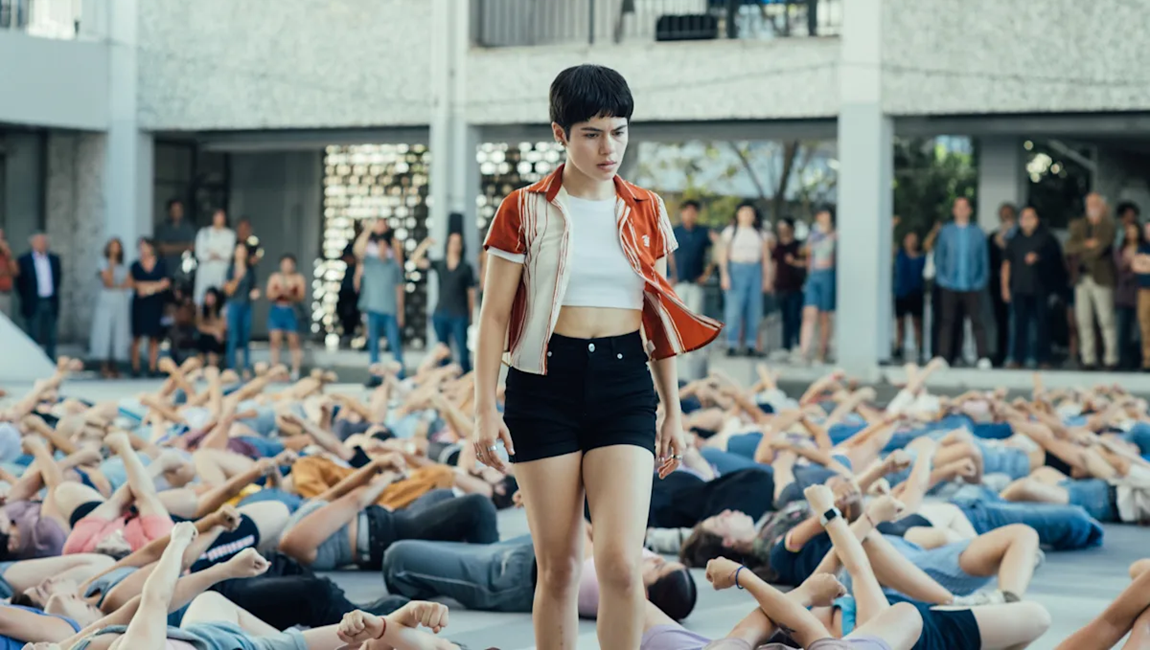
Sebastián Lelio’s The Wave swiftly announces itself as a musico-political spectacle. Music as activism, activism as music, but mostly — and sorely — musical activism. In its opening moments, Lelio establishes a propulsive, dissentful atmosphere: our protagonist, Julia (Daniela López), is interrupted mid-choir lesson by a commotion in the campus courtyard. A choreographed feminist protest is about to transpire, signaled by the unfurling of a banner that reads EN ESTA UNIVERSIDAD SI TITULAN VIOLADORES [THIS UNIVERSITY GRANTS DEGREES TO RAPISTS]. Julia, seemingly on cue, syncs up with her peers in vibrant demonstration, whooping and hollering, chanting about feminist solidarity and accountability, forcefully calling the university administration to pay attention.
This early sequence is lengthy but infectious. Theatrical, posturing, yet not egregiously so. It has the intoxicating energy of stumbling on a protest and hopping into the masses. It brings one back to the early days of COVID, when so many people — this writer included, during long walks through desolate Manhattan to alleviate his mental health crisis — found genuine motivation for a greater cause in the scores of Black Lives Matter activists usurping the streets, demanding police reform, condemning the systemic pattern of police brutality and racial violence in the United States. However, this writer’s engagement — undoubtedly like so many others’ — while well-intentioned, was haphazard and perhaps a bit selfish, and therefore had its limitations. Lelio shows us a similar limitation in his poorly conceived take on the 2018 Chilean feminist movement.
The history here is fascinating, so much so that the film’s central conceits can’t really handle it. As Karen Alfaro Monsalve recounts, “In April 2018, an accusation of sexual harassment and abuse made against a male academic triggered feminist and student mobilisations… at the Austral University of Chile. Thanks to a process of social network sharing and communication, 26 university takeovers were staged in its wake and the shutdowns were reproduced in the majority of the country’s educational institutions. In May, the movement grew beyond university campuses.” The Wave is certainly inspired by these events, but only insofar as they involve large groups of women speaking out against the patriarchy — a perfect opportunity to make a musical with such numbers, to make them dance and sing and spout didactic, overly obvious slogans about having a voice and wax on the nature of consent. Important principles to explore, to be sure, but Lelio strips them of much of their context beyond the Chilean setting and Spanish language, leaving us with a musical dramedy that has activism on its mind but is unsure of what to do with it.
There is very little concern for the digital tools that help to both mobilize and further obstruct 21st-century social justice practices, which, for a project inspired by such a specific period of time, is negligent at best. Most of the organizing moments depicted in the film are either highly choreographed musical numbers or Activism 101-style speeches and Greek choruses of slogans. Additionally, most of the dramatic momentum is paid to our conduit Julia, who was raped by a teaching assistant and, despite naturally breaking into perfectly harmonized numbers with classmates, is still torn between remaining silent and letting her voice be heard as the movement around her escalates its strategies. In the grand scheme of things, she’s not an actual character who’s allowed room to navigate this confusing and sensitive territory; she’s a sounding board for sexual politics.
In EJ Basa’s doctoral dissertation on post-dictatorship Chilean cinema — Lelio’s earlier film Gloria, a more thoughtful character study, is among the analysis — it’s argued that the filmic case studies chosen for the paper “are not only part of the socio-cultural and political dynamics of the nation, but they also depict them at play on screen.” The fact that an earlier Lelio film is included in this study only points more adamantly to the disappointment of his latest release; he shifted from socially engaged but focused character studies in films like Gloria, A Fantastic Woman, and Disobedience, to The Wave — a film in possession of a premise that lends itself to collective engagement and thorny searching, but seems wholly disinterested in its individual characters and their transformation under civil unrest in favor of a self-reflexive, fourth-wall-breaking carnival.
In a similar self-reflexive fashion, the director calls himself out for being a man directing a feminist narrative, while also force-feeding us meaning at every turn and deflating moments that could become a genuine confrontation with terror or trauma or cultural tension by jamming in musical pomp, vaudevillian slapstick, and dialogue that feels derived from a fortune cookie within this stylistic framework. What Basa would consider an effective trend in contemporary Chilean cinema, a penchant for “employ[ing] the senses beyond vision to articulate in the spectator other modes of knowing,” is bastardized here. We are handed the one and only mode of knowing that Lelio wishes for us: that these things are complicated, and this film is not.
DIRECTOR: Sebastián Lelio; CAST: Daniela López, Avril Aurora, Lola Bravo, Paulina Cortés, Catalina Infante; DISTRIBUTOR: Wolfe Video; IN THEATERS: June 26; RUNTIME: 2 hr. 9 min.
Comments are closed.