
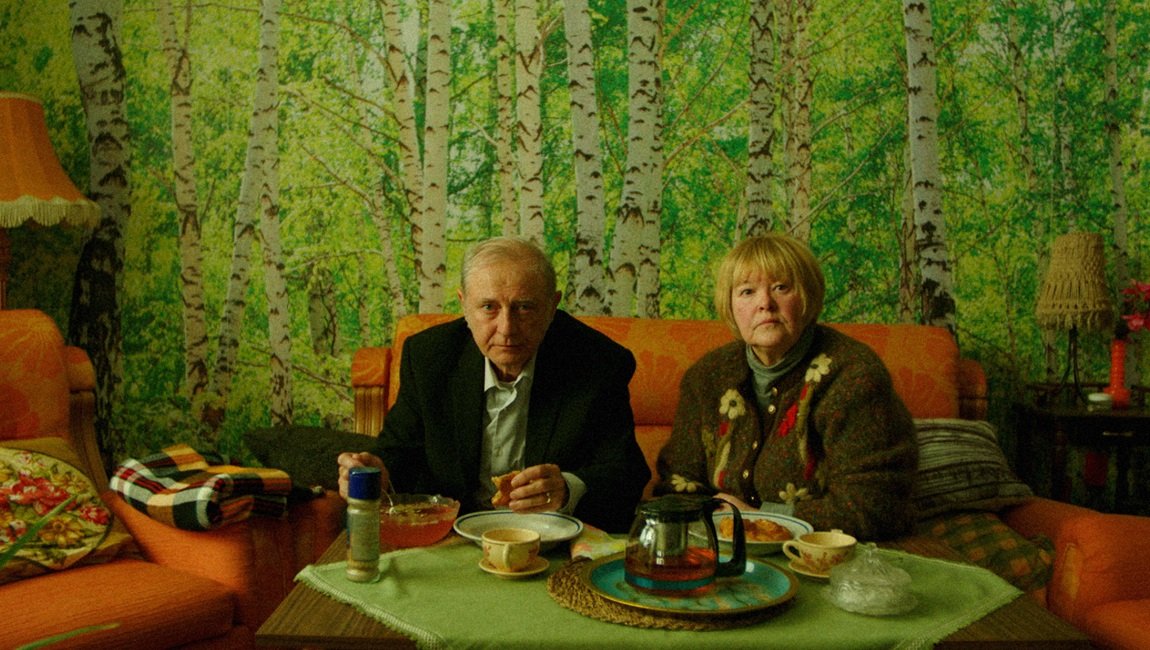
As they so often do, sixtysomething Bulgarian couple Marina (Tanya Shahova) and Gosha (Ivan Savov) spend their evening in front of the television after a long day of blue-collar labor. But tonight the routine flicking of channels is ruptured by the gravest of geopolitical upheavals: Russia, a news report tells them, has launched its full-scale invasion of Ukraine. “What does it mean for us?” an ashen Marina asks her husband. “We’re far enough to be safe,” Gosha replies stoically, clearly failing to soothe his wife, who cuts in bluntly: “No, I mean what will happen to our trip?”
After winning the Crystal Globe in 2019 for the tragicomedy The Father, Bulgarian power couple Kristina Grozeva and Petar Valchanov return to Karlovy Vary’s competition with Black Money for White Nights, a bleak satire on the selfishness of Europe’s “apolitical” middle class. In the face of the continent’s biggest war since 1945, Marina and Gosha worry only about their long-awaited, suddenly imperiled holiday to Saint Petersburg. To fund Marina’s lifelong dream of seeing the White Nights in her idolized Russia, they have painstakingly scraped 10,000 leva into a tin can by pocketing extra cash through petty corruption. As the near-retired railway dispatcher, Gosha turns a modest profit by looking the other way while crooks siphon gasoline from stalled cargo trains. Meanwhile, Marina’s duties as maternity nurse allow her to charge patients on the side for preferential treatment. These seniors can then hardly be called upright citizens, which is rather the norm in the morally gray universe of Grozeva and Valchanov, who have risen to become some of Bulgaria’s finest contemporary filmmakers.
Never extending their sympathies to the real subjects of Russia’s aggression, Marina and Gosha fashion themselves instead as victims of a run of unfortunate events that plays like a cosmic joke about karmic debt coming due. A dodgy travel agency in a Sofia back alley assures them that, with a few detours and a slightly higher fee, they can still make the journey — a transparent scam that now robs the gullible couple of their own ill-gotten gains. This almost Coenesque stacking of petty crimes is the directors’ cheeky indictment of Bulgaria’s rotten political economy, a recurring theme in their scathing body of work, cast in even sharper relief by the contrast with Europe’s latest crisis.
As in earlier films like The Lesson (2014), Glory (2016), and The Father, money is the root of all evil, always compounded in the hell called family. Stranded in the capital, the hapless, childless couple has no choice but to fall back on Marina’s younger sister Lucy (Margita Gosheva), in whose cramped home the real cringe of Black Money for White Nights commences. It’s where Alexander Stanishev’s restrained, rigorous cinematography lets deeply buried familial resentment seep into the frame. Much like their career high The Father, Grozeva and Valchanov’s latest revels in the delusional stories people build their identity on, compellingly embodied here by Shahova, who masterfully unpacks how Marina’s unapologetic Russophilia runs far deeper than mere political incorrectness. The socially torturous stay in her sister’s family home reveals that Marina’s now-forbidden pilgrimage was meant as a spiritual journey to resolve a lifelong crisis of not belonging. Robbed of this once-in-a-lifetime chance, Marina and Gosha have also lost the shared goal that held their marriage together, which rapidly unravels before our eyes.
The pleasure always resides in the way Grozeva and Valchanov put their protagonists through the wringer: a high-wire act that gets as close to social cruelty as it can without tipping into gratuitous suffering. The bleak humor of Black Money for White Nights walks that line almost perfectly, with the notable exception of an ending so relentlessly dour that it barely sticks the landing of its final cruel joke. That is a minor complaint, however, for a film otherwise pitch-perfect in its comic dissection of social unease, moral decay, and political apathy — major themes cannily attacked in a fittingly minor film about small-minded people.
Comments are closed.