
Given that present-day existence has been thrown into disarray by — in roughly chronological order — the smartphone, COVID-19, and the resurgence of fascism, how exactly do we make it through the day? More specifically, how can we characterize our current experience of quotidian time? We can often feel suspended between the cataclysmic and the mundane, learning another harrowing fact about impending environmental disaster and then having to walk the dog or make macaroni and cheese for the kid. A general numbness can feel like the only way to stave off the complete dissolution of the self.
Anna Marziano’s debut feature, Foam of Worlds, represents a conscious occupation of this subjective gulf. It’s a film that constantly shifts its attention between the global and the immediate, but does so with a notable lack of tonal disruption. Instead, Foam of Worlds is a film of placid continuity, so much so that at times it feels static, as if its viewer were observing it through the prism of a fugue state. It’s a series of present moments, inching their way forward but almost imperceptibly.
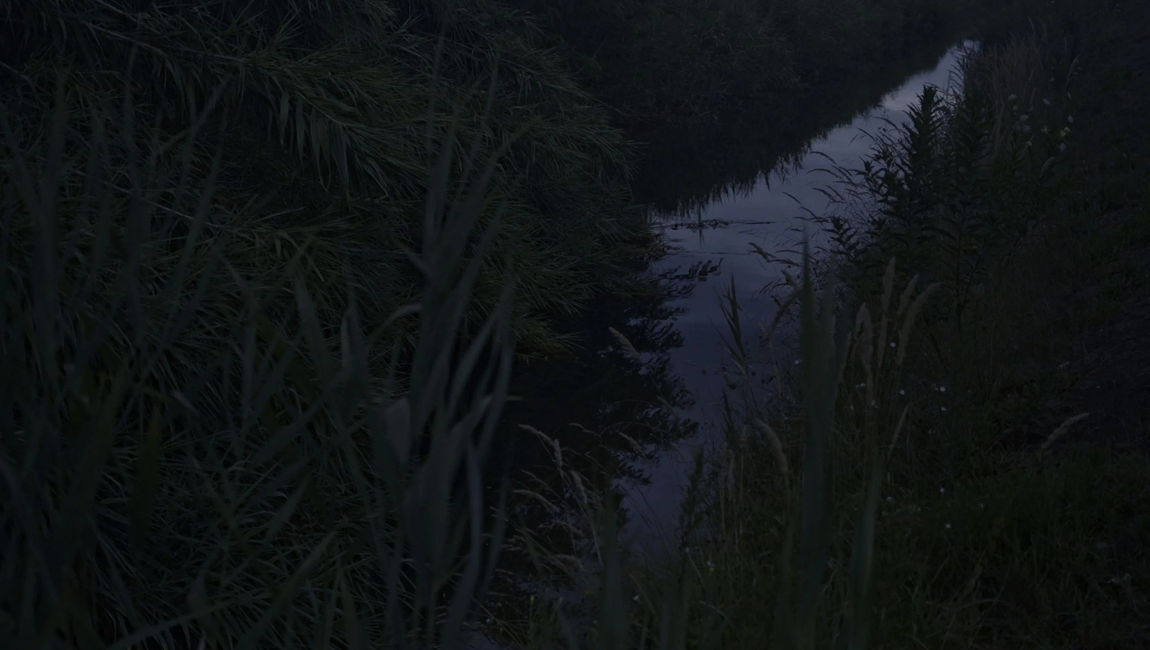
Marziano is one of Italy’s premiere experimental filmmakers, and her work has often focused on the body, specifically the female body, as it finds itself in circumstances both hostile and confusing. Her 2011 film The Mutability of All Things and the Possibility of Changing Some consisted of a series of tableaux in which ordinary scenes of daily life were made strange by a recognition that the body doesn’t always “fit” into the spaces in which it finds itself. Her silent 2024 film Farsi seme actually went inside the body, examining blood as both an extension of the self into space and a bold chromatic phenomenon, perhaps explaining why the history of cinema has shown such an attraction to the stuff. In a sense, Foam of Worlds expands on Farsi seme, bringing it into a semi-narrative frame. The new film is about water, although it takes awhile to recognize this. From ocean waves to murky creeks, water is flowing through much of the film, and in time we come to recognize that it poses an encroaching threat.
A single mother, Antonia (Laura Fantacuzzi), and her young daughter Lena (Alea Lori Marziano) live on the Venetian island of St. Erasmo. Between eating meals and playing with Lena, Antonia is a lawyer who is hard at work researching a case for the European Court of Human Rights. Building on a landmark case in Switzerland, Antonia gradually considers a plan to prosecute inactivity regarding climate change, arguing that it victimizes future generations and deprives them of their basic rights. As it happens, coastal levels around St. Erasmo are steadily rising, so this is a problem that threatens to literally consume Lena’s home if it continues unabated.
Marziano organizes the film in a way that tamps down any sensationalism or fearmongering regarding climate change. In fact, there is a patient, subdued tone that permeates Foam of Worlds, preventing any one scene from drawing undue attention to itself. We observe Lena in school learning to spell, Antonia preparing dinner, and the two of them acting silly and goofing around. And yet there is a somber atmosphere throughout the film, seemingly alluding to the fact that even as we go about our lives, there is an existential threat always looming in the background.
We see Antonia reading and researching about climate change in terms both scientific and legal, and this provokes eerie juxtapositions that Marziano’s editing and framing tend to smooth out. At times, Foam of Worlds evokes the documentaries of Gianfranco Rosi, with their broad scope and dialectical examinations of Italian life. And yet that observational atmosphere is interrupted by scholarship and data, beaming in like transmissions from another reality.
But, of course, that’s the point. Impending climate disaster is our reality, and we tend to suppress this knowledge to allow ourselves to conduct our daily affairs. For those of us with children, this dissonance is especially pronounced, since we cannot allow ourselves to believe that we brought new life onto the planet only for it to die an agonizing death. So if we must partially deny the truth in order to live, what hope is there? Foam of Worlds provides a possible answer. By depicting scholarship, education, and activism as coextensive with daily life, rather than a disruption or digression, Marziano suggests that we can gain awareness and take action without lapsing into the paralysis of despair.
Roberto Rossellini claimed that Freud’s theories of the sex and death drives were incomplete, because they ignored a third drive that he believed was every bit as primal. This is the drive for knowledge. Foam of Worlds does not ignore the possibility of death, but Marziano counterbalances it with education, and the hope that by facing reality head-on, we might yet be able to steer it away from death and toward the possibility of sustained life.
Published as part of FIDMarseille 2026 — Dispatch 1.
Comments are closed.