
Shireen Seno’s short film you dreamt you saw yourself but couldn’t see your face begins with a small video image situated in the center of the screen. We see an older gentleman in a tam walking in a park, eating a pear, while we hear him whistling a seemingly random tune. This introduction sets the parameters for the remainder of Seno’s film, which is primarily concerned with water and landscape. As we enter a different set of images, which fill the entire screen, we still hear the whistling. So this emphasizes the absence of the older man in the newer footage while also permitting him to occupy this space as an echo.
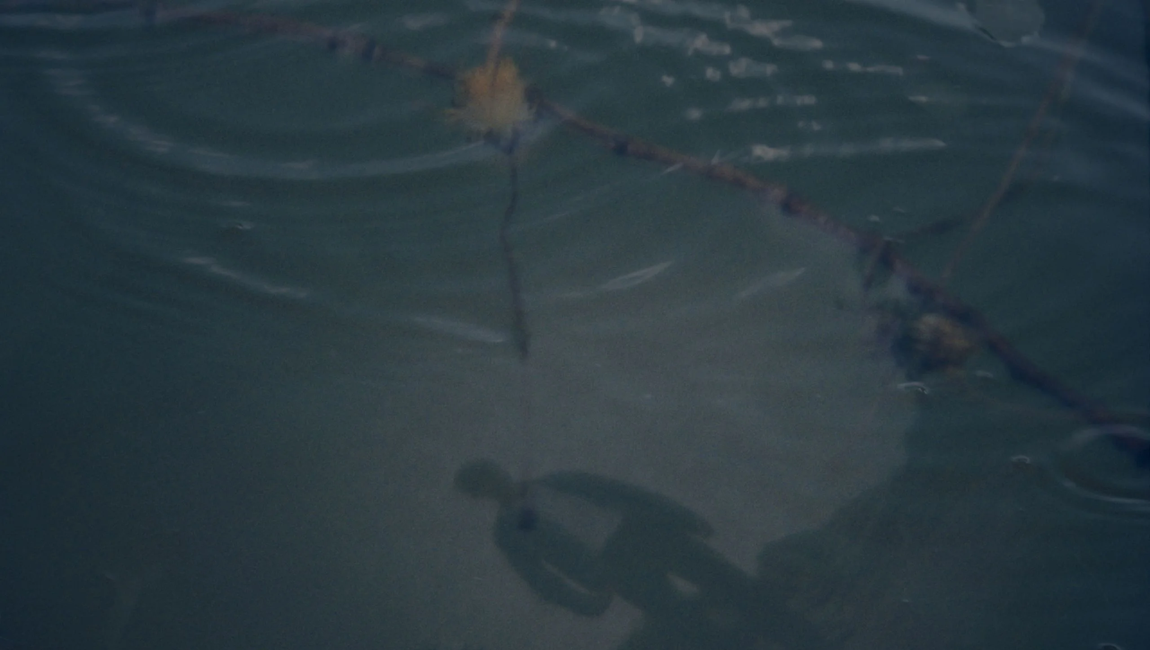
Seno provides a series of images of the water’s surface, reflecting the space around it: clouds, telephone wires, trees on the shore. In the fourth or fifth shot, we see a large stick penetrating the surface of the water, which both disturbs the reflections and alerts us to the presence of an unseen figure. In time, we see the person’s hand enter the frame. But coming and going across these shots is a man reflected on the surface of the water. Although his general shape resembles that of the older man in the opening segment, it is not clear whether Seno has photographed an actor or whether the man’s presence is layered in through digital editing. As with the sound of the whistling, this image is an echo of a previous presence.
In formal terms, you dreamt you saw yourself; treats the water’s surface as a reflecting plane, one that occupies the entire frame or part of it, depending on the camera angle. This results in a prismatic film, one that keeps the flat surface of the water as a constant but pivots the viewer’s perspective around that plane. In the final minutes of the film, Seno provides close-ups of the water, with leaves floating by as the current moves through the frame. In the final minute, we see the reflection of a hand holding a plastic bag, and realize that this person is spreading ashes on the water. The film is dedicated to Jolly Tecson Seno (1947-2024), presumably the director’s father. This makes the emotional stakes of the film crystal clear. This location is where the elder Seno now “is,” even though he is no longer there. His remains, like his memory, are moving ever further away.
Published as part of FIDMarseille 2026 — Dispatch 1.
Comments are closed.