
Let’s get this out of the way: Yutaro Seki and Kentaro Hirase’s Sai: Disaster is not a complete work, or at least not one that contains the whole scope of the filmmakers’ project, as it is a theatrical reedit of their original six-hour television series. Not having seen the longer version, this writer can’t speak to what’s been cut or rearranged, but all signs point to Disaster being a fairly radical restructuring of the material, presenting a nonlinear, mosaic take on Sai’s feel-bad mystery plot. That new structural game is one of the few engaging elements of the film, however, and unless all the best stuff was inadvisably left on the cutting room floor, this plodding movie does not inspire confidence in the quality of a version three times as long.
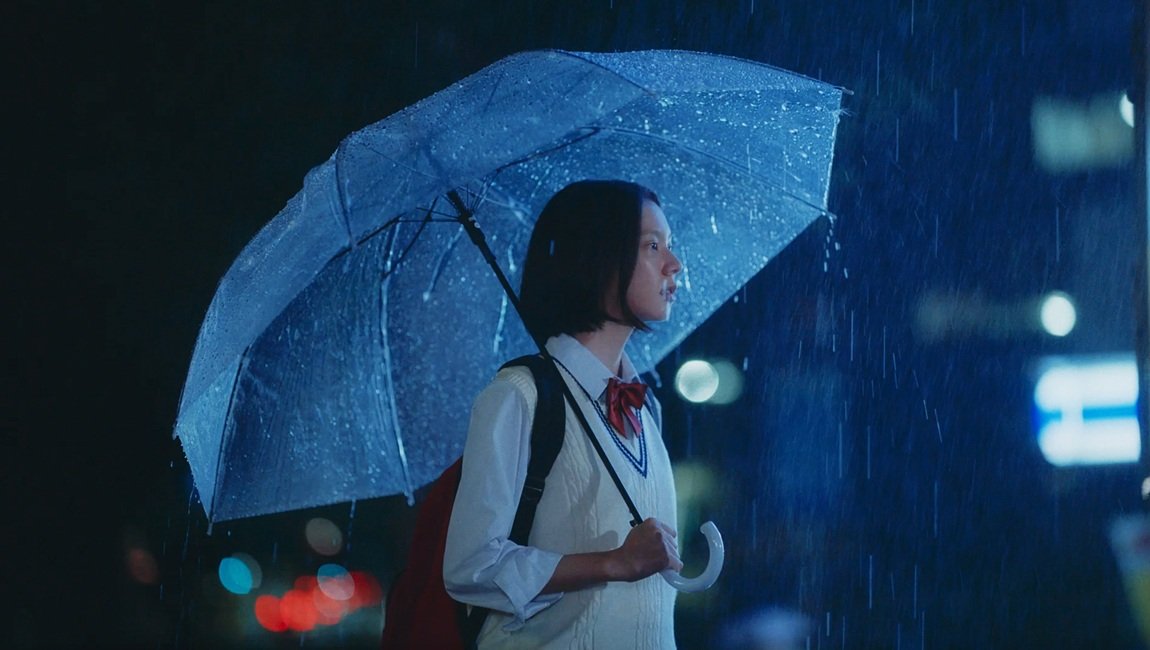
Since the film opens on a few murders, quickly suggesting the presence of a serial killer, the character portraits Sai: Disaster intercuts across its first hour or so are tinged with dread, though what’s on screen rarely suggests much danger or suspense even as the obtrusive score insists on portent. Each of the film’s narrative segments focuses on a character — a schoolgirl concerned with exams amidst her parents’ divorce, an alcoholic truck driver navigating the end of his own marriage after a tragic accident, a celebrated chef separated from his wife, and a mall custodian whose marital status is uniquely irrelevant — on what will turn out to be the last few days of their life. A strange man played by Teruyuki Kagawa appears at the fringes of the lives of each of these people. Meanwhile, we see short scenes of a detective on a murder case as her colleagues’ insistence that these deaths are random grows increasingly unbelievable.
Despite the body count and a few grisly images, Seki and Hirase elide scenes of violence entirely, which both keeps its focus squarely on the human cost of the crimes and justifies the film’s exasperating attempt at high-minded ambiguity. But its refusal to give in to genre pleasures leaves the film barren of anything engaging. Perhaps there was more meat to these characters’ lives in the longer, sequential television cut, but in this version they are archetypal figures ensnared in familiar stories. Plus, the philosophical musings spoken by several characters that suggest that murder, suicide, or accidental death are all the same thing, just another disaster that can befall a person, come across as little more than a juvenile gesture toward deep thinking, an attempt to paste meaning onto an otherwise pointless procession of corpses.
In tone and subject matter, Sai: Disaster is redolent of Kiyoshi Kurosawa’s influence — even the casting of Kagawa as an unnerving presence calls to mind Creepy. If inviting the comparison does the film no favors, it’s instructive in how it illuminates the master’s strengths beyond the doom-and-gloom worldview adopted here. Cure, another film that deals with the malevolence of a strange man and the mysterious death in his wake, is a classic not only for its vibe and musings on evil, but also for Kurosawa’s incredibly precise staging and his ability to extract dread from every inch of the frame, even when there’s little on screen. Sai: Disaster leaves little impression because it is, in contrast, desperate. It’s the type of film that shows you a slow-motion close-up of spilled water, drops a heavy-handed musical cue, and hopes that you feel shaken.
Published as part of Japan Cuts 2026 — Dispatch 1.
Comments are closed.