
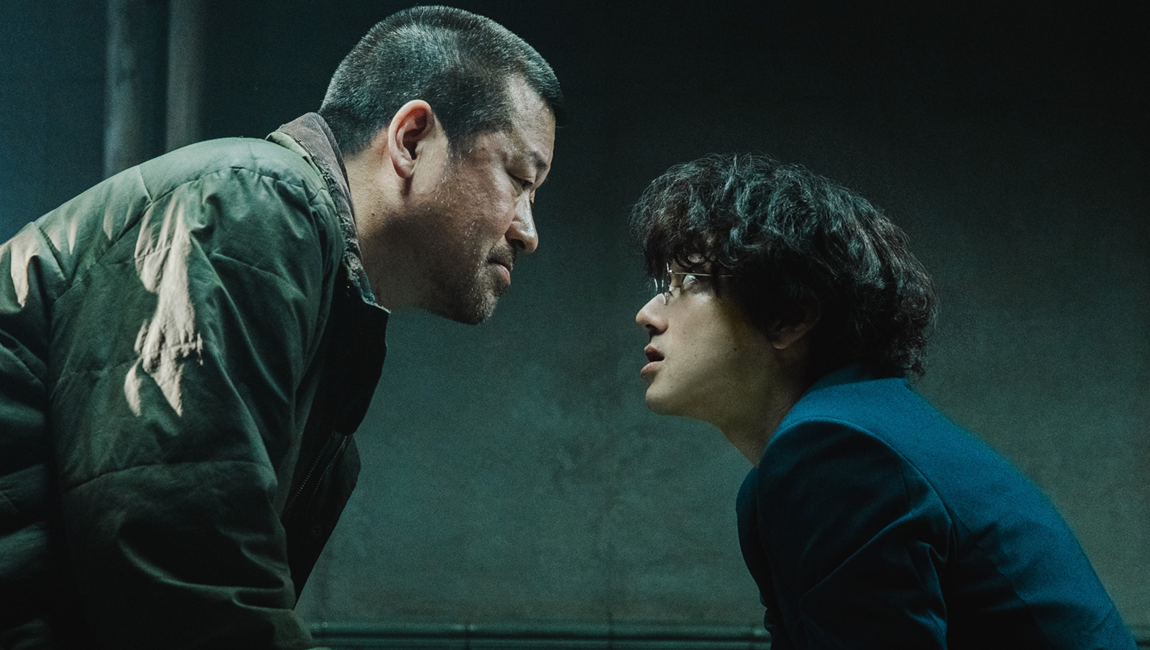
Akira Nagai’s Suzuki=Bakudan is a police procedural in which nearly every consequential movement begins with a man sitting at a table. Tagosaku Suzuki (Jiro Sato), detained after drunkenly attacking a vending machine and an employee, claims that bombs will soon detonate around Tokyo. The first accurate prediction forces the police to reconsider everything coming out of his mouth. Even his jokes require attention. From there, the film cuts between the interrogation and officers pursuing clues across the city. Cinematographer Tetsuya Kondo’s handheld camera gives the room an unsettled texture, while editor Suguru Ninomiya turns Suzuki’s remarks into changes of location and pace. For roughly an hour, this arrangement works. The trouble is that Nagai continues cycling through it long after the viewer has learned its rhythms, leaving Sato to supply most of the remaining surprise.
The police decide who questions Suzuki and whether he can stand or leave. None of that prevents him from directing their attention. Kondo begins at conversational distances, then moves closer as the predictions acquire credibility. The camera picks out a finger lifted from the table, an abrasion, the corner of a smile. Small handheld tremors keep these inserts from looking clinical. Early on, each detail can change how Suzuki’s last sentence is understood. By the final third, similar close-ups have become routine coverage. The city may be under greater threat, but the camera is still returning to the same hands and injuries.
Suzuki initially looks like someone the institution can process and forget, an unidentified drunk attached to a minor offense. The equal sign in the international title describes the suspicion he creates once the first blast occurs: every part of him might now be evidence. His control depends on the police becoming afraid of interpreting him incorrectly, whether or not they can prove that he commands the bombs. A stray remark can send several officers out of the building while he remains in the same chair.
Sato keeps changing the temperature of the room. Suzuki often mumbles and seems pleased with himself. Occasionally he raises his voice, though volume is never a reliable measure of danger. Some of his ugliest statements arrive with exaggerated courtesy. A pause may suggest drunken distraction until his eyes settle on the interrogator and make the delay look planned. Sato can let the laughter disappear while leaving the smile in place; elsewhere, his mouth relaxes before the suspicion leaves his face. Nothing about the performance feels casually improvised, even when Suzuki appears to be inventing the conversation as he goes.
Yuki Yamada works in a broader register as Ruike. He plays the detective as a slightly anime-coded sad boy, announcing disillusionment through lowered eyes and a clenched jaw. When that restraint breaks, the response is sudden and large. Nagai repeatedly cuts to Ruike after Suzuki lands a provocation, using his face to underline that the exchange has changed. This makes the interrogation easy to follow, but it also limits Ruike’s intelligence to visible reaction. Sato sets the tone and Yamada confirms it. Ruike rarely appears to be thinking on a track the film has not already shown us.
Outside the station, Sairi Ito’s Koda and Ryota Bando’s Yabuki move through public spaces with considerably more freedom. Nagai keeps the searches geographically clear, and Ninomiya accelerates the cutting when a word from the interrogation redirects them. These passages initially give Suzuki’s speech physical reach: something said casually inside a drab room sends bodies across Tokyo. After several repetitions, their arrival becomes predictable. Another cryptic remark means another burst of police activity before the film returns to the table. Yaffle’s score enters at the expected pressure points and withdraws without leaving much behind. It supports the existing tempo rather than altering it.
The English subtitles create a separate difficulty. Some riddles depend on kanji or verbal associations that are rarely placed onscreen, so the translation has to provide a clue whose components the international viewer cannot fully inspect. The police are shown recognizing a connection; someone reading the subtitles may receive that connection already half-assembled. The loss is inevitable to a degree, but Nagai makes little attempt to give written language a stronger visual role. Consequently, an elegant piece of wordplay can arrive as information to be accepted rather than a deduction the internacional audience can perform.
Before the first explosion, Suzuki is a shabby detainee whom the police would have little reason to remember. Afterward, the same men lean closer whenever he opens his mouth. That reversal gives some weight to his complaints about which people receive attention and whose deaths matter. The film gives him the sharpest formulations of those grievances, while the endangered public usually appears as a reason for the police to hurry. Nagai seldom remains with ordinary victims long enough for their experience to answer Suzuki’s claims. His resentment is vivid because Sato is vivid; the social world supporting it is much thinner.
At 137 minutes, Suzuki=Bakudan could lose 20 or 30 without damaging its mystery. Around the hour mark, the route from a new riddle to another search has become familiar, and changing the camera position no longer renews it. Sato uses the extra time well, continuing to adjust Suzuki’s voice and facial tension after the investigation itself has begun to stall, but Nagai cannot keep pace with him. Late in the film, the camera once again searches Suzuki’s face and hands for fresh information, even though it has already taught us exactly where to look.
Published as part of Fantasia Fest 2026 — Dispatch 3.
Comments are closed.