
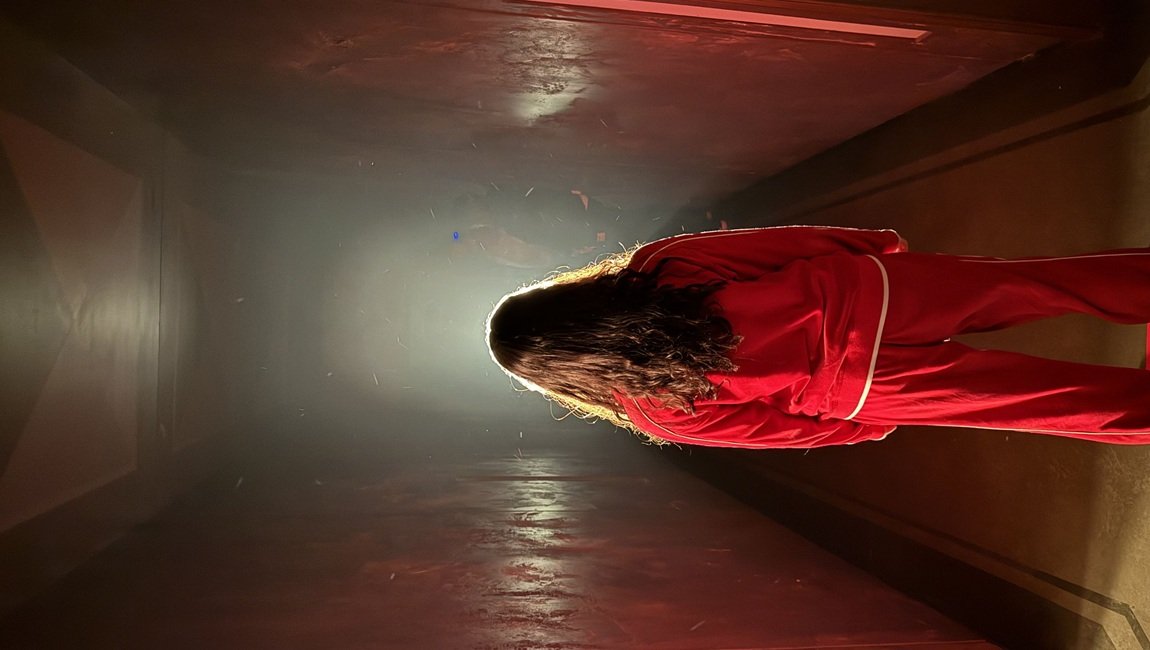
It’s all too easy to feel at home in Casey Walker’s Home Bodies. Red (Emma Ho) and Blue (Ian Ho) have lived all their days in a small but intricate home. They seem to both be around 14 years old. Aesthetically, the various rooms, each outfitted for a specific and essential purpose (the eating room, the TV room, the bedroom, the toilet room) looks as if it were stuck in the ‘50s. The appliances and decor are all retro-futuristic, but also decaying, browning from old age. But at the same time, the home is technologically advanced: cupboards re-stock themselves (evidenced by a mechanical whooshing), the microwave turns ingredients into meals, and the cellar disappears the bags of trash the siblings place into it, but only after they close the door and recite “garbage” three times.
They regularly visit “Papa,” a paternalistic disembodied being who resides behind a locked door. We and the siblings only ever hear his robotic voice, which is summoned after they ring a doorbell. They must kneel before the door every time they speak to Papa, who answers any questions the kids have, and also doles out advice and discipline. Their entire knowledge base — their language, moral lessons, hygiene — has been inculcated in them by Papa and by a show called “Barn,” a children’s puppet show that Red and Blue watch on VHS tapes that Papa provides them daily. Papa and the puppets in the show (a cow, chicken, and pig) are the only other beings the kids know.
Only a few moments into the film, it feels as though we, too, have spent all our lives in this little home with Red and Blue. They don’t have much purpose other than to move through the days, measuring time by the light that brightens or dims (marking days and nights) outside the translucent glass of their windows. They wake up, eat breakfast, watch “Barn,” eat lunch, play, watch more “Barn,” eat again, and then go to sleep. It’s incredibly ordered and comforting, at least to Blue, who relishes and thrives in the rigor. Red — it grows increasingly apparent in the first act, through her lazing around, her reluctance to wake up as swiftly as Blue does, through her dragging heels — is growing bored with their existence.
The siblings’ simple and predictable days are disturbed by the appearance of Pal (Ess Hödlmoser), an androgynous being about the same age as Red and Blue. Pal doesn’t speak and Papa tells the kids that they must treat Pal with the respect they have for each other. Red is elated, having found in Pal a new friend, while Blue rankles. The figure of Pal introduces in the lives of the two siblings ideas more grim than they are used to, and the film watches as Red and Blue deal with this newness and the growth it foists upon them. In service of this shift, the set design, pacing, and cinematography, along with the Ho siblings’ portrayals of Red and Blue, are so incredibly well done, are so well realized and cohesive (each aspect completing and complementing the other), that it’s tough not to forget yourself as you watch the film. And so when Pal does appear, one feels both Blue’s discomfort and Red’s elation with visceral force.
Home Bodies works incredibly well on its immediate level, telling a story at once simple, engrossing, and monumental. And it is this simplicity that allows the film to successfully and poignantly carry its bevy of ideological meanings. Most sci-fi stories often carry a single, hefty allegory, which reflects in broad strokes the complex world that the stories have built. In Home Bodies, the story, the world built, is fairly simple — that is, even as the small home that Red and Blue live in is intricate and has distinct rules and regulations, there isn’t much in the way of exposition for why things are the way that they are. In anchoring the story in such distinct and well-wrought characters, which are superbly embodied by the Ho siblings, characters who have little need for reasons behind why their world is the way that it is, the story is able to afford its simplicity. And it is this literal or narrative simplicity that enables and deftly supports the film’s analytical openness.
The story of Home Bodies can be an allegory for a coming-into adulthood, for psychological individuation; it can be an allegory for how our society is built on decaying systems; it can be a commentary on the surveillance state; it can even be read as a critique of religion and blind faith in stolid and ancient symbols and myths. The viewer is encouraged to identify with whichever sibling speaks to their soul; each is equally and stridently characterized, neither is pedestaled over the other. It is this strong foundation of story that supports ideological freedom. Each reading depends on the viewer, and this wealth of interpretations speaks to Walker’s admirable ability to, through a certain kind of narrative control that facilitates our psyche’s enmeshment in the story, give up analytical control. And so because we feel so at home within Home Bodies, we have a stake in the siblings’ fates, and then we feel impelled to find an allegory, to search for answers that might satisfy us.
Home Bodies is a confident film that is not afraid of unanswered questions, but rather encourages them. In its manner of carrying and developing Red and Blue, prodding them through Pal to ask existential questions, and in its respecting its characters to reach meaning for themselves, Home Bodies is triumphal. Because the thing is, the film does for us what it does for Red and Blue. The film itself feels like a lesson in emboldening us to read films for a meaning that speaks to us. At a time when so much art is terrified of open-endedness, takes pains to explain and over-analyze itself, Home Bodies, for how it opens itself up even as it remains so distinctly contained, so distinct in its identity, is a refreshing, renegade, and beautiful being.
Published as part of Fantasia Fest 2026 — Dispatch 3.
Comments are closed.