
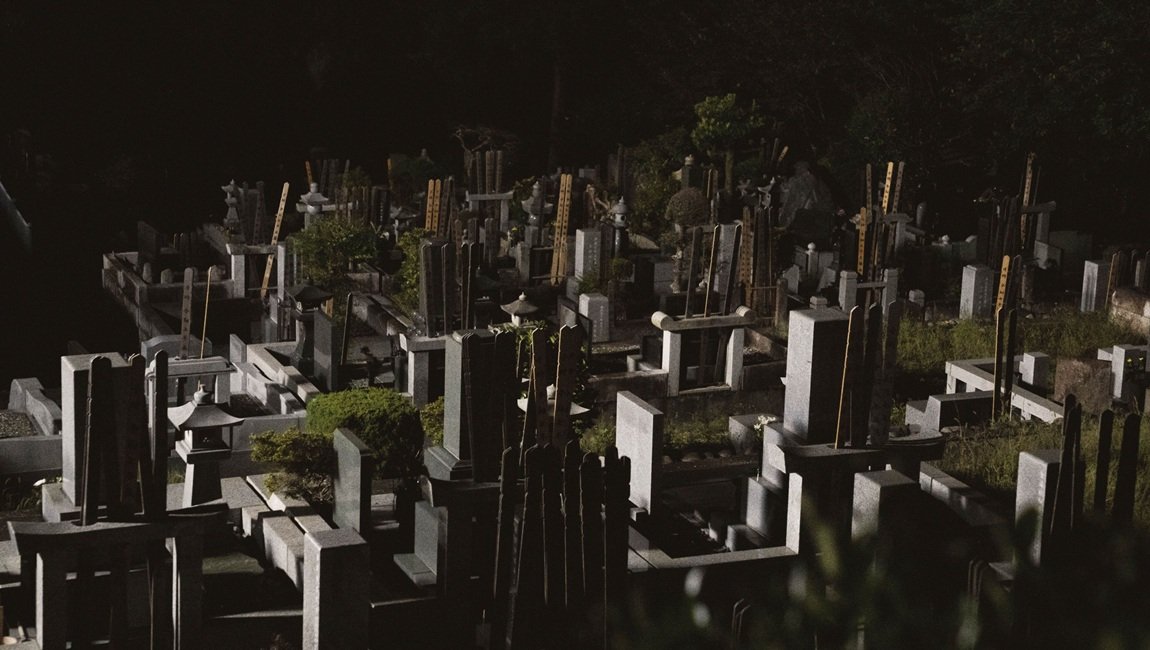
There is something about horror maestro Takashi Shimizu’s The Mouths that feels as foundational as myth. The film’s premise is simple enough: a group of university-aged friends have heard stories of a gnarled tree standing deep within a neglected cemetery that is cursed. The tree is rumored to grant wishes, but as all things cursed, the wishes granted come at a price. The four friends decide to have some fun. They head to the cemetery and decide to walk up to the tree individually, to see who can get closest to it, to test who is the bravest of them all. Things go well until it’s Ann’s turn, who they find has climbed the cicada-covered tree and is speaking nonsensically. The next day, she disappears and each friend begins experiencing a strange sort of haunting: visions of a woman with a long neck, enormous cicadas assailing them, and a strange vision of Ann herself. As the friends try to investigate the tree’s history and ascertain what exactly happened to them and Ann at the tree, they find their sense of reality and sanity slowly unraveling.
The film’s story is both depicted and told — that is, the general, outermost narrative follows a detective listening to audio tapes of Ann’s friends as they, one by one, describe the events of the night they went to the tree and everything that happened afterwards. It’s as if we’re listening to the tapes of the kids’ interrogations. But something doesn’t feel right — it’s in each friend’s increasing loquacity, in the madness that creeps into their faces as they tell their version of events. Something strange is going on; or rather, four different strange stories are taking place, all alongside the detective’s search for the truth, if there be such a thing.
The Mouths is intense and captivating. Like all good horror-thrillers, it scoops us up as viewers into its narrative and leaves us breathlessly running after the story in an effort to solve it, to understand. Shimizu’s genius, which was amply demonstrated in 2002’s Ju-on: The Grudge, lies in his ability to parcel a single narrative in various characters’ serpentine minds. It’s exciting watching this film: darning an image out of the various threads becomes the thrilling task, and leads to an onus placed on us by Shimizu to find a meaning that isn’t correct so much as it is resonant with our understandings.
By no means is The Mouths a perfect film, nor is it the scariest horror film you will see. But there is something wonderfully poignant here, something important that turns not on gimmicks like jump scares or explosions of gore; it’s something akin to a lesson or a reminder of the kind of storytelling we would be sorry to lose: slow, open, and excavating. The point here is to feel The Mouths move through us, whether it is in waves of horror, suspense, or exhilaration.
Much of The Mouths feels like an aged story, the kind shared at a sleepover or around a campfire; it feels like a familiar myth even as its story tells a tale we’ve never heard before. And the point isn’t to get to the ending and a singular, final answer of what exactly it was that happened to Ann and her friends; rather, the point lies in the telling. This film pedestals the act of storytelling and the act of listening and watching above truth, and as such, it brings us back to one of the greatest foundations of mythmaking, storytelling, and filmmaking: pure entertainment.
Published as part of Fantasia Fest 2026 — Dispatch 3.
Comments are closed.