
A life sentence would seem to afford you a good deal of thinking time. But for Akutsu, a former yakuza facing his last days on earth in a cell, prison is anything but quiet. Akutsu does his time with Hōsenka, a smartassed talking balsam plant who cracks one-liners as Akutsu stares down death behind bars. Such is life within Baku Kinoshita’s The Last Blossom, an anime that keeps one heel drifting over the mystic as it reckons with histories of violence, a broken family’s last traces of warmth, and the hope to turn it all around with one final move.
Before he caught a 30-year bid, Akutsu (voiced in old age by Kaoru Kobayashi and earlier in life by Junki Tozuka) was a quiet criminal who kept his head down. The Last Blossom spends the better half of its runtime in flashback, where we meet a young Akutsu building his life in 1987 Japan. Akutsu is straightlaced, aloof, and a bit severe, but his quiet passions can betray his austerity. He’s a gifted artist and spends his idle days wandering through town and drawing his own maps, which he insists are more precise than anything you can pick up at a store. But the biggest fissure in Akutsu’s asceticism is revealed by Nana (Hikari Mitsushima [young] and Yoshiko Miyazaki [old]) and her son Kensuke (Natsuki Hanae), with whom Akutsu shares his home under no pretense of money or romance. In fact, Akutsu does whatever he can to prevent the latter: the life of a yakuza is hard, he tells Nana, and even though love bubbles beneath their dates at ramen shops and rounds of Othello, he won’t make his found family official.
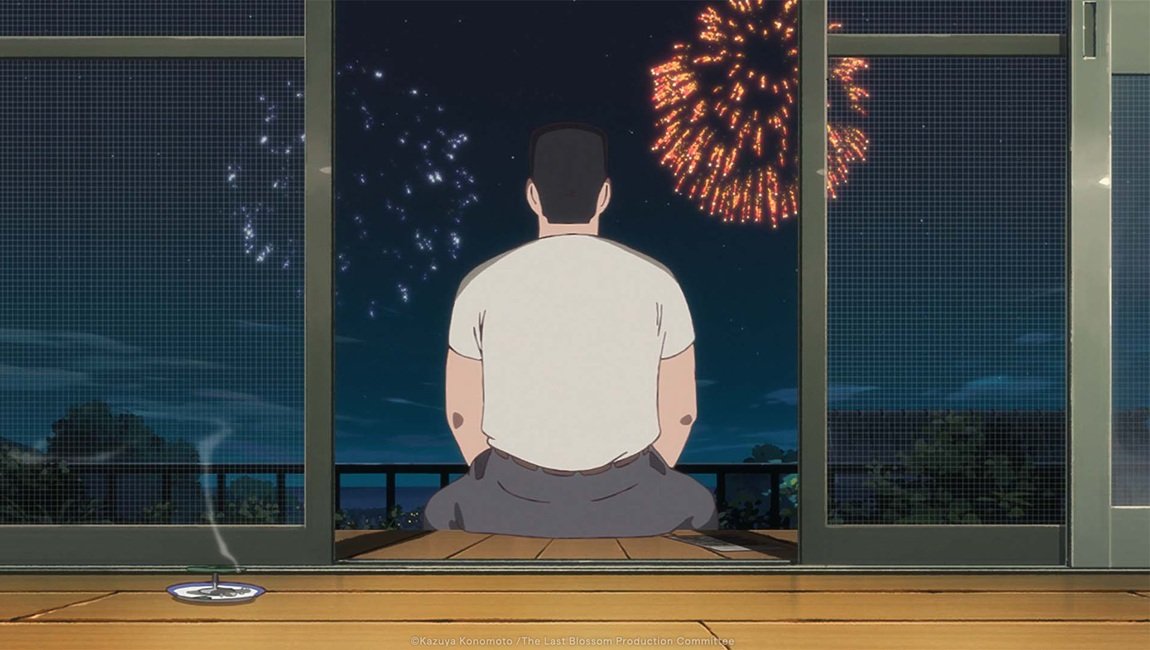
All that time spent in memory allows The Last Blossom to trade in its greatest strength: a serene and acute appreciation of the sensory. “Don’t touch them,” Nana admonishes Akutsu as he moves to pluck a flower from their yard. “What comes from nature should be left to nature. That’s the gods’ domain.” Baku Kinoshita exhibits a similar reverence for the gods’ domain. His anime’s attention is glued to the sounds that compose silence: a breeze over a sheaf of paper, birdsong muffled by a wall of trees, the shuffle of feet behind sliding screen doors. For a movie about the yakuza, The Last Blossom is surprising in how it revels in a patient, dogmatic sense of quiet. And while its computer-generated animation can’t capture the awe of older or more expensive hand-drawn anime, its character designs are striking, emotive, personal.
That’s especially true with Kensuke, the doughy and doe-eyed infant that Akutsu struggles to keep at arm’s length. Akutsu’s coldness is calculated and protective, but it pushes Nana to her limit. She wants the love of a traditional family — dangers of the mob be damned — and can’t seem to crack Akutsu’s disciplined refusal. Leave that to a deus ex machina: Kensuke is diagnosed with dilated cardiomyopathy, a potentially fatal condition at his young age, and it’s the key to cracking Akutsu’s icy façade. He decides to sacrifice his rising star within the yakuza and constructs a house-of-cards scheme to rob a rival mob boss, betray his own leader, and secure the funds for a heart transplant — even if it means spending the rest of his life incarcerated.
At 90 minutes, The Last Blossom can’t afford much breathing room around its plot, and Akutsu’s scheming can feel rushed as it eats through time better spent basking in the movie’s more patient moments. As Akutsu and Hōsenka (Pierre Taki), his ersatz Jiminy Cricket, reflect on the crimes that will eventually save Kensuke’s life, Akutsu recalls the nights he spent flipping Othello chips with Nana. It serves as the film’s central metaphor — the chance we get to right a morally tenuous life with one final move — and while it’s logically coherent, the connection is ideologically brittle. Akutsu pulls what strings he can from prison to provide for Nana and Kensuke; it makes for a saccharine ending for his modern family, one that glides vacantly across the screen, hobbled by serendipitous convenience.
The Last Blossom’s race toward the finish line is most frustrating in its betrayal of the precious quiet it lets bloom in its first half. Which, for what it’s worth, is what will endure after the credits roll. Baku Kinoshita’s serenity isn’t quite a rebuke of the maximalist anime (Chainsaw Man, Demon Slayer) reinventing Western box office expectations, but it does serve as an oasis, trading rivers of blood for the breeze of Ozu. For all Hōsenka’s wisecracking, Akutsu’s life — both free and behind bars — is lived in the gods’ domain.
DIRECTOR: Baku Kinoshita; CAST: Kaoru Kobayahi, Junki Tozuka, Hikari Mitsushima, Yoshiko Miyazaki, Hiroki Yasumoto; DISTRIBUTOR: GKIDS; IN THEATERS: August 30; RUNTIME: 1 hr. 30 min.
Originally published as part of Japan Cuts 2026 — Dispatch 1.
Comments are closed.