
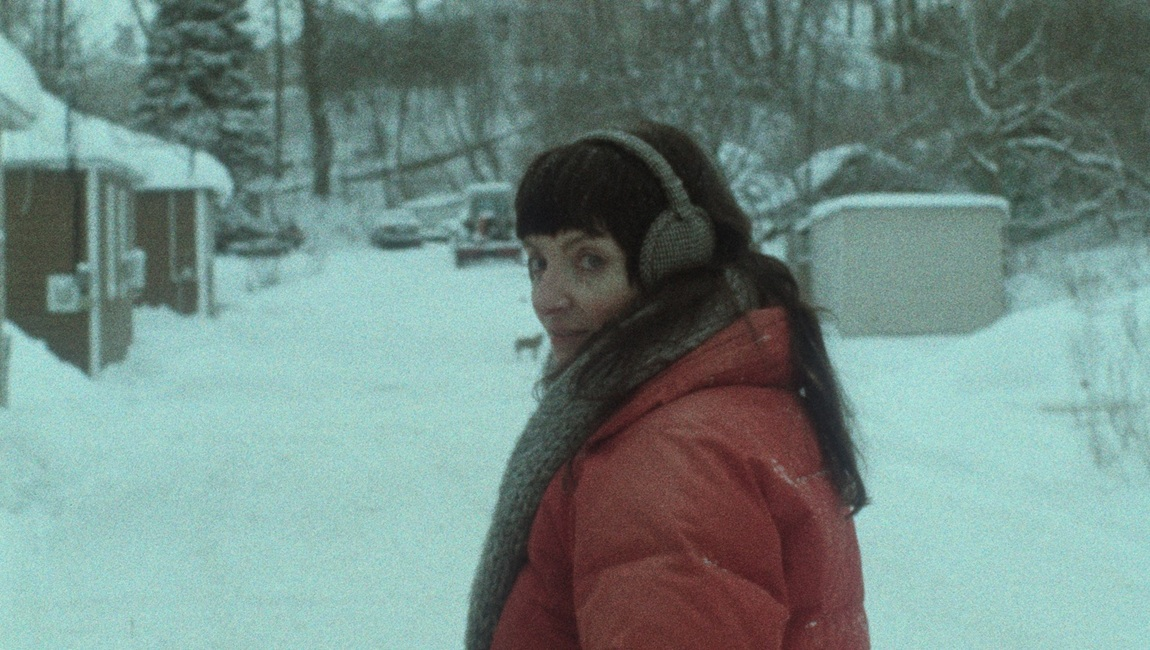
A woman of unknown origin and, for a time, unknown purpose, Mira (Larissa Corriveau) observes. For some, her observation is distant, silently watching the people around her living their lives; her own life, sleeping in her car with only her pet dog for company, seems little worth observing. But Denis Côté observes; as for others, Mira’s observation is intimate, as she watches them living their final moments. Supplying these people with a lethal powder mixed into a glass of water, she facilitates an act of irreversible violence that is also, it seems, an act of necessary mercy. Neither devil nor angel (of death), Mira is also less a person than a part of a process. Stoic and terse, her observant eye, mirrored in Côté’s, is entirely non-judgemental.
Nobody’s Violence is the latest of Côté’s signature portrayals of the far-flung fringes of society in his native Canada, a land so sparsely populated that these fringes seem more like remote enclaves, mini societies of their own. He’s hardly tempted to justify nor contextualize the peculiarities of his characters, though the generosity he shows them — that non-judgemental eye — grounds their actions in a humanity that’s easily identifiable. Mira’s actions are obscure, initially, then curious, and eventually clear — Côté’s decision to reveal the nature of her work only gradually is enriching in its embrace of any and all perspectives on it. Varying, even conflicting interpretations are encouraged.
As Nobody’s Violence departs from its early episodic scheme, and divulges some narrative context for why Mira is doing what she’s doing, it loses some of this richness. That’s not to say that it becomes didactic, but rather that it becomes indulgent — Mira travels to the remote home of her employer, Ludo (Philippe Rebbot), a volatile man who regards all in his orbit as his subjects in some manner or other. He’s hosting a dinner party-cum-business retreat for his underground assisted suicide operation, and Côté turns his attention away from Mira and toward Ludo and his colorful guests. One wonders if Mira takes these people seriously, or if Côté does, but he certainly lavishes an inordinate amount of time on their revelling and scheming, and the middle section of the movie is flaccid and aimless as a result.
There are important details within this section, though, as hints to Mira’s past, and her wishes for a future, raise poignant questions when set alongside the decisions of her clients earlier in the movie. They’ve chosen to end their lives, for whatever reason (though its validity is never in doubt), a choice that Mira evidently has the power to make too, since it’s her weapon they all end up wielding. Côté asks not just what we live for, but what memories, what pain are each of us capable — or incapable — of living with? And is Mira’s near-perpetual reserve a response to her own troubles, or a defense against succumbing to the temptation to partake of the powder she so routinely dispenses to others?
Yet while these questions may linger, Côté’s treatment of them doesn’t, as he resists developing them, instead opting for contrivance to close out his story, and close off the interpretive ambiguity that had been so appealing. There’s a distinct unease between his chilly, almost passive style and the drama and theatricality of Nobody’s Violence’s final sequences. Earlier, other instances of unease had held more formal and stylistic interest, as in that between observation and manipulation (a jarring zoom out is particularly memorable), or that between mundanity and the finality, even barbarity of death — Mira’s bike ride with the man who’s wife wouldn’t even permit him to witness her death is extremely moving, paradoxically so in its total withholding of emotion. But when emotion finally does erupt, it feels out of place in a movie that’s always conveyed more through doing less. It’s a confused, self-sabotaging movie, as rich in profundity as it is determined to undercut it.
Published as part of Locarno Film Festival 2026 — Dispatch 4.
Comments are closed.