
The advent of digital cinematography has been both a blessing and a curse in the history of cinema. For one, it’s made film productions far more feasible, while also gifting masters like Michael Mann and Hong Sang-soo new tools to explore different textures and capture stunning new images. On the other hand, it’s inspired a slew of filmmakers to pursue some truly misguided aspirations, few more misguided than shooting an entire feature in a single take. Some films, namely Russian Ark and Victoria, have managed to pull this feat off, while others, including Oscar winners Birdman and 1917, heavily utilize hidden cuts to merely create an outward illusion that the film’s events unfold in an extended, unbroken sequence. Bury the Devil, the latest horror film from director Adam O’Brien (2024’s Mom), purports to be one of the former examples, but actually falls in the latter camp, working overtime to deliver a spooky carnival ride of a film in one stitched-together “take.” And it’s important to acknowledge this gambit right at the top, as Bury the Devil falls into the same trap as so many before it: beyond this formal hook, it has little else going for it. Specifically, what O’Brien attempts here is a mix of haunted house, home invasion, and demonic possession cinema, its events crammed into a single horrible night and slathered only in the fact that the footage does not cut away as often as filmgoers might be used to.
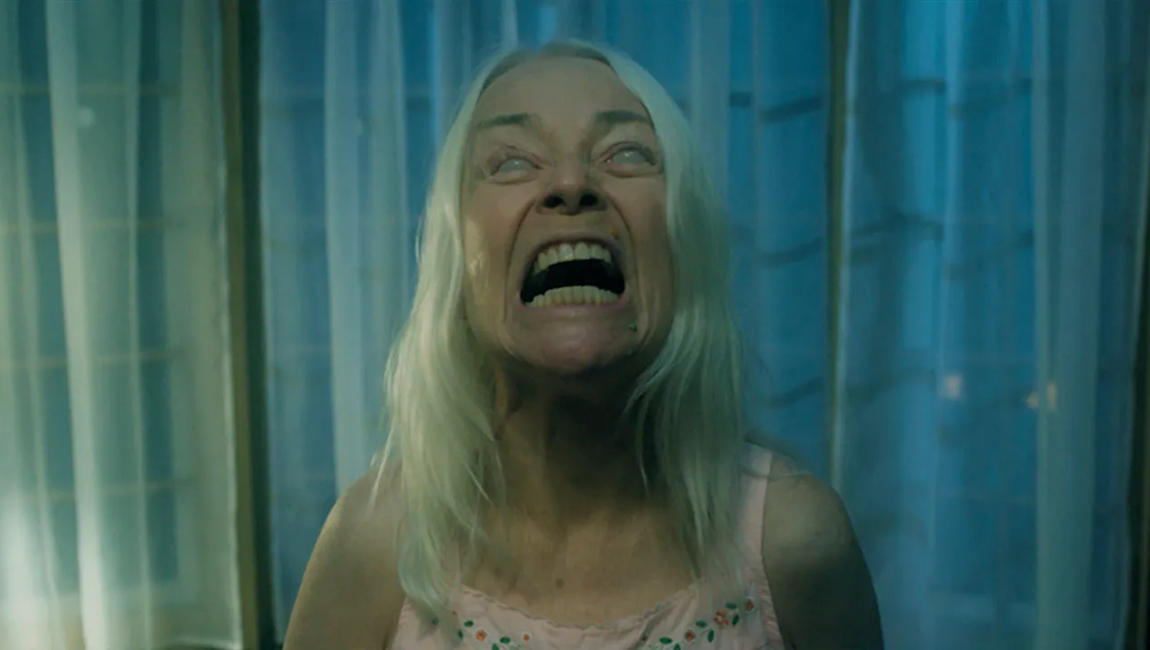
Kicking things off with the ending, we first witness a lakeside mansion set ablaze while screams are heard in the distance, the obvious conclusion of an event gone terribly wrong. Bury the Devil, which is credited to screenwriters John Petrizzi and Brad Hodson, then winds the clock back 75 minutes, spelling out that danger is imminent but more importantly underlining O’Brien’s single-take gimmick, almost as a form of a showman’s patter. (“For the next 75 minutes…”). We’re introduced to Evelyn (Dawn Ford), an elderly woman afflicted with dementia, and Julia (Emmanuelle Lussier Martinez), a live-in hospice nurse charged with her care. It’s a dark and stormy evening — the picture’s soundscape features what must be the most incessant use of thunder in recent memory — and Evelyn is off to bed. Only she can’t bring herself to go to sleep, opting instead to recite the lord’s prayer or wander the corridors of her byzantine residence, sharing stories of her deceased daughter Sarah along the way. Try as she might, Julie can’t seem to get this poor woman to bed, and further complications arise with the arrival of Randall (Bill Rowat), Evelyn’s ex-husband, who comes warning Julie that Evelyn is not at all who she appears to be. He’s hastily turned away, but when Evelyn begins acting more bizarrely, Randall returns with an intimidating group of men, and Julie finds that her nightmare is truly just beginning.
Part of the issue with staging a film in a single take is that pacing takes a backseat to ostentatious camerawork, which only grows more tedious to watch the longer an audience is being prodded into ooh-ing and ahh-ing at some exhausting Steadicam maneuvers. With Bury the Devil being set in a single, spooky location unfamiliar to our protagonist, the endlessly roving camera becomes a detriment to the proceedings, with new sections of the house constantly creeping into frame with the expectation that something is going to jump out at you anytime. It’s the mobile equivalent of the classic trope of a character opening a mirrored-medicine cabinet door, removing an item, and then closing it to reveal the monster in the reflection. But what’s really deflating about O’Brien’s trick is that he cannot commit to the bit and begins throwing in several blatantly hidden cuts, as when the camera makes a Fincher-esque dive through the keyhole of a locked door, or when it exits the house through a plainly closed window to investigate some exterior commotion. In these moments, what is gained from keeping up the ruse of presenting the film in one take? Would natural editing really hurt if the director is clearly covering an impossible logistical issue?
But even if one were to disregard the one-take conceit, Bury the Devil ultimately suffers from being too familiar in its genre trappings to blossom as something truly memorable. There’s a hoary demonic aspect to Evelyn’s illness that has been done to death in several other “creepy old lady” movies, and O’Brien himself is incapable of resisting the urge to punctuate a jump scare with a sharp musical sting at every opportune moment. Some stuff does work: Martinez acquits herself well as the lead, delivering a completely credible performance as the oft-terrified Julia, and after its short runtime lapses, the film does commit to an agreeably bleak ending. But a few strong elements aside, there’s nothing fresh about Bury the Devil, a film you’ve likely seen a hundred times before in traditionally shot and edited form. Keeping the camera running doesn’t change that.
DIRECTOR: Adam O’Brien; CAST: Dawn Ford, Emmanuelle Lussier Martinez, Bill Rowat, Jason Cavalier, Skyler Clark; DISTRIBUTOR: Brainstorm Media; IN THEATERS/STREAMING: August 21; RUNTIME: 1 hr. 24 min.
Comments are closed.