
History has always been a dumping ground for those in power. It’s littered with, as the affectless narrator in Chris Marker’s 1983 cine-travelogue Sans Soleil eloquently puts it, “empty bottles”: forgotten stories waiting not so much to be fulfilled, but just to be seen or heard. The conscientious filmmaker (always) arrives late to the scene, then, with the hope of picking up and reassembling these shattered pieces together. How they decide to put these disparate parts together — more so than what all they decide to put together — determines their approach to illuminating history. The filmmaker can, of course, take a Ken Burns-like educational approach to the material: that is, linearize (and chapterize) history to clearly demonstrate (and detail) its heroes, villains, and incidents. Or they can choose to commit to its inherent blurriness. Heroes and villains may still be as clearly defined here as they are in the conventional approach to recounting history; the difference lies in the filmmaker’s stitching together of its constituent parts. The poetic montage — or montage in general — becomes critical here: it overtly crisscrosses among timelines, media forms, voices, and people to evoke the flow of history. Clarity, in some way, shape, or form, is compromised here for the sake of a stream-of-consciousness-styled experientiality.
First-time feature filmmaker Casey Carter’s admirably ambitious To Use a Mountain wants to do both. Ostensibly — and this is not to patronize Carter’s film at all — it’s the flipside of Christopher Nolan’s Oppenheimer. Gone is the intense subjectivity (or even presence) of the man who “started the end of the world” by creating the atomic bomb. Instead, what we have here is a film about multiple subjectivities contending with said “end of the world.” In other (well, its director’s) words, To Use a Mountain is a testament to a “people’s history of resistance” against the U.S. government (and Department of Energy) trying to use their respective lands as a potential burial ground for the 77,000 tons of nuclear waste generated during the making of the atomic bomb. It’s also, according to the director’s statement in the film’s valuable press notes, “a poetic and reverent picture of the American landscape, its layered histories, and its many dedicated stewards — bound together by the land, the air, and the water.”
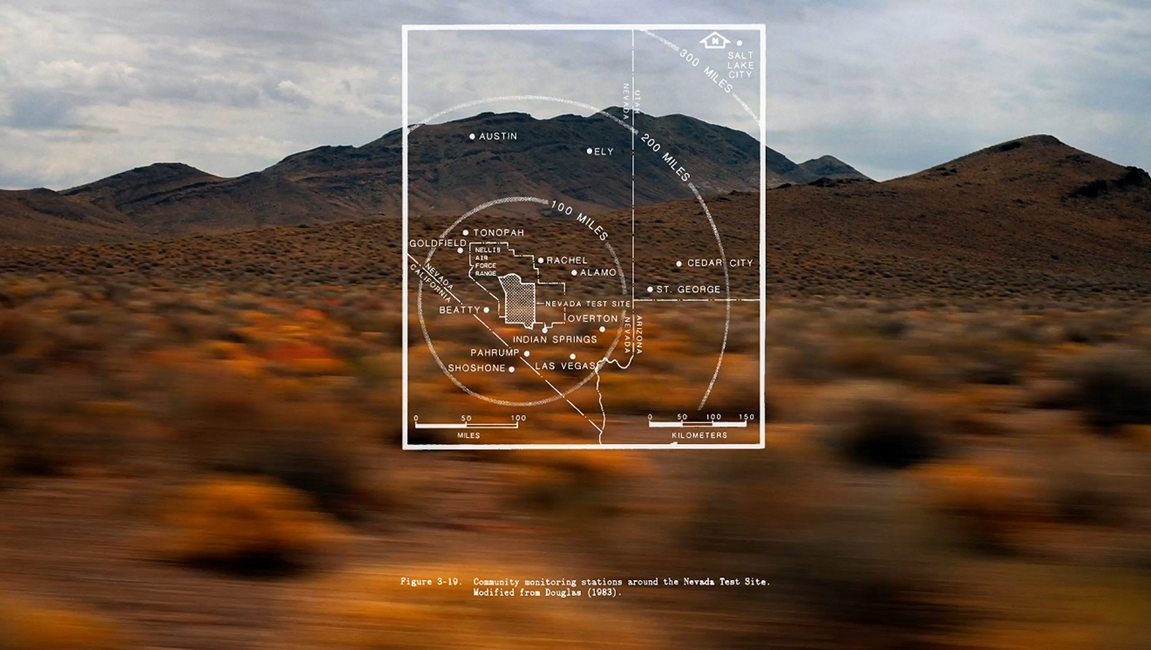
There’s nothing dishonest about what Carter says here, for his filmmaking instincts rarely betray his intent. The filmmaker is interested in creating a documentary that isn’t just dryly informational — he wants to try and capture the feeling of being submerged in a sea of information that threatens to consume you whole. So, despite neatly chaptering his film into six parts — each based on the six rural American communities identified as potential burial sites by the U.S. Department of Energy in 1982 — Carter does, at least occasionally, capture a strange synchronicity that may exist among them. The major “trick” he repeatedly employs to do this is to “convert” the varied voices of his subjects into voiceover that either complements the B-roll footage of the location he’s inspecting, or, oftentimes, contradicts the specific clauses of the 1982 Nuclear Waste Policy Act document he’s scrutinizing by highlighting them on screen. Because we don’t see the subject on screen, the voiceover — aided by Carter’s montage constantly cutting between written documents, on-location footage, and archival footage — spills over from one chapter to the other, filling in the gaping holes of information left unexplored in one section from the knowledge gained in the other.
But, unfortunately, Carter doesn’t always adhere to this brand of poeticism. Initially, the lack of talking-heads may alienate viewers looking for something more conventional. But gradually, Carter pushes closer — to this writer’s disgruntlement — to a “middle ground.” The seemingly haunting (and haunted) voiceovers in the film no longer speak to (and for) each other because Carter decides to show snippets of his conversations with them. In a conventional documentary, the talking-heads approach to personal testimonies would be perfectly fine, honorable even, since the filmmaker is providing time and space for a people’s history silenced by history itself. But its effect in a 99-minute poetic documentary is precisely the opposite: the filmmaker isn’t providing them enough time and space to express themselves. They’re reduced to a fleeting presence by a filmmaker who’s clearly interested in making their voices heard, but primarily in a tokenistic sense. To Use a Mountain — unintentionally, of course — risks repeating history’s cruelty itself by compressing as opposed to capturing these people’s stories.
DIRECTOR: Casey Carter; DISTRIBUTOR: Grasshopper Film; IN THEATERS: August 21; RUNTIME: 1 hr. 39 min.
Comments are closed.