
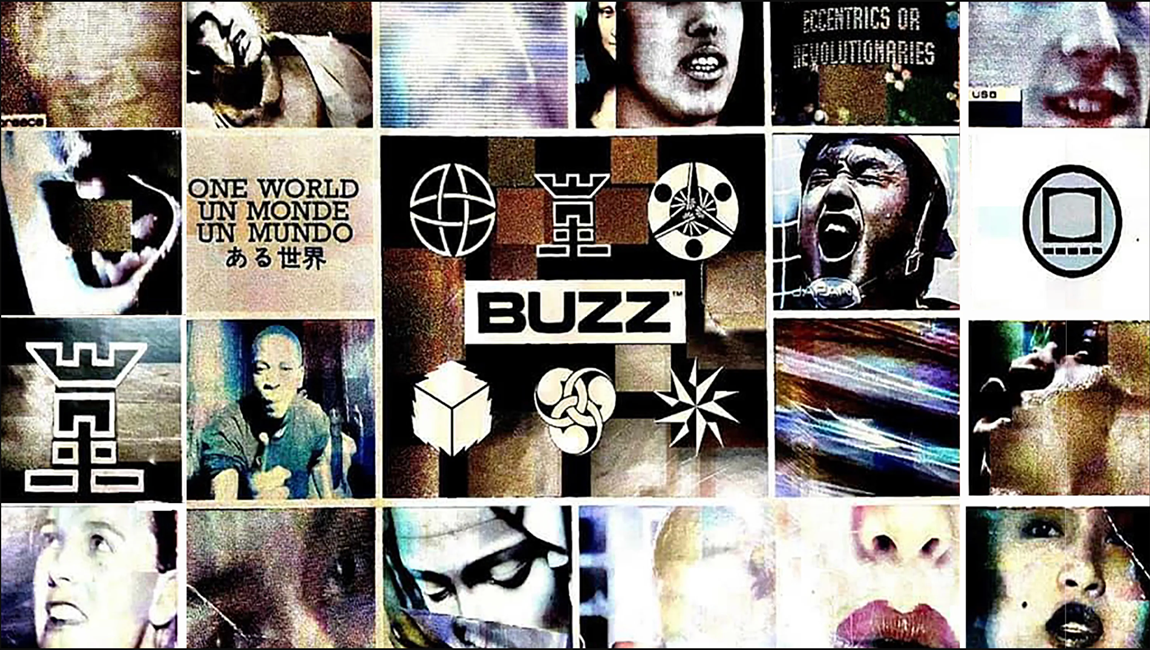
What is “Buzz”? The murmur around a popular film at Sundance? The alarm from an angry bee, fly, gnat? The sultry purr of a sex toy? The co-star of Toy Story, a one-time symbol of progress contemplating his irrelevance? The sound of TV static? Headphone jacks? The room tone in a tape recording? In any case, “buzz” encompasses a flash in the pan, burning hot, fading fast, a current jumping from wire to wire, containing information, but not necessarily meaning.
Buzz is also the name of a short-lived MTV current affairs series that debuted in 1990, co-created by Jon Klein and Mark Pellington. This is Buzz, Pellington’s new documentary covering the rise and fall of the experimental show, simultaneously — and perhaps unintentionally — is a totemic text essential to culturally defining Generation X, an epoch inspired by the revolutionary aesthetics of the preceding era but dominated by creators with few material ties to the circumstances that precipitate revolution.
That’s not to say that This is Buzz nor the series it’s about aren’t worthwhile. On the surface, it’s an answer to the loss of the instructive pop-culture specials that would air on MTV’s sister network, like The Greatest… and the I Love… series. Pellington got his start directing music videos and creating interstitials for MTV, and though his subsequent career as a filmmaker has received mixed critical reception (I’ll go to bat for Arlington Road and The Mothman Prophecies any day), his movies have always been interesting, and he’s been able to consistently make them for 30 years. This is Buzz is entertaining and well-constructed, and Buzz as a series was undeniably groundbreaking for mainstream cable television. (Some incomplete episodes can be found on YouTube.) Klein’s background working in broadcast newsrooms brought an interest in global correspondence, and Pellington had a dedicated track record bringing innovative collage editing styles to the network. Natural successors like Current TV and Viceland may have replicated some of the tongue-in-cheek approach to culture documentary, but nothing has been quite as synesthetic as Buzz — nor as fast and loose with appropriating source footage and music. Buzz’s short shelf life, including tensions with MTV executives that are covered in the film, only points to the show’s challenge to the status quo. There was nothing like it on mainstream television before, and hardly anything similar has followed in its wake.
But the operative words here are “mainstream television,” and this is where This is Buzz as an object gets complicated. Pellington is simply too close to the material to construct any real insight about the creation of the show, and that proximity is evident in how frequently he and his collaborators confidently assert the historic, innovative nature of their work. Klein, Pellington, and co. accurately illustrate how much appropriation and reproduction (particularly through the use of emerging technology) defined ’80s and ’90s culture, referencing photo collage and the use of sampling in rap music. Pop Art and Dadaism are cited as preceding influences — maybe the documentary should’ve been named Ceci n’est pas Buzz — and admirers of Buzz describe Klein and Pellington as Futurists. Okay, sure. At another point, an interview subject claims that if Marcel Duchamp were alive and working at the time, he would’ve worked on Buzz. Alright. The documentary fails to mention, however, the avant-garde filmmakers that predate Buzz’s inception. How does one talk about experimenting with inscribing and painting directly on the film strip without mentioning Stan Brakhage? If historic art movements were so critical to Buzz, how can you leave out Stan Vanderbeek’s use of reappropriation, animation, and computers?
Also mentioned in the documentary is the political strife that Gen X was born into and resentment toward the world left to them by Baby Boomers. Yet, with all the references to Dada and rap music, and for all of the hot-button issues addressed in Buzz — the episode on racism gets a small spotlight in the documentary — its creators are hard-pressed to make any meaningful connections between their work and what was happening around it. Klein himself says as much in the documentary in response to criticisms of Buzz’s frenetic, dense editing: “As opposed to, ‘We missed the meaning of this thing cuz we were too fast,’ it was like, ‘You know what it meant? It was fast as fuck.’” The interviewees aren’t wrong in describing the show as an innovation, but there’s a fascinating ignorance that Buzz was still, ultimately, a commercial product. The documentary functions as an unwitting commentary on the MTV generation: youth who want to fight The Man, but who have never truly felt the pressure of The Man’s boot; Dada art divorced from its manifesto; the rage of protest art without protest. It’s no wonder that artificial intelligence is mentioned in the documentary as an exciting development: it’s all about empty aesthetics. Still, watching clips of Buzz incorporated into the film, plenty of viewers are likely to find themselves thinking, “Yeah, this is cool as shit.” And if this all sounds like an exercise in pillorying something that’s not that deep, such criticism is lodged only because the film itself can’t decide how deep Buzz really was.
In this way, This is Buzz — like the show — is masturbatory, but also valuable. It’s crucial documentation of forgotten media that challenged the mainstream. It also offers rare documentation of MTV’s contradictions as both celebrator and destroyer of culture, the symbolic, inevitable outcome of an era of empty revolutionary promises and consolidated corporate power.
DIRECTOR: Mark Pellington; DISTRIBUTOR: Antenna Releasing; IN THEATERS: September 11; RUNTIME: 1 hr. 42 min.
Comments are closed.