
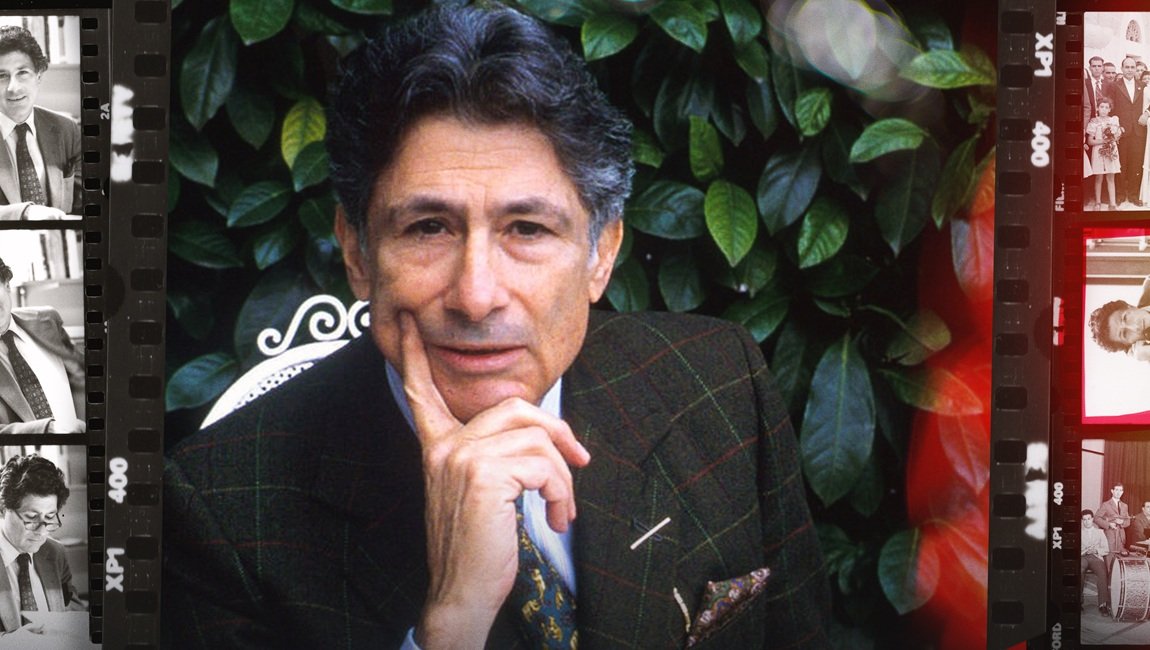
As a certain theory of Baudrillardian post-intellectualism would have it, we now live in what could be referred to as an “anti” age — an era so replete with meaning that the notions of meaning are negated entirely. If this is to be considered true, then Edward Said could be regarded as a definitive figurehead of the “pro” age — pro-intellectualism, pro-curiosity, pro-human spirit — in his seemingly inexorable inquiry toward life’s conditions. Said was many things: a prolific academic, scholar, critic, political activist, and champion of human rights, most expressly Palestinian rights. Anyone familiar with Said’s work would contend that he was obstreperously committed to his side of an ailing battle for a people’s right to exist. And while perhaps best known for his rigorous and incisive Orientalism — and a number of other considerable academic texts — it would seem that Said’s later memoir, Out of Place, was the threshold from which Maiken Baird’s new documentary, Edward Said: Between Worlds, arose.
And like most memoirs, both filmic and literary, Baird’s film begins with Said reminiscing on his childhood in Jerusalem, long before his eventual immigration to the U.S. These early moments are as roseate as they are elegiac, with Said contextualizing through interview voiceover a collection of his father’s Super 8 home videos before delving into childhood loneliness and his father’s disdain for leisure. Later, after the film treks further into adulthood, Said details an argument with a U.S. official regarding his passport, which named his place of birth as Jerusalem, Israel, instead of Jerusalem, Palestine (the official later agreed to name his place of birth simply as “Jerusalem,” omitting a nation altogether). As Said had learned, to be Palestinian was to be wrongfully ostracized, and his persistent sense of lifelong otherness followed suit. To use his own words, “My sense of exile really has been lifelong. I’ve always felt myself to be out of place.” Edward Said: Between Worlds arrives at a number of pointed ideas throughout its runtime, but perhaps none more critical than the primordial connection between geopolitical exile and personal alterity.
Thus, the driving factor of Baird’s film becomes Said attempting to reconcile this notion of a figurative and literal homelessness. When viewing Edward Said: Between Worlds, the first impulse is to describe the various actualities onscreen as being of the present moment as opposed to referring to them as a thing of the past. It goes without saying that Said’s musings on Middle Eastern conflicts were especially prophetic, and Baird rightfully treats them as such. Regrettably, the political and humanist perils which fueled Said’s struggle for his people’s freedom — and ultimately his central mission as a person and academic — persevere today. So the central question of Between Worlds becomes not one of a singular man, but of the manner in which his advocacy echoes into the broader contemporary malaise. In this regard, Baird’s documentary takes on a twofold structure in that it situates the personal tribulations of an egalitarian voice within the conflict which he sought to rectify. Or, in far simpler terms, through Said, Between Worlds reminds us that the fight for change is ongoing, and we mustn’t forget the tragedies of history.
In this sense, despite the fact that Said died over two decades ago following a battle with leukemia, Baird’s film grants him the new life he so justly deserves. Naturally, this is evident in the rather straightforward manner in which Between Worlds relays information to the audience. Though, the formal qualities of the film are immaterial, especially because Baird understands that her film is chiefly one of discourse as opposed to images. To harken back to the aforementioned point of Baudrillard and the aftermath of his teachings, the notion of a discourse-driven cinema is becoming for a subject such as Said, who dealt in words and intellect rather than images. And if an ideology which speaks to the un-meaning of images is valid in any capacity, then perhaps discourse is the most appropriate route. As Edward Said: Between Worlds asserts, the avenue through which social change is triggered begins with a discourse between two opposing ideologies. As with Said’s own Orientalism, only then will change occur, and with it, synthesis.
Published as part of TIFF 2026 — Dispatch 3.
Comments are closed.