
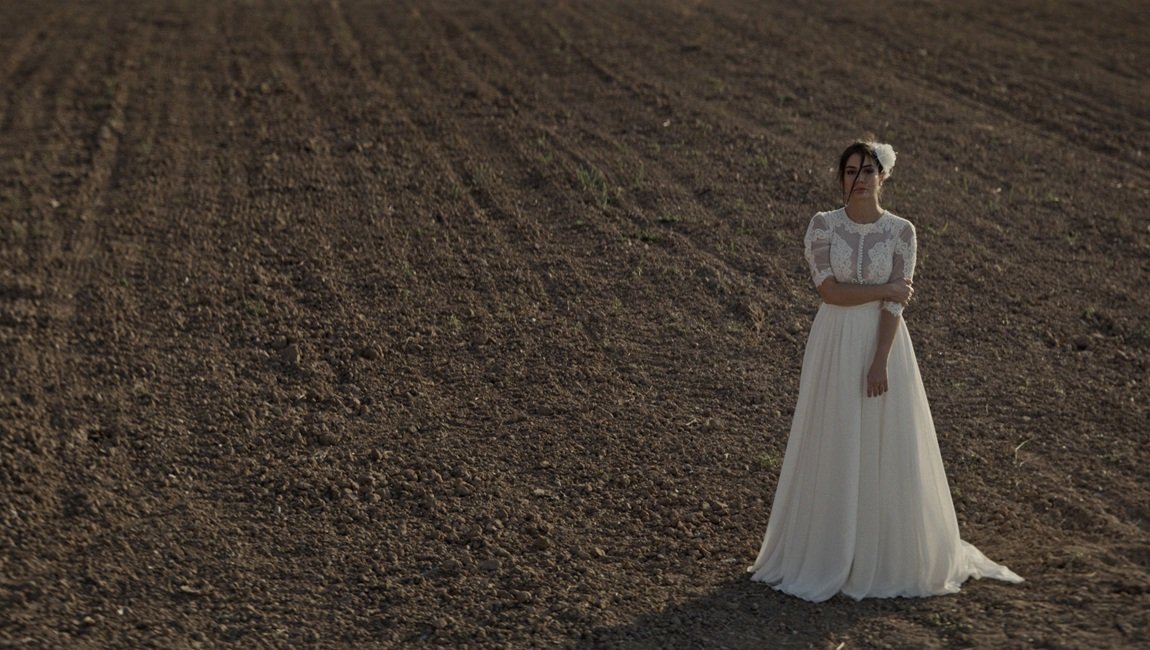
How to escape from the bottom of the barrel? In Ferit Karahan’s Djinn Wedding, a family in desperation moves into an abandoned house in rural Anatolia. A white horse lingers nearby, meteors fly through the sky, and the kids see evidence of dinosaurs in the fields beyond. A curse befalls them, two parents and four children apparently doomed to a life of misfortune. In this way, Djinn Wedding is a somewhat dour, pessimistic movie, save for a last-minute implied stab at hope for the aforementioned escape, though it’s not a film lacking in insight or intelligence.
Those who saw Karahan’s 2021 international breakthrough feature, Brother’s Keeper, won’t be surprised to discover that, but where that movie was taut and piercing, Djinn Wedding is loose and sloppy. Karahan casts his net too wide here, following several characters over three time periods; the jumps in perspective and period stymie emotional and thematic development. Holding it together is only the exploration of misery, the hardship that accompanies each and every family member through life in their own, uniquely punishing way. But without a clear catalyst or purpose, the gloominess quickly begins to feel gratuitous, and the haste with which promising storylines are abandoned holds emotional connection at a resolute reserve.
The first of the movie’s three chapters concerns the inception of the family’s woes, as illness brings tragedy and self-destructive vices are passed through the generations. The second takes place some 10 or 15 years later at the wedding of Deniz, the only daughter in the clan. Here, Karahan begins fleshing out these characters, and his talent for so doing reaps rewards — he’s particularly good at orchestrating a confluence of multiple internal conflicts and stances within both individuals and groups, and there are a few tense encounters that fizzle with the ambiguity and uncertainty of where they might lead. But, alas, they don’t really lead anywhere, as this chapter concludes with another tragedy, one glib and implausible, before chapter three leaps ahead a couple of decades. Here, the family’s fortunes are at their lowest, though a new generation offers the possibility of change.
All that this would require, Karahan suggests, is to dismiss the validity of the curse. One of the movie’s most persuasive qualities is its assertion that those most doomed to despair are those who invest in that doom, be it poverty, loneliness, or dogmatic spiritual adherence. Two scenes, mirroring one another, in the local imam’s car reveal a distrust for conventional authority that’s familiar from Brother’s Keeper; the imam is Djinn Wedding’s most keenly observed character. Karahan draws everyone, from the family members to the supporting parts, as powerless in some manner or another — and often several — their lives instead dictated by tradition, religion, money, the past, superstition, or their elders. Those who eventually claim power do so of their own accord, and must do so alone.
Most alone is Ceren, the eldest son, whose roguish, black sheep quality is oddly cliché for a movie that otherwise deals in more nuanced personalities. The focus on him forces a judgemental, faux-objective stance — as one man against the world, he has some substance, but as one man against the real people around him, with their real problems, he’s too insipid to inspire positive identification. This is one of Djinn Wedding’s most persistent problems — it’s hard to feel sorry for such sorry souls, and, by the time you do, Karahan has already moved his perspective elsewhere.
That restlessness is why this movie ultimately doesn’t work, and this fault is easy to diagnose due to the fact that Karahan’s better instincts are entirely observable. His sharp, unfussy compositional sense (there’s one long tracking pan that feels manufactured, but it’s an outlier), his canny blend of verisimilitude and dramatic urgency, his understanding of character and of how various distinct characters interact — all are present. They’re just scattered, nuggets of cinematic diamonds in a sea of misguided impulses. Karahan’s not quite at the bottom of the barrel himself, but, with his next feature, he could do with an escape of his own.
Published as part of TIFF 2026 — Dispatch 5.
Comments are closed.