
In This Dispatch
A Long Winter
Andrew Haigh has proven adept, at times exceptionally so, at crossing diverse conceptual landscapes. His relationship dramas, of both the young and queer (Weekend, Looking, All of Us Strangers) and the older and heterosexual (45 Years) variety, have a clarity of perspective and ready embrace of ambiguity that immediately set Haigh apart from his peers. His other films (and miniseries), like Lean on Pete and The North Water, combine — to thoughtful effect — similar, if much more subdued, treatments of queer identity, countered by amped-up explorations of homosocial dynamics in rugged physical environments. His perspective is open but piercing, and the result has been more than a decade of good and great films.
The Irish novelist Colm Tóibín’s 2006 short story, A Long Winter, is the basis for Haigh’s new film of the same name, though it shifts the setting from post-Civil War Catalonia to the 1950s American West. Haigh’s interest in the marrow-deep murmurs of marital strife, burgeoning homosexuality, and harsh natural landscapes makes a familiar, even custom-fit, home for Toibin’s story. It’s in these contexts that A Long Winter follows a young man, Mike (Fred Hechinger), whose repressed, alcoholic mother disappears without a trace into the blizzard-stricken wilderness. That choice will bring to light not only the deeper, darker secrets that fomented his mother’s dissatisfaction with life, but also, upon the introduction of a new houseguest, Mike’s burgeoning sexuality.
Thematically, Haigh feels right at home, but there’s an alien quality in his stately illustration of this hardened world. Where 45 Years operated on a knife’s brittle edge, expressing a marriage’s silent but brutal transition from status quo to disruption, here the forces underlying the strife between Mike’s parents Louise (Caitriona Balfe) and Lester (Ebon Moss-Bachrach) are telegraphed with a thud. Symbols of Louise’s dissatisfaction range from behavioral and linguistic (“A quarter of a century, gone,” she says of the passage of time since her marriage, with a snap of her fingers), to the literal (a hidden stash of Cosmopolitan magazines tease a life away from the mountains she’ll never have). Then, of course, there is the drinking. Haigh at least tells us right away that Louise hides things from her family. On one of their regular trips into town, she goes off by herself to a hardware store, only for Mike to find her tucked away at a bar. It’s played off as an innocent quirk, but in truth she, of course, deserves a little time for herself, away from the family.
It’s unusual in a film by Haigh for all these signifiers, no matter how clear their intentions, to feel so blatant. His deft weaponization of ambiguity in 45 Years, for example, builds up to a devastating final sequence in which Charlotte Rampling’s face wavers and quivers on and over the edge of an emotional rupture the viewer is left only to infer. Here, Louise’s intentions are a matter of simple explanation. Mike’s uncle (Martin Freeman) tells him she was always “restless,” a cliché of the dissatisfied mid-century housewife — but of course she loved Mike and his brother, Tommy (Kit Connor, visible for a few scenes before he leaves to fight in Korea), more than anything. Louise was dissatisfied with something greater and less concrete than mere marriage. In Haigh’s carefully constructed imagination, Louise is a calculated, rather than intuitive, mystery. The viewer has little room or incentive to wonder what beyond her marriage might have made her unhappy.
Both Louise and Lester are sketches of a familiar kind of mid-century repression, differentiated by their gender. Balfe’s performance thankfully deflects many of these signifiers’ regular thuds. In her few scenes, contained within the film’s first third, she is a volatile creature with a twinkle in her eye and a voice just shy of cracking. Moss-Bachrach’s performance is necessarily more subdued, but it also bears less conviction. His depths are there to an extent (though they fall under their own cliches of mid-century masculinity), but are plumbed by Haigh’s script with visible effort and less feeling.
Mike, on the other hand, is not addled with as many of the cliches of 1950s cultural hangups. He’s no tortured James Dean or perfectly quaffed Tab Hunter, though you wouldn’t be surprised to see either in a film like this (attendants to underdiscussed Winter Westerns will notice similarities to William Wellman’s late-career, Hunter-starring Track of the Cat from 1954). Hechinger, for his part, comports himself well as the film’s emotional core. In early scenes, his smallness of character materializes in an apologetic face and a tentative gait, as if he’s ashamedly aware of not making use of the space he takes up. When he eventually becomes one of the “men” of the house — despite taking on domestic duties in his mother’s absence — his confidence manifests in a noticeably more assured stance; shoulders back rather than hunched, eyes searching instead of darting. He even takes charge of searching for his mother, often alone, when the few townies willing to make the effort finally accept that it’s best for everyone to be rid of a woman like Louise.
Haigh grazes delicately against the question of Mike’s homosexuality. A young man named Jimmy (D’Pharaoh Woon-A-Tai) comes to live with Mike and Lester to do the domestic work they don’t want to do or keep neglecting. After a fleeting infatuation with a young police officer involved in Louise’s search, Mike falls harder for Jimmy, a quiet, brooding figure passed between families as an obedient domestic and silent absorber of underhanded racial and gendered insults. The relationship develops naturally, if not very passionately. The traditional markers of a budding romance threaten to bloom, but Haigh holds back — for what reason, it’s not entirely clear. Perhaps praise is warranted for taking an unconventional, less emotionally permissive tack, but it leaves the viewer wondering what exactly it was all for. There’s some mild titillation when Jimmy brushes against Mike’s erection as he dries him after a bath, but something firmer remains frustratingly out of reach.
It’s no spoiler to reveal that Louise doesn’t survive her disappearance. That was inevitable from the moment she left, a spiritual sacrifice to the wilderness and to the cage of domesticity. Haigh’s attention rests squarely on Mike, whose development from a complacent young man to something more active barely holds the film together, and it’s disappointing to see the director, master of subtlety and delicacy, falter under an overwhelm of convention. — CHRIS CASSINGHAM

Misty Green
Over drinks at a lounge in Hollywood, Chris Rock tells Rosalind Eleazar that if you go anywhere in America, there’s a chance that at some point in history, Black people weren’t allowed there. This scene is a key moment in Misty Green, a jagged, convoluted, and compelling star vehicle about many things, too many things. But this idea — of conditional access and opportunity for Black creatives in the entertainment industry — is always lurking in the background.
Misty Green is just Rock’s fourth movie in 23 years, a filmmaking career that began with the pre-Obama Black President hypothetical comedy Head of State in 2003. As a director, and even an actor, much of the brilliant, generationally important comedian’s work on screen could be characterized as good ideas on paper that suffer in execution. He co-wrote and starred in a Heaven Can Wait remake. He made a buddy cop terrorism thriller with Anthony Hopkins. He’s directed an Éric Rohmer adaptation about marital ennui. He starred in a Longest Yard remake with his SNL buddy Adam Sandler at the peak of his powers. He’s submitted himself as the Ethan Hawke to Julie Delpy’s own take on Before Sunset. He’s put himself in the center of an installment of the Saw franchise. And he made an auto-fiction Annie Hall with dashes of Spike Lee sermonizing and, literally, Tracy Morgan.
With the exception of that last film, 2014’s excellent Top Five (still his best), Rock’s fans have experienced a now familiar cycle of being intrigued by the potential of these can’t-miss elevator pitches, then invariably underwhelmed at the cinema. He’s a director and actor who feels like he is in a constant state of tension, torn between his highbrow personal taste, his political concerns, his projection of his audience and what they may want from a Chris Rock film, and his studio.
Misty Green has some of this DNA. It’s another great idea: a messy Cassavetes riff about a beguiling, former Emmy-winning diva who incites a reaction wherever she goes because she’s gorgeous, because she can act and sing, but she can’t get out of her own way. The film opens with Misty nearly out of chances and bridges to burn, with a week left to crash at the cushy beachfront apartment she’s been squatting in as a kept woman after her rich and powerful Hollywood producer lover died. The demand for housing incites a desperate pursuit of a job that can sustain her financially and jumpstart her career. You can imagine a version of the film that updates Hollywood Shuffle, a series of broad Chris Rock Show sketches sending up the contemporary industry as an oblivious, racist, and misogynistic nightmare factory. And the film doesn’t shy away from this critique, but its strength lies in holding Misty accountable for her hubris, poor social skills, lack of discipline, and bad decision-making.
This is because Rock found his Gena Rowlands/Llewyn Davis in Eleazar, a 38-year old “discovery” best known to American audiences for a supporting role in Apple TV’s spy serial Slow Horses, but who made a name for herself on stage in London’s West End. Even Slow Horses fans will be unprepared for this performance. As the Pilates-ripped, rage-coiled, eye-ringed, and smile-lined Misty Green, she is no longer an ingénue, but remains defiant of the expectations placed on a Black starlet at this perilous moment in her career. Misty refuses to settle down as a powerful man’s arm candy wife, play Hollywood’s game to make it conventionally by taking on shitty, uninteresting parts, or sell out to nefarious concerns on the margins of the industry to exploit her fame in the interest of safety and comfort. Eleazar is objectively a superstar here. Rock knows it, and in the first of his films that he isn’t at the center of, the director capitalizes on finding an actor in the zone with multiple audition scenes, karaoke performances, and tense confrontations that make Eleazar what should be an immediate, chiseled-in-stone, no-brainer Oscar nominee.
Rock has long had a preoccupation with Black celebrity, Black power, and the responsibility of Black influence within the context of white-led industries and spaces, going back to his first film — about a DC community liaison/alderman who becomes president — and running through his last film — about a Black celebrity with a lot of fellow ‘90s Black comedy star Martin Lawrence’s career in its construction. He is drawn to stories about Black people pushed to satisfy corporate and/or institutional (white) interests, who must wrestle with the compromise of self wrapped in monetary and status-based rewards. Misty Green is his most interesting protagonist to date to wade into this struggle. She is her own worst enemy, but Rock goes to lengths to show the routine indignities she’s subjected to as a Black woman who won’t take shit, relegated to chattel in this industry, and why her relationship to the stardom she ostensibly wants and the roles on stage and off it would require her to embrace is so fraught and complicated; why she subconsciously may be doing everything in her power to torpedo her own success.
Unfortunately, Eleazar has to be as good as she is because the film is in constant danger of flying off the rails of that idea without her grounding it. The supporting performances are near uniformly excellent — particularly Adam Driver, having a fucking blast as Mephistophelesian “director”/Epsteinish sex-trafficking drug dealer — but as a director Rock loves to let the camera roll regardless of the budget (a shoestring $5 million here), and as is historically the case in his films, the edit is rough, the seams are visible, and there are multiple plot threads he would’ve been wise to jettison. Chief among them is a B-story with Daniel Kaluuya as Misty’s brother who suffers from schizophrenia. Kaluuya is asked to play an American, with an accent he occasionally commits to, but more notably plays a mostly normal, charismatic, regular guy, which he struggles with until he’s not normal, where he excels. Rock clearly had a message to express and a story he wanted to tell about Black mental health, the non-existent social safety net supporting that community, and the unsympathetic police state constantly endangering it, but it’s also fair to ask why he felt the need to splice that movie into what would otherwise be a small, thorny, and wonderful character sketch built around an exceptional woman on the verge of collapse. But perhaps that’s the point.
Speaking of fair questions, let’s return to the aforementioned lounge and drinks. In this scene, you watch Rock’s palpable chemistry here with Eleazar and wonder why can’t that just be the movie? Why haven’t we gotten one of those per year from a writer and performer as entertaining, inventive, and capable as Rock in the dozen years since Top Five? Maybe it’s because he can’t find the greenlights; or like Misty, he refuses to make it easy. He has other things he wants to say, and after 12 years in the wilderness begging for this meager budget, he is concerned he may never get another chance to say them.
At the end of Top Five, Rock runs into DMX in jail, who repeats the refrain that has defined a career played out across multiple creative mediums: “One thing I really respect about you, why I fuck with you for real son, is you won’t let the industry box you in.” Then he barks Charlie Chaplin’s “Smile” through prison bars. It’s now unfortunately the second-best musical performance in Chris Rock’s filmography. The best is officially Rosalind Eleazar in Misty Green singing “One Night Only” from Dreamgirls, auditioning for the role that may finally get her the stardom she’s been fighting for on her terms. She throws her soul into it, and it is a heart-stopping moment delivered by a breakout star in a film full of them. What’s unfortunate, then, is to fold Rock’s preoccupations here into the discourse of Oscar forecasting: if Eleazar does end up getting nominated for this vital performance, she will likely still lose to a white woman. — ABE BEAME
Clarissa
Virginia Woolf’s seminal novel Mrs. Dalloway is a daunting candidate for cinematic representation, relying as it does on the detailed evocation of the inner lives of society hostess Clarissa Dalloway and military veteran Septimus Warren Smith via a non-linear narrative and stream-of-consciousness prose. In their sophisticated adaptation, Clarissa, sibling writer-directors Arie and Chuko Esiri add an additional layer of complexity by updating the setting to contemporary Lagos, with flashbacks to a 2018 military campaign against Boko Haram in northeast Nigeria and an idyllic summer vacation in Abraka (the Esiris’ hometown) in the 1990s. Anchored by a multidimensional leading performance by Sophie Okonedo, Clarissa impresses as both a feat of adaptation and a sharp analysis of contemporary Nigerian society. Where Clarissa truly lodges in one’s memory, though, is in its sensitive, sensuous evocations of transient intimacies and long-simmering regrets.
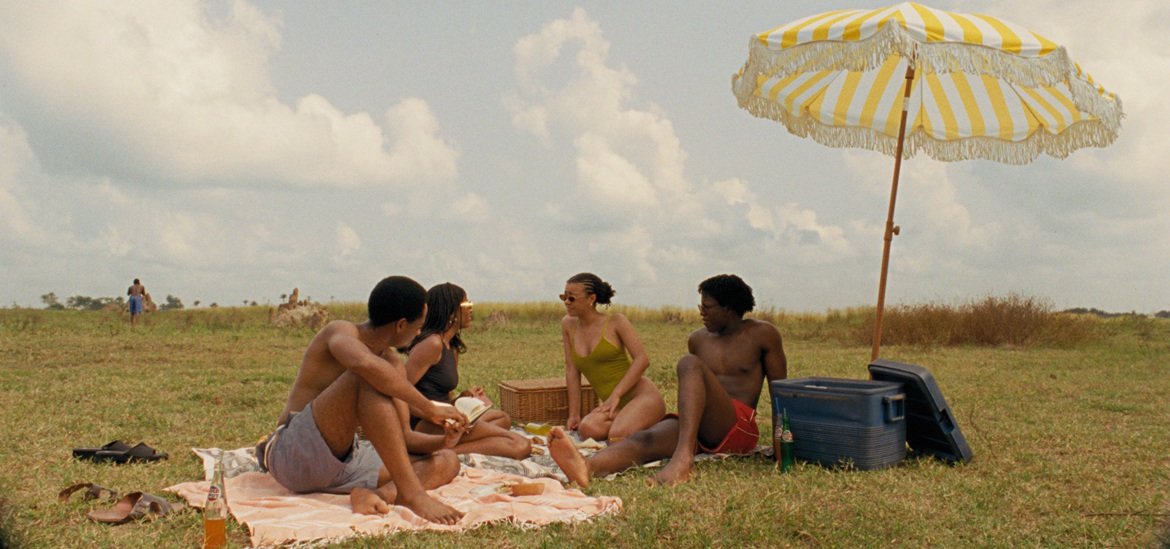
Okonedo plays Clarissa, a wealthy woman who is meticulously preparing for a party at her home — like all other major characters in the film, Clarissa bears the same first name as her counterpart in Woolf’s novel. A series of flashbacks, elegantly interwoven throughout the film, depict Clarissa in her youth (here played by India Amarteifio) enjoying a summer at her family estate with friends Peter (Toheeb Jimoh), Sally (Ayo Edebiri), Ugo (Kehinde Cardoso), and her future husband Richard (Jable Osai). In the present timeline, all four will be in attendance at Clarissa’s party, and the romantic entanglements and minor schisms that emerged during their youthful summer take on greater emotional weight with the accumulated years. Running parallel to, and briefly intersecting with, Clarissa’s storyline is that of Septimus (Fortune Nwafor), a longtime soldier who is unwilling to accept his diagnosis of post-traumatic stress disorder, which stems in part from a violent act he witnessed eight years prior.
The Esiris mine Woolf’s novel for veins of thematic richness, which they smoothly translate to the Nigerian setting, and shed light on Nigeria’s social mores through Clarissa and Septimus, who represent opposite poles of society: Clarissa is an educated, refined, and influential woman who speaks with a British-inflected accent that echoes her country’s colonial legacy, whereas Septimus occupies the untenable position of exhausting his body and mind through military service without any meaningful social support. Cultural and political complexities are threaded throughout the film; for instance, one of the film’s most striking scenes features young Clarissa and her friends discussing colonialism and feminism with intellectual passion, only to fall silent when Clarissa’s father joins their party and berates a servant for not wearing gloves while serving food. The Esiris’ clear-eyed depictions of issues surrounding class, gender, sexuality, and political strife do not overwhelm the personal arcs of Clarissa and Septimus. Rather, as in Woolf’s novel, these cultural concerns are inextricable from the characters’ personal lives, with Clarissa’s class and gender constraining her to a luxurious but unfulfilled life, and Septimus’ taxing life as a soldier bearing down on his marriage and mental stability.
While the narrative elements and structure of Clarissa are quite similar to Woolf’s novel, the Esiris do not attempt to translate the novel’s complex, deeply internal prose. Rather, they suggest interiority and interconnection through classical cinematic techniques, including close-up and montage. Okonedo and Nwafor’s faces, often shot in long takes in medium and tight close-ups, prove to be exceptional narrative instruments. Micro-expressions cascade across Okonedo’s face, communicating Clarissa’s suppressed but roiling desires; Nwafor expresses his character’s untenable emotional strife through a mask of brooding stillness, only for unvarnished vulnerability to burst through the cracks.
Scenes of dialogue highlight the actors through precise visual direction. Most notably, two central scenes see Clarissa conversing with Peter and Sally in the present timeline (played in their older incarnations by David Oyewole and Nikki Amuka-Burd). As a young woman, Clarissa had rejected Peter romantically and fell in love with Sally; the scenes of their respective reunions must then carry the weight of decades of unspoken longing and regret. Rather than the shot-reverse-shot setup, the Esiris stage these scenes with both actors in the frame, periodically shifting the focus between them. Through this technique, the directors foreground the actors who, with thoughtful characterization and grounded emotionality, deliver the scenes’ meaning, while transmuting Woolf’s fluid shifts in perspective to the cinematic frame.
Clarissa is well-crafted all-around, with Jonathan Bloom’s warm, textured 35mm cinematography and Kelsey Lu’s lilting score lending the film a sensuality that is at once dynamic and dreamy. Particularly effective is Blair McClendon’s intuitive yet precise editing, seamlessly weaving together the time-hopping narrative, and in montage — namely the city symphony-esque opening credits that depict scenes from a busy morning in Lagos — he and the Esiris vividly evoke the rhythms of the film’s physical environments. This enveloping craftsmanship and the film’s vast narrative sweep, ultimately, are all in service of Clarissa’s deep intimacies. Details about the characters’ histories and relationships build with steady accumulation, so that by the time the film reaches Clarissa’s climactic party, the viewer is primed to read decades of history in the smallest interactions between the characters — the late scene between Clarissa and Sally, especially, somehow seems to distill the totality of their relationship within but a brief conversation. So while it’s true that the narrative and thematic intricacy of Clarissa consistently impresses and engages, Arie and Chuko Esiri demonstrate that the most resonant complexities ultimately emerge in passing gestures and meaningful glances. — ROBERT STINNER
Comments are closed.