
Andrew Haigh has proven adept, at times exceptionally so, at crossing diverse conceptual landscapes. His relationship dramas, of both the young and queer (Weekend, Looking, All of Us Strangers) and the older and heterosexual (45 Years) variety, have a clarity of perspective and ready embrace of ambiguity that immediately set Haigh apart from his peers. His other films (and miniseries), like Lean on Pete and The North Water, combine — to thoughtful effect — similar, if much more subdued, treatments of queer identity, countered by amped-up explorations of homosocial dynamics in rugged physical environments. His perspective is open but piercing, and the result has been more than a decade of good and great films.
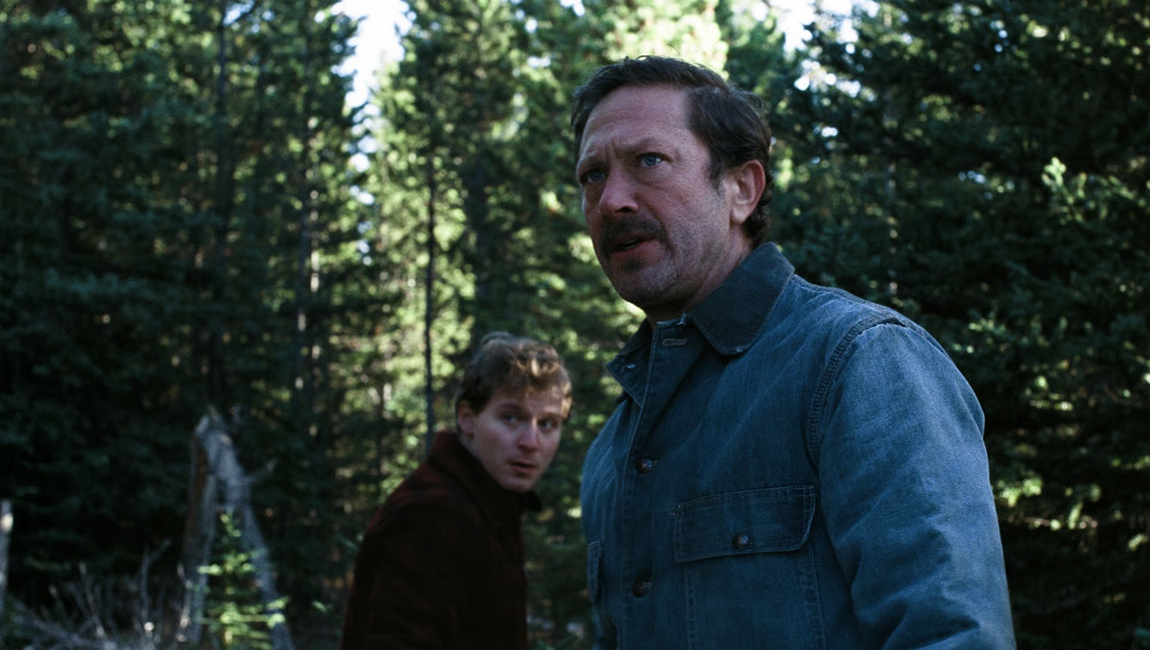
The Irish novelist Colm Tóibín’s 2006 short story, A Long Winter, is the basis for Haigh’s new film of the same name, though it shifts the setting from post-Civil War Catalonia to the 1950s American West. Haigh’s interest in the marrow-deep murmurs of marital strife, burgeoning homosexuality, and harsh natural landscapes makes a familiar, even custom-fit, home for Toibin’s story. It’s in these contexts that A Long Winter follows a young man, Mike (Fred Hechinger), whose repressed, alcoholic mother disappears without a trace into the blizzard-stricken wilderness. That choice will bring to light not only the deeper, darker secrets that fomented his mother’s dissatisfaction with life, but also, upon the introduction of a new houseguest, Mike’s burgeoning sexuality.
Thematically, Haigh feels right at home, but there’s an alien quality in his stately illustration of this hardened world. Where 45 Years operated on a knife’s brittle edge, expressing a marriage’s silent but brutal transition from status quo to disruption, here the forces underlying the strife between Mike’s parents Louise (Caitriona Balfe) and Lester (Ebon Moss-Bachrach) are telegraphed with a thud. Symbols of Louise’s dissatisfaction range from behavioral and linguistic (“A quarter of a century, gone,” she says of the passage of time since her marriage, with a snap of her fingers), to the literal (a hidden stash of Cosmopolitan magazines tease a life away from the mountains she’ll never have). Then, of course, there is the drinking. Haigh at least tells us right away that Louise hides things from her family. On one of their regular trips into town, she goes off by herself to a hardware store, only for Mike to find her tucked away at a bar. It’s played off as an innocent quirk, but in truth she, of course, deserves a little time for herself, away from the family.
It’s unusual in a film by Haigh for all these signifiers, no matter how clear their intentions, to feel so blatant. His deft weaponization of ambiguity in 45 Years, for example, builds up to a devastating final sequence in which Charlotte Rampling’s face wavers and quivers on and over the edge of an emotional rupture the viewer is left only to infer. Here, Louise’s intentions are a matter of simple explanation. Mike’s uncle (Martin Freeman) tells him she was always “restless,” a cliché of the dissatisfied mid-century housewife — but of course she loved Mike and his brother, Tommy (Kit Connor, visible for a few scenes before he leaves to fight in Korea), more than anything. Louise was dissatisfied with something greater and less concrete than mere marriage. In Haigh’s carefully constructed imagination, Louise is a calculated, rather than intuitive, mystery. The viewer has little room or incentive to wonder what beyond her marriage might have made her unhappy.
Both Louise and Lester are sketches of a familiar kind of mid-century repression, differentiated by their gender. Balfe’s performance thankfully deflects many of these signifiers’ regular thuds. In her few scenes, contained within the film’s first third, she is a volatile creature with a twinkle in her eye and a voice just shy of cracking. Moss-Bachrach’s performance is necessarily more subdued, but it also bears less conviction. His depths are there to an extent (though they fall under their own cliches of mid-century masculinity), but are plumbed by Haigh’s script with visible effort and less feeling.
Mike, on the other hand, is not addled with as many of the cliches of 1950s cultural hangups. He’s no tortured James Dean or perfectly quaffed Tab Hunter, though you wouldn’t be surprised to see either in a film like this (attendants to underdiscussed Winter Westerns will notice similarities to William Wellman’s late-career, Hunter-starring Track of the Cat from 1954). Hechinger, for his part, comports himself well as the film’s emotional core. In early scenes, his smallness of character materializes in an apologetic face and a tentative gait, as if he’s ashamedly aware of not making use of the space he takes up. When he eventually becomes one of the “men” of the house — despite taking on domestic duties in his mother’s absence — his confidence manifests in a noticeably more assured stance; shoulders back rather than hunched, eyes searching instead of darting. He even takes charge of searching for his mother, often alone, when the few townies willing to make the effort finally accept that it’s best for everyone to be rid of a woman like Louise.
Haigh grazes delicately against the question of Mike’s homosexuality. A young man named Jimmy (D’Pharaoh Woon-A-Tai) comes to live with Mike and Lester to do the domestic work they don’t want to do or keep neglecting. After a fleeting infatuation with a young police officer involved in Louise’s search, Mike falls harder for Jimmy, a quiet, brooding figure passed between families as an obedient domestic and silent absorber of underhanded racial and gendered insults. The relationship develops naturally, if not very passionately. The traditional markers of a budding romance threaten to bloom, but Haigh holds back — for what reason, it’s not entirely clear. Perhaps praise is warranted for taking an unconventional, less emotionally permissive tack, but it leaves the viewer wondering what exactly it was all for. There’s some mild titillation when Jimmy brushes against Mike’s erection as he dries him after a bath, but something firmer remains frustratingly out of reach.
It’s no spoiler to reveal that Louise doesn’t survive her disappearance. That was inevitable from the moment she left, a spiritual sacrifice to the wilderness and to the cage of domesticity. Haigh’s attention rests squarely on Mike, whose development from a complacent young man to something more active barely holds the film together, and it’s disappointing to see the director, master of subtlety and delicacy, falter under an overwhelm of convention.
Published as part of NYFF 2026 — Dispatch 2.
Comments are closed.