
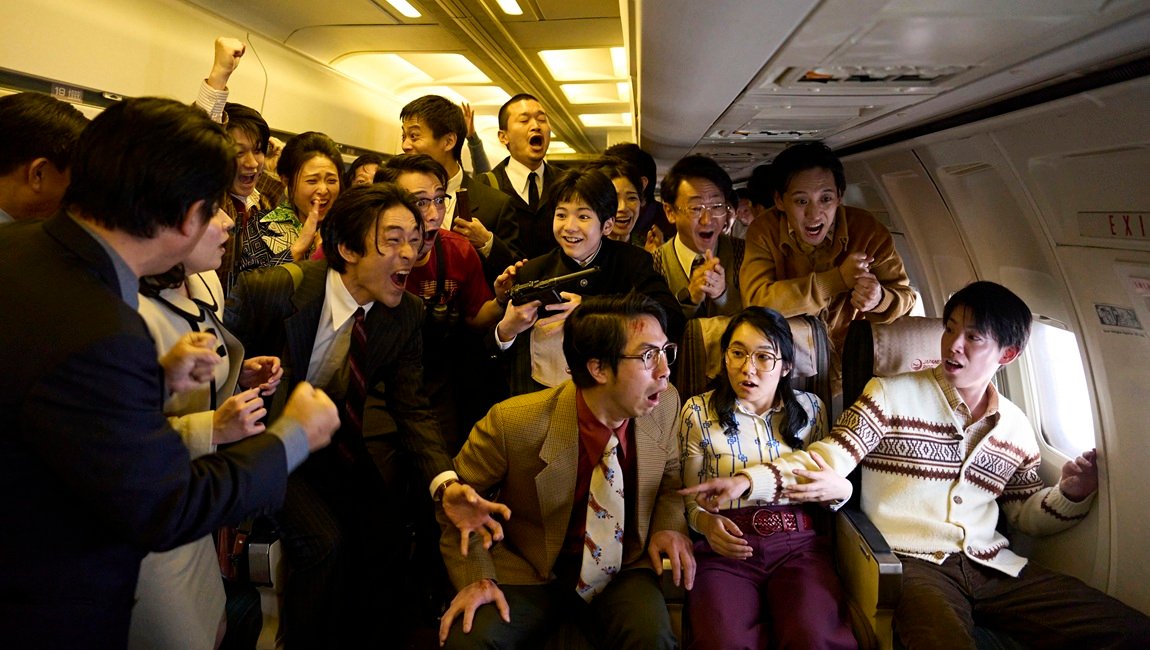
Good News opens with members of the Japanese militant communist group Red Army Faction — armed with pistols, katanas, and a bomb — hijacking Japan Air Lines Flight 351 and demanding that the domestic flight from Tokyo’s Haneda Airport be rerouted to Pyongyang, North Korea. It’s unusual and usually unwise to open a hijacking film with the actual criminal event central to the genre, but director Byun Sung-hyun, an expert in twisting genres to make them do new things, layers in both black comedy and a political thriller with his hijacking to scolding effect.
The hijacking of Flight 351 in 1970 actually happened. Good News gets the most memorable details correct, despite an opening narration mysteriously warning against the reliability of the events. The flight was hijacked by the young Japanese communists who sought a socialist haven, although the original haven of choice was Cuba before they settled for North Korea. (Likely for both narrative simplicity and nationalistic reasons, Cuba is never mentioned in the South Korean film.) South Korea, knowing the flight to the upper part of the peninsula would involve its airspace, stepped in to help Japan. It helped that their collaboration would please their American neo-colonizers, too. As portrayed in the movie, air traffic controllers gave false directions to the North Korean capital and unexpectedly rerouted the plane to Seoul, where the Gimpo Airport was transformed with the help of a movie director to look like Pyongyang in a naïve attempt to fool the young communists. The hijackers were even obsessed with the Ashita no Joe manga, as depicted by Byun.
Byun refreshingly spends more time scolding his own government and their American and Japanese allies than he does the Red Army Faction. In fact, the terrorists actually end up being the most undeveloped and ideologically void characters in the film. As the KCIA and Japanese authorities agree to let the flight go north and hope for the best, Korean Air Force lieutenant and expert flight controller Seo Go-myung (Hong Kyung) is the lone moral voice, a clean proponent of following the rules and still saving the Japanese citizens. The script also conveniently saves him from direct disobedience. North Korean dissident-turned-South Korean governmental problem fixer Nobody (Sul Kyung-gu) also earnestly seems to want to save the Japanese passengers, but he proposes a less than straight-laced way of accomplishing it. Their two moral means point to the same democratic end, with a capitalist victory over communism.
Good News’ black comedy cuts with both edges of its katana. This comes in how Byun scolds Korea and their allies for cowardice, imperialistic puppetry, bureaucratism, and blame-shifting, while also integrating considerations of race when a Black American soldier stationed in Korea becomes involved. He is made the subject of racial jokes after being spotted at the “Pyongyang” airport by one of the hijackers: Surely there are no Black people in North Korea… So is he from the USSR? Do they have Black people there? (He also plays a role in implementing the American ideology of racial subjugation by forcing Seo to break international air traffic law instead of doing it himself.) Coincidentally, the film’s Netflix release came the same month as Gyeonggi province adopted new anti-racial discrimination laws, the first such laws to exist anywhere in South Korea, and in this way the film’s black comedy concerning Blackness, in this context, points back with critical vigor to the Korean social climate. But the film’s insistent humor also consistently spoils the naturally compelling political thriller that exists within. Following suit with the slow Marvelization of the South Korean industry, every 10 minutes requires a joke, which only functions to numb the thriller at Good News‘ core with hemorrhoid jokes and random body humor, as when a character falls while on a life-or-death sprint or when a fat guy has to pretend to be a soldier.
Byun further develops the flashes of expressionistic direction shown in his underappreciated kinky sex comedy Whatcha Wearin’? and his more populist action flick Kill Boksoon. The most amusing example of that style comes the one time the thriller and comedy merge together flawlessly: North Korean and South Korean flight controllers duel to become the first to reach the stray flight on the universal emergency channel, and Byun envisions their one-on-one competition as a Western duel with firearms and all. The filmmakers also employ flashier techniques elsewhere, such as when North Korea sends warning shots and the Japanese communists in the cabin see not promontory cannon fire but celebratory fireworks. Intentionally playing fast and loose with truth and fiction as the opening text instructs, cinematographer Jo Hyoung-rae transitions the real artillery fire into the imaginary fireworks. That instinct toward maximalist spectacle courses through Good News, and ruins any chance it might have had at balance.
DIRECTOR: Byun Sung-hyun; CAST: Sul Kyung-gu, Hong Kyung, Ryoo Seung-bum, Takayuki Yamada; DISTRIBUTOR: Netflix; STREAMING: October 17; RUNTIME: 2 r. 16 min.
Comments are closed.