
“What are the stats on shark movies? Still just the one good one?” That’s a direct quote from perennial funnyman Paul F. Tompkins, made during his guest appearance on bad movie podcast How Did This Get Made?, where the topic du jour was 1999’s Deep Blue Sea. The colossal joke of comparing Renny Harlin’s maritime actioner to the unassailable masterpiece that is Jaws aside, Tompkins does make a salient point: how has Steven Spielberg’s shark film endured while so many others have floundered? That’s not to suggest that making a shark movie involves rocket science, but to observe that the strengths of Spielberg’s film extend to its indelible performances, lived-in setting, and his masterful control of suspense, aided in large part by John Williams’ iconic score. Jaws didn’t set the bar so as it invented the sport: any shark film that followed would always be destined to pale in comparison.
Still, that hasn’t stopped filmmakers from trying, as shark movies continue to be released like chum being thrown into the water, with the most notable recent efforts including the likes of The Meg, 47 Meters Down, and last year’s Dangerous Animals. Next up to bat is Thrash, which comes from the mind of filmmaker Tommy Wirkola. The director first made a name for himself in his native Norway with his pair of cult zombie films, Dead Snow and Dead Snow 2: Red vs. Dead, but he’s also helmed pop genre titles like Hansel & Gretel: Witch Hunters and Violent Night. Anyone familiar with his work will recognize he’s a fan of violence dosed with a helping of irreverence, but he dials back these more impish tendencies in his latest, playing Thrash as something more straight-faced. Sadly, that works against the film’s favor, robbing it of personality and leaving it to land as a derivative effort, filled with one-dimensional characters and laborious amounts of exposition.
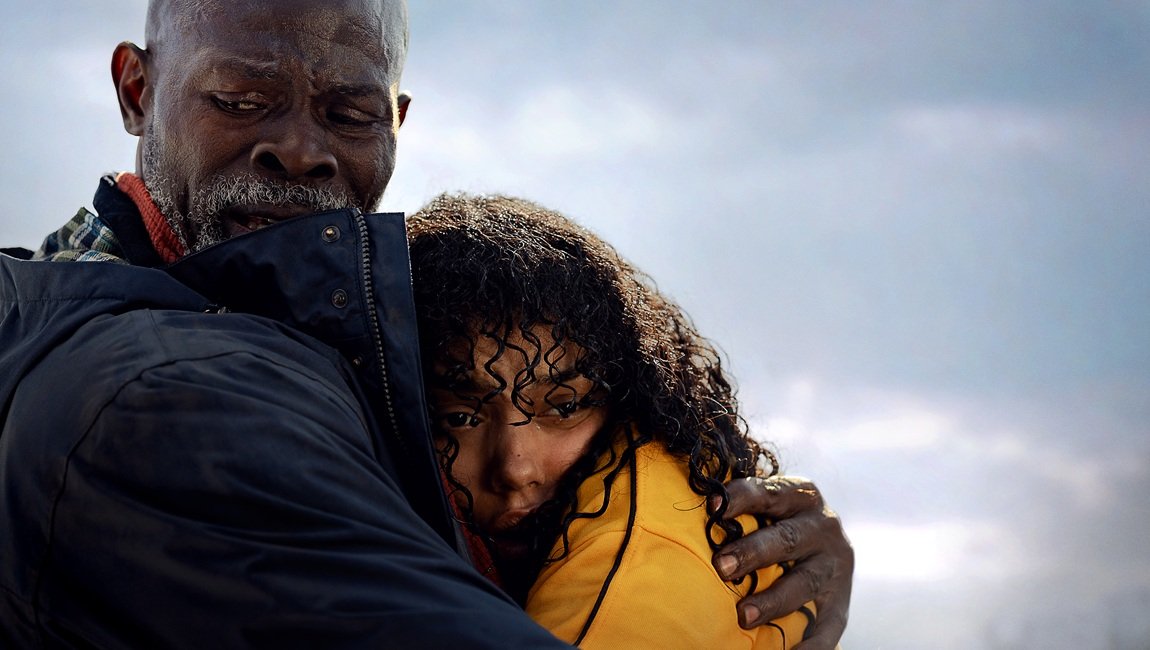
Things aren’t looking good for the town of Annieville, South Carolina, currently staring down the barrel of a Category 5 hurricane. While the more prepared citizens have safely evacuated, a few remain, including Dakota (Whitney Peak), an agoraphobic young woman reeling from the recent death of her mother. Also stuck in town is Lisa (Phoebe Dynevor), a heavily pregnant woman whose work duties kept her from being able to flee in time. On the other side of town are are foster siblings Dee (Alyla Browne), Ron (Stacy Clausen), and Will (Dante Ubaldi), forced to remain behind due to the poor planning of incompetent foster parents Billy (Matt Nable) and Rachel (Amy Mathews). Monitoring the situation at sea is Dale (Djimon Hounsou), a marine researcher and Dakota’s uncle. When the hurricane hits, the levees break and the town begins to flood at an alarming rate, forcing the survivors to keep themselves above the rising tides. But the water proves to be the least of the town’s worries, when a frenzy of bull sharks settle in for post-hurricane meal, drawn to the town by the bloody contents of a capsized meat delivery truck.
If “Jaws in a hurricane” sounds familiar, you’re not alone: Thrash has a shocking amount in common with 2019’s Crawl, a far superior picture that set its characters in a similar predicament, though they were tasked with facing deadly crocodiles rather than ravenous sharks. (Thankfully, neither share any real DNA with the Z-grade Sharknado films — small mercies.) Wirkola, who also wrote the screenplay, has brevity on his side with Thrash, which clocks in at a lean 75 minutes before credits, guaranteeing there won’t be much dead air for streaming audiences jonesing for the shark attack sequences as they settle in for the evening’s entertainment. But this tactic proves to be a double-edged sword, as Wirkola has to speed-run through an abundance of exposition to establish any semblance of characters, quickly shifting from the perspectives of Dakota, Lisa, and the foster siblings, each saddled with their own complications. For Dakota, there’s fear of leaving her home, finding herself crippled by grief anytime she steps one foot out the door. For the siblings, they face the neglect of Billy, who offers very little in the way of warmth or care for their livelihoods. But it may be Lisa who is actually going through the most, wrapping up work duties while awaiting a baby that could literally arrive at any moment, a precarious circumstance that only gets more complicated when a felled tree traps her in her car as the storm hits the town.
After the first rush of water settles, the sharks come out to play, but Wirkola does not linger on these beasts for too long, relegating their appearances to quick cuts and brief attacks as they lurch out of the water and hastily retreat into the shallows (the CGI for these creatures is, regrettably, none too convincing). Given the wreckage of the hurricane and the threat of its players being app, entree, and dessert for a shiver of apex predators, Thrash should be brimming with insurmountable tension, but unfortunately there aren’t any memorable characters to guide viewers through, just thinly sketched cut-outs with a knack for spewing profanities. In fact, these forgettables form a perfect metaphor for the experience of watching Thrash: all empty calories, ready to be consumed and immediately forgotten. Wirkola does work up to his ultraviolent ways for the climax, but it’s still a case of too little, too late, and the film’s final twist leaves viewers with nothing to chew on. So, what are the stats on good shark movies? Sadly, still just the one.
DIRECTOR: Tommy Wirkola; CAST: Phoebe Dynevor, Whitney Peak, Djimon Hounsou, Matt Nable, Andrew Lees; DISTRIBUTOR: Netflix; STREAMING: April 10; RUNTIME: 1 hr. 24 min.
Comments are closed.