
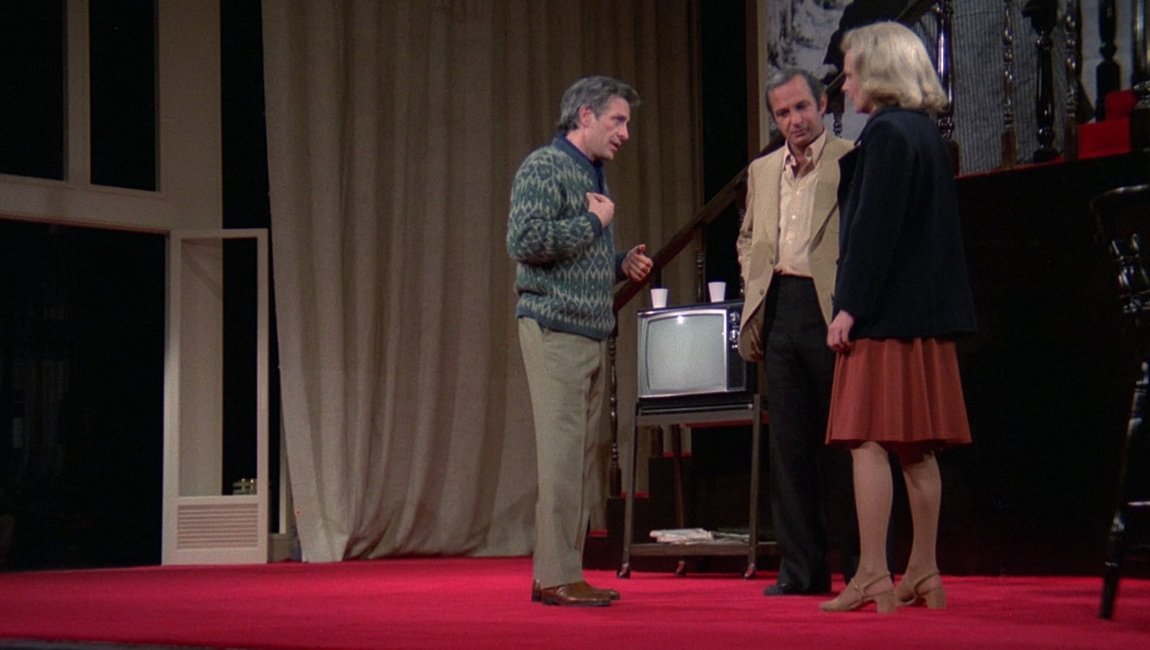
Myrtle Gordon, the actress played with dazed, turbulent ferocity by Gena Rowlands in John Cassavetes’ 1977 film Opening Night, struggles to articulate her problem with the role she plays during a difficult rehearsal: “She’s very alien to me… I seem to have lost the reality of the reality.” As Cassavetes indicates over the course of the film, there are several interlocking reasons for her struggle to perform — none of which are helped by her collaborators, who alternately flatter, ignore, and humiliate her — but her statement, early in the film, that she has “lost the reality of reality,” is an apt distillation of the film’s overarching questioning of what constitutes truth. With the play-within-a-play leaching into the “real world,” and the problems of the players slipping into the performance, the division between reality and fiction progressively blurs.
The film’s inciting incident was, fittingly, the seed of its initial concept, as stated by Cassavetes. Myrtle emerges from an early performance of a play entitled The Second Woman in New Haven, Connecticut, before it bows on Broadway, and is mobbed by fans, even in a rainstorm — most insistently by an adoring teenage girl whose face is largely concealed by a hood. The girl knocks on the window of Myrtle’s car and blows kisses as the car pulls away. Then, suddenly, she is run down and killed by a driver who does not see her standing on a median in the middle of the road. Myrtle was already compelled, and somewhat disturbed, by this girl, and her sudden, violent death becomes an expanding obsession in the days to come. “We started from the need of the autograph girl,” said Cassavetes, “to see what need that would reflect on this actress. The idea had always been: A woman sees herself in this young fan everything that she was when she first entered into the profession of acting.”
The play Myrtle is both rehearsing and performing is entitled Second Woman, written by playwright Sarah Goode (Joan Blondell) as a reflection on aging. The implication is that Myrtle is now being assigned the role of the “second woman,” who, because of advancing age, must now resign herself to the loss of her sexual power. The character seems to be older than Myrtle, but Sarah repeatedly insists that Myrtle should personally understand the role. Bluntly and ominously, Sarah states that it is “over” for both herself and Myrtle; inherent in this phrasing is that old age is a living death.
Myrtle, unwilling to accept her role as a menopausal woman — she believes, if she plays the part well, that no audience would ever believe her as a younger woman again — acts erratically in rehearsals and performances, often arriving drunk, and almost never sticking to the script. Off-stage, she has repeated visions of the teenage girl, Nancy Stein (Laura Johnson), whose death she witnessed. Though seemingly unsure whether the girl is a fantasy she can control, a hallucination, or a ghost, Myrtle accepts her presence, and uses her to connect with the vibrant, bold girl she thought herself to be when she first began her career.
Myrtle becomes increasingly unmoored, and her colleagues — among them hapless producer and Sarah’s husband David Samuels (Paul Stewart), frustrated director Manny Victor (Ben Gazzara), and Myrtle’s co-star and ex-lover Maurice Aarons (Cassavetes) — grow increasingly concerned, less for her well-being than the well-being of the play. The presence of the spectral girl grows more insistent, to the extent that Sarah introduces Myrtle with multiple psychic mediums, and that Myrtle has numerous knockout brawls with the girl, fighting to supersede what is ultimately a projection of her own youth. In one remarkable scene, we see one of these fights from Sarah’s perspective, so that Myrtle seems to be slammed repeatedly into a doorframe with no physical impetus. Myrtle’s ultimate quest, which her struggle with her own vision of youth is bound up with, is to find the “truth” of the play without succumbing to the fatalistic vision of age that Sarah has written — a daunting task which takes a clear toll on her mental and physical health.
Opening Night, a challenging, startling, and engrossing piece of work, was unable to secure commercial distribution when it was completed, and it received minimal press coverage. The review published in Variety is telling: “Cassavetes’ highly personal work will please his coterie of enthusiasts, but for general audiences it will be viewed as shrill, puzzling, depressing and overlong.” The commercial rejection foreseen by this un-bylined writer did come to pass, though Rowlands and Blondell managed to receive Golden Globe nominations, and it wouldn’t be more widely distributed until after Cassavetes’ death in 1991. Its reception, still, was largely uncomprehending, even when reviewed positively: Roger Ebert viewed the film solely through the lens of Myrtle’s alcoholism, and Peter Bradshaw, after another re-release, oddly referred to the film as a “meditation on the enigma and loneliness of being beautiful.”
It has taken until recently for Opening Night to be treated for what it is: an unrestrained depiction of an artist’s deep, searching quest for meaning, even to the detriment of her own well-being, and despite the attempts of those around her to assimilate her into a more manageable role. Cassavetes spoke lucidly about Myrtle’s central problem, which is that “she must communicate something hopeful to an audience, otherwise they will not listen.” Cassavetes shows the culmination of Myrtle’s goal in a bravura final sequence when, so drunk she is barely able to stand, Myrtle still somehow manages to perform in the Broadway opening, pushing through the play until she reaches the final scene. In this crucial scene, Myrtle and Maurice deviate far from the script, and perform with audience-pleasing abandon and childlike freedom. As described by Cassavetes, Myrtle and Maurice spontaneously decide that “we’re not going to project ‘death is the main thrust of this play,’ we’re going to project life, and put age in its perspective.”
Philosophically, the irrepressible artistry central to Cassavetes’ own filmmaking triumphs over the tightly scripted, pessimistic vision embodied by Sarah Goode. Ebert, among others, viewed the finale as an alcoholic breakdown — and it is indisputable, narratively, that Myrtle’s alcohol abuse reaches an apotheosis in this final scene — but even if one views Myrtle’s performance as Pyrrhic victory, she nonetheless emerges victorious by achieving the performance she strived for. Kicking and screaming, Myrtle drags reality into a fictive frame, and the audience receives her with cheers.
Comments are closed.