
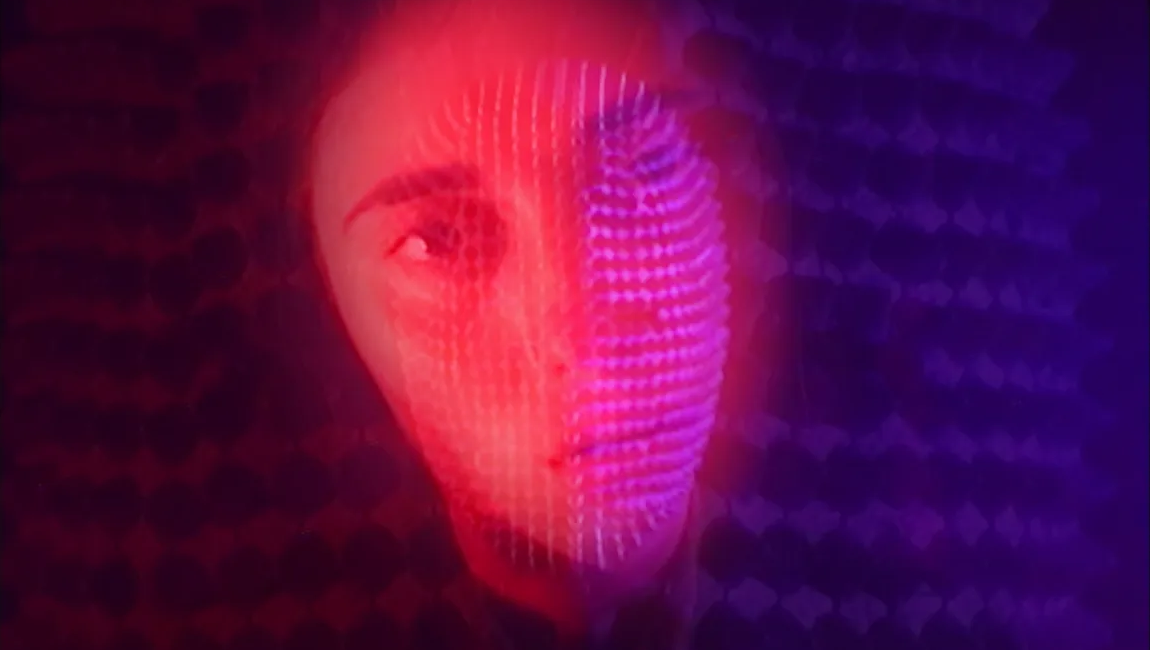
Josh Heap’s City Wide Fever is the best kind of micro-budget, DIY indie film, one that doesn’t attempt to hide its poverty of means but leans into its own roughshod, grungy aesthetic. Shot on a Sony DSR-PD150 (the same camera Lynch used for Inland Empire) by Ethan Johnson, Heap has crafted a gleeful homage to giallo films that doubles as a playful skewering of film schools and obsessive cinephilia. One of the more intriguing aspects of City Wide Fever seems to have happened almost entirely by happenstance; actress Nancy Kimball, cast as the lead character, Sam, left the production partway through. Heaps cast Diletta Guglielmi to replace Kimball, but kept the footage he and Johnson had already shot. This leads to a fascinating bit of Bunuelian surrealism, as the film cuts between both actresses and expects the audience to simply keep up and roll with the diegetic fissure.
The pixelated, artifact-heavy photography lends a wonderful incongruousness to the proceedings: a movie set firmly in the present tense that’s riffing on a genre that had its heyday in the ’70s & ’80s, shot on outmoded tech from the early 2000s. It’s a winning mixture of modes, and gives the film an identity beyond simple homage (it also separates City Wide Fever from other, more high-profile efforts like Censor, Knife + Heart, Berberian Sound Studio, or Amer, amongst others). As the film begins, student Sam (Guglielmi and occasionally Kimball) finds a discarded thumb drive on the street. She takes it home and plugs it in, only to find a treasure trove of archival material about Italian horror movies.
Of course, she knows Bava and Argento and Fulci, but one name in particular stands out: she’s never heard of Saturmino Barresi, who apparently predated them all, and disappeared under mysterious circumstances while scouting locations for what would have been his fourth feature, titled City Wide Fever. She takes a meeting with one of her professors, Keith (Onur Tukel), who claims to know virtually nothing about the filmmaker except that his onetime cinematographer now works at one of the few remaining sex shops in post-gentrified New York City. And so begins Sam’s odyssey of tracking down anyone with even a tenuous connection with the mysterious Barresi, a fraught journey that will lead to madness and murder.
Like the best giallos, Heaps isn’t so concerned with airtight narrative logic so much as stylish, moody sequences of stalking and occasionally gruesome deaths. Johnson accentuates this atmosphere by bathing scenes in blue, red, and green lights, the film’s milieu becoming more and more ostentatious as Sam traverses her own Heart of Darkness. As Sam meets more people and the bodies pile up, Keith will reveal himself to be both a creep and a liar, while Sam’s roommate, Chloe (Angelica Kim), might be more foe than friend. Is it a conspiracy at work, a truly cursed film, or is Sam simply losing her mind while wandering down rabbit holes?
Heaps and Johnson shot the film piecemeal over the course of two years, working from a loose outline and often making things up as they went along. Plenty of indie filmmakers can sympathize with this sort of haphazard production schedule, squeezing production into the cracks of day job obligations and when a handful of people are available to help out. In this regard, it’s amazing that the film is as coherent as it if, even as Heaps makes room for oddly funny interludes that add some local flavor to the mix. Goosing the vibe are quirky cameos from filmmakers Mike Bilandic and Larry Fessenden, well as some homemade special effects that are a hoot. But while the film has a sense of humor, it’s not some lightweight, tongue-in-cheek spoof. Heaps takes the genre seriously, and City Wide Fever culminates in a wild, vividly-colored cacophony of blood, rapid-fire editing, and shocking reveals. City Wide Fever reflects some honest-to-goodness guerrilla filmmaking, a true indie project that makes up for its lack of money with creativity, style, and an anything goes DIY ethos. Heaps’ film is a true gem.
DIRECTOR: Josh Heaps; CAST: Diletta Guglielmi, Angelica Kim, Hugo Alexander-Rose, Rutanya Alda; DISTRIBUTOR: Factory 25; IN THEATERS: April 15; RUNTIME: 1 hr. 13 min.
Comments are closed.