
When a long-suppressed work of art finally surfaces, it generates unexpected conceptual ripples. We understand that the work was made in a particular time and place, and that it is responding to the historical conditions of its making. But, of course, its delayed emergence causes us to consider not only what it can say to us now, but what sorts of messages might be in wider circulation if the suppressed work had been allowed to influence the work to come. A trajectory is interrupted, and we do our best to reactivate it in the present day.
The films made by the Chinese collective known as Structure. Wave. Youth. Cinema. Collective, produced in the ’90s, represent a heretofore missing chapter in the history of China’s independent documentary movement. The first film from the collective, 1991’s Tiananmen, was made just one year after Wu Wenguan’s Bumming in Beijing, the film often cited as having unofficially started the Sixth Generation’s documentary movement. And in fact, Tiananmen is the only one of S.W.Y.C.’s seven films to receive even a brief mention in the authoritative English-language text on the subject, 2010’s The New Chinese Documentary Movement, edited by Chris Berry, Lu Xinyu, and Lisa Rofel. This is by no means to disparage that invaluable scholarly collection, but only to point out how thoroughly the Collective’s efforts have been lost to time.
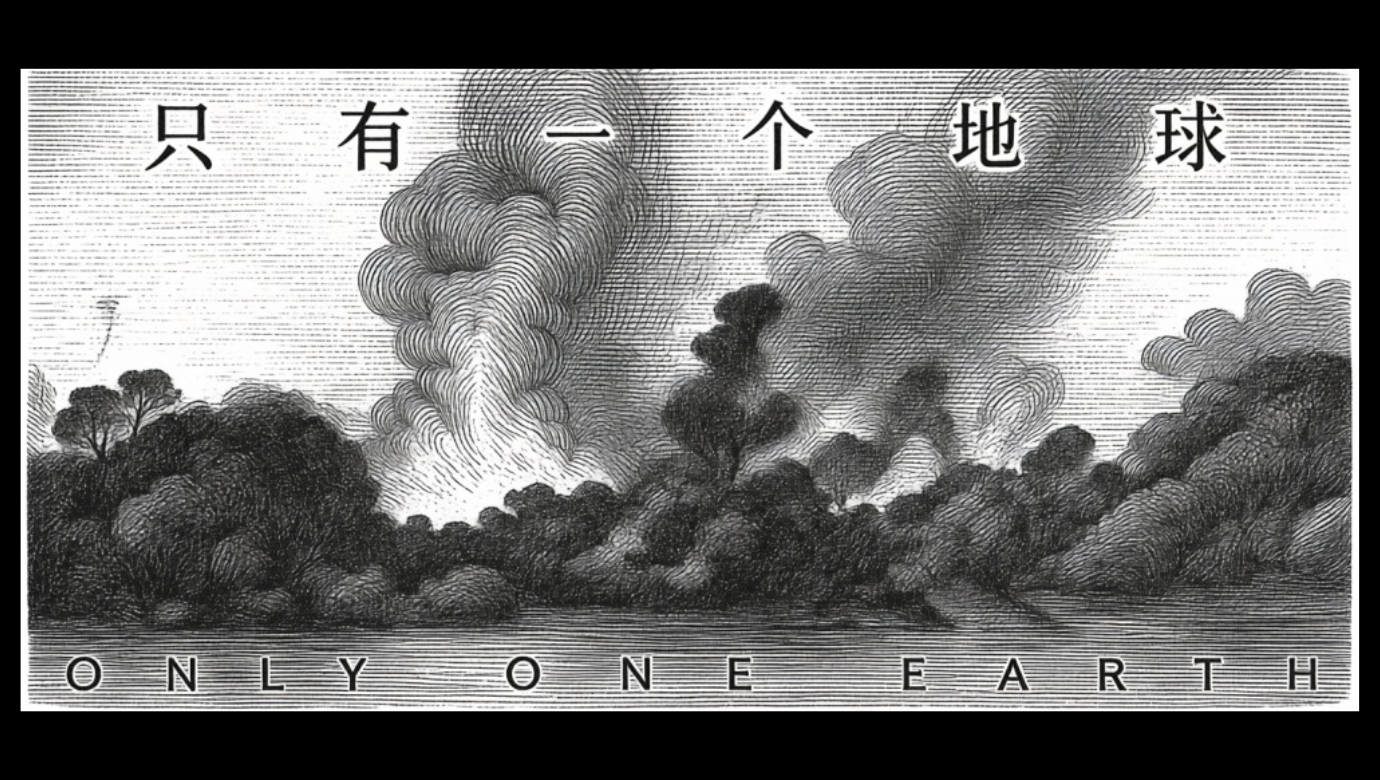
The four principal members of the Collective were associated with Central China Television (CCTV), and although some of their films were made under the auspices of China’s official media, most were censored and never broadcast, and those that did make it to air were severely compromised in editing. One such film was the four-part, 80-minute-long series Only One Earth, which was made in observance of Earth Day in 1990. The program, co-directed by Chen Jue (Tiananmen) and Jiu Ke, is a dense collage film comprised of found footage from international news reports and environmental documentaries, layered into an unsparingly cataclysmic portrait of a world in the process of self-destruction.
Various passages of Only One Earth, particularly in the first two segments, “Memory” and “Wound,” seem to speak directly to the period’s high-modernist tradition of protest documentary. The rueful narration and contrapuntal editing recalls the Chris Marker of A Grin Without a Cat (1977) and The Owl’s Legacy (1989), while the use of collision montage and superimposition for maximum horror and disorientation has much more in common with experimentalists like Canada’s Arthur Lipsett (Very Nice Very Nice [1961], N-Zone [1970]) and Armenia’s Artavazd Peleshian (Inhabitants [1970], Nature [2020]).
But it is not just Only One Earth’s formal organization that sets it apart. Its primary distinguishing feature is its tone, and this is what makes the film so bracing for the contemporary viewer. Chen and Jiu are detailing the various global decisions that are bringing about environmental catastrophe, and are doing so with an absolute faith in the power of their words, and especially their images, to startle and enlighten the audience. There is neither a shred of irony nor any hint of defeatism, and this is why Only One Earth feels like a vital message from the past. The acceleration of environmental degradation, after all, has been historically coterminous with the rise of the mass media, culminating in the Internet. (Ironically enough, the scourge of artificial intelligence represents the ultimate wedding of these two tendencies.) Skepticism and image fatigue have undermined our belief in the power of evidence to alter behavior and to change minds. The dominance in contemporary pop culture of post-apocalyptic fiction typifies this attitude, suggesting to the viewer that since we are powerless to avert the end of the world, we may as well turn it into entertainment.
Even a masterwork of Chinese documentary, Huang Weikai’s Disorder (2009), which in many ways borrows from the S.W.Y.C. sensibility, is shrouded in irony and black comedy. By contrast, Only One Earth echoes the films of British maverick Peter Watkins (The War Game [1966], The Journey [1987]) displaying a sense of urgency, and a belief that the course of global events can yet be altered through rational action. In its opening chapter, “Memory,” the film moves from the fall of the Mayans straight to modern, human-created catastrophes such as Minimata, the chemical poisoning of the Rhine River in Switzerland, and (in the second chapter) the Union Carbide industrial disaster in Bhopal, India. These very specific historical events are described in detail, usually with layered footage that is itself distressed and decayed, its physical substrate doubling down on the warning contained therein. And in most cases, Chen and Jiu show two channels of footage atop one another, providing mutual emphasis but also rendering the image partially illegible. The dominant message, as in Godfrey Reggio’s Koyaanisqatsi (1982), is one of “life out of balance.”
Part two, “Wound,” draws its name from a Japanese poem which states, “time heals everything except the wound.” This segment begins with a discussion of the U.S. Army’s use of Agent Orange as a defoliant in Vietnam, its environmental and human toll, and then turns its attention to environmental conditions in China. The film adopts a slightly different tone at this point, less accusatory and more factual. We learn statistics about the depletion of China’s topsoil, the air pollution released from the burning of coal, the pollution of the Yellow and Yangtse Rivers, and the nation’s annual production of 500 million tons of industrial waste. As you might expect, these disturbing events are not assigned a particular causal agent.
But as a work of argument, the movement from the first to the second chapter is incredibly skillful. It alarms the viewer by detailing the ruination caused by the West’s rapacious profit motive, and then gently turns the criticism back onto China, the implication being that the Chinese people — and by extension the Chinese Communist Party — have a greater moral commitment to reversing environmental destruction. Of course, one can assume that the criticism wasn’t taken all that gently, given the CCTV’s refusal to screen Only One Earth. But inasmuch as the Chinese censors had any specific agenda in suppressing the program, it probably had to do with the ever-decreasing difference between Chinese industrial capital and its Western counterparts. In these final years of the Deng Xiaopeng era, any demand for greater restraint in the energy and manufacturing sectors was an untimely message, to say the least.
This consideration might in part explain the rather different tone of the third and fourth chapters of Only One Earth. Where the first two parts combined environmental alarmism with absolute historical specificity, part three, “Life,” focuses on the African continent in a regrettably blinkered manner. This is the segment that leans in most heavily to the sorts of conventional appeals familiar from liberal Western media. The (presumably unlicensed) soundtrack, tracks from the Rendez-Vous album by Jean-Michel Jarre, is intensified here for maximum pathos, as we see footage of starving, emaciated “Africans” (no nations are ever mentioned by name), followed by scenes of traditional dancing tribesmen persisting through adversity. All we see are naked or half-naked bushmen, before the focus shifts almost entirely to African wildlife. An extended sequence of poachers and safari hunters — mostly but not exclusively white — emphasizes the human race’s role in depleting the animal population. But throughout, Chen and Jiu depict the African continent as a place with no coherent history, devoid of modernity, a perpetual global victim.
The fourth and final chapter, “Time,” appears to want to open the foregoing discussion outward, to consider ecology and biodiversity within the scope of human history. As it is constructed, however, this chapter skates across centuries, pointedly vague precisely because the first two segments were so exacting in their specificity. Instead of identifying particular events with acute, preventable causes, “Time” gives way to more existential pondering. After beginning with a discussion of the murders of George and Joy Adamson, two anti-poaching activists in Kenya, the narration retreats into generalities. “It is precisely this kind of death,” he states, “that compels us to rethink life.” We then return to the primordial ooze and the very beginnings of life on earth. In a few minutes, we are in the industrial age, visualized by early computer graphics of railways, satellites, and the rapid sprouting of skyscrapers.
Throughout Only One Earth, Chen and Jiu draw on cultural and literary figures for insights and epigraphs, including Shakespeare, Whitman, Tagore, Rachel Carson, and several citations of T.S. Eliot. This focus accelerates in the middle of part four, with a rapid-fire montage of human civilization. The Sistine Chapel, the Mona Lisa, Einstein, Edison, all leading to a consideration of Hitler and World War II. The filmmakers seem to be implying, in a vague and unsystematic way, a basic sympathy with the argument Horkheimer and Adorno set forth in The Dialectic of Enlightenment. They observe that the very tools humankind has employed to control its destiny — above all, reason itself — have devolved into their opposite, a rationality of means-end thinking that dehumanizes and degrades life itself. It is doubtful that the makers of Only One Earth could have gotten away with making that argument. Then again, to the degree that they hedged their bets, it was to no avail.
Despite its flaws, there is something piercing about Only One Earth, especially as we watch it today. It feels utterly out of step with our media culture, one that has embraced cynicism and regards any serious commitment with skepticism or outright scorn. This film exhibits a rare faith in its audience. It evinces both fear and care, and expects that we too will care, about ourselves and the planet, but above all about our children. Chen and Jiu could not make a program like this today, because it would appear hopelessly naïve to think that seeing evidence of the horrors we are perpetrating might actually prompt us to demand a course correction. Only One Earth is a missive from a past that still believed in the possibility of a future. It’s a past we must work to retrieve.
Comments are closed.