
The opening shot of Dutch director Jona Honer’s documentary Club Heaven plunges us into the heart of the “Playhouse” club in Chengdu. A perfectly symmetrical wide shot of the empty dancefloor resembles a kind of altar: a hefty circular lighting truss hangs above a cluster of glass-walled cubes, while dry ice billows upward in thick clouds. “Playhouse” is renowned as one of the world’s foremost EDM clubs, always primed for another night to ignite. But first things first: the briefing. As the general manager steps out in front of dozens of workers lined up like a military battalion, he launches into an uplifting-to-humiliating speech urging them to treat the job as sacred, while welcoming new team members who have only just turned 18. Club Heaven declares its focus from the outset on the nuances of labor, setting out to observe a nightclub in operation, from the highest chain of managers down to the girls whose job is simply to show up. From this flamboyant opening and the motionless shots of studious prep, a natural build-up toward some ecstatic release as the party time approaches is felt — only for the director to break those expectations, relentlessly yet ingeniously.
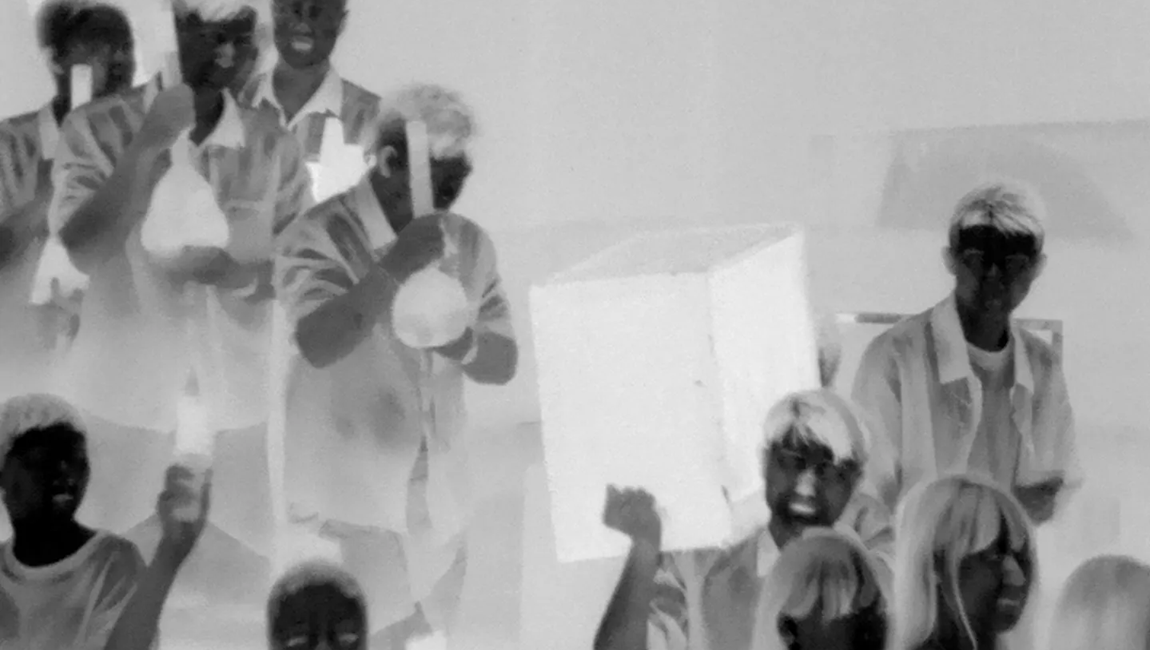
Once the film finally reaches the dancefloor, its camera switches to a thermal one, abandoning its rigid stasis for the freer movement of a handheld zoom that roams across the space. The inherent photonic specificity of the thermal optics, with its rough negative contrast, presents the dancers as a phantom, soulless throng moving in modest dance, while its focus stays with the very workers hyping sales. All this monitoring unfolds in dead silence, and the extended takes of several minutes imbue such scenes with ever-increasing disquiet. That is precisely the film’s strictly formalist and steadfastly devoted rhetorical stance: a leapfrog editing style that alternates between dancefloor and back-of-house, the latter dominating the runtime.
With the almost mathematical precision of roughly five-minute static long-distance shots, the camera observes the dark corridors, underwhelming lunch breaks, and eavesdrops on aggrieved conversations about miserable salaries, reaching for what might be called a bare-minimum Wiseman-esque quality of institutional portraiture. While the film’s synopsis promises that “the euphoria of some feeds on the fatigue of others,” it would be a stretch to define such a dynamic. The relation here is rather horizontal, the same moody register played at differing intensities across the entire club. It reads better as a rigorous attempt at a miniature metonymy of tough Chinese labor.
Club Heaven would make for an obliging programming company to Wang Bing’s Youth trilogy, devoted to the slow documentation of young migrant workers in Zhili. Here, too, some of the protagonists are migrants, and it comes as no surprise to hear Russian spoken in one scene. The Chinese nightlife industry is known to actively recruit white girls as dancers and party companions, both for the exoticism they bring and, primarily, to tap into the festive register of their Slavic origins. The film draws its best from its steady register in the scenes devoted to the female workers. It keeps returning to them being scolded for not looking cool or fun enough, then cuts to the thermal muteness of the dancefloor, where the fun feels a bit forced.
It is undoubtedly an original take on the club-set film, but as this alternating editing is so locked into its own rhythm, the film reaches its point too rapidly, while the thermal shots, however engrossing, grow predictable as the runtime wears on. There is something else Club Heaven‘s pedantry has to contend with by its very essence — namely, that it never lets us hear the music from the heart of the sound system. Honer’s assertiveness is here for a clear reason, yet the missing EDM bass drops and builds inevitably settle in as a stolen ecstasy. We do hear one song, though, and it arrives with bitter irony. At the film’s very end, a young female worker sits in the corner against LED projection walls of the sky and sings a tragically sentimental karaoke number, one which seems to exactly capture her mood after a long, overworked, underpaid night at the club.
Published as part of Visions du Réel 2026.
Comments are closed.