
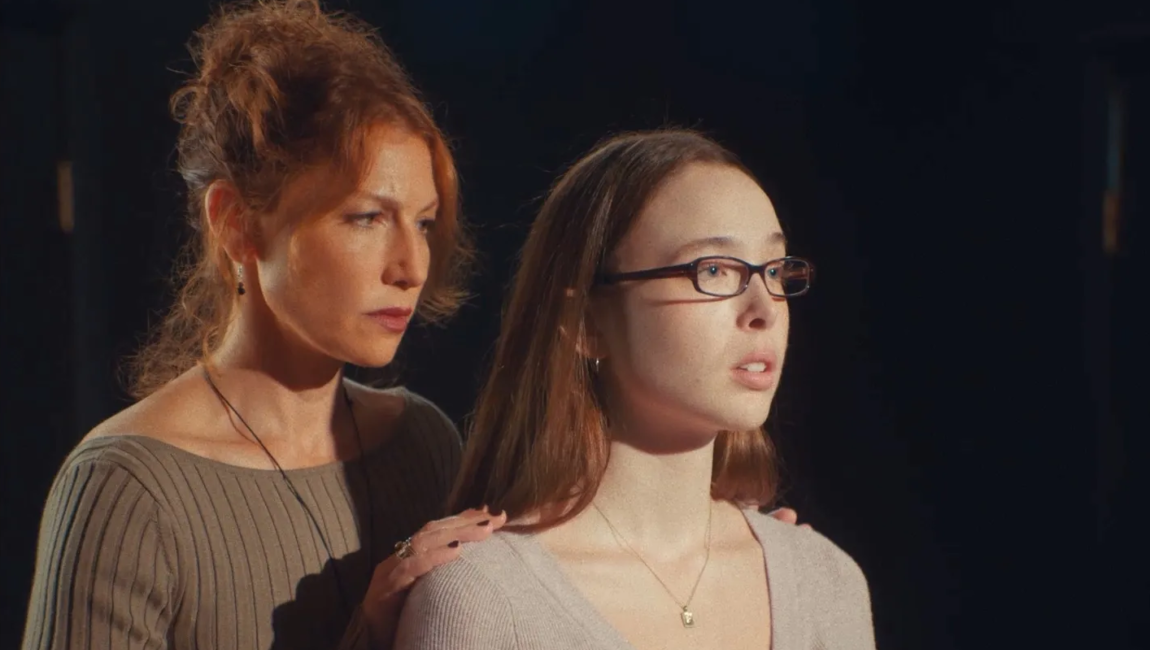
With her first feature since 2019’s Black Christmas remake, Sophia Takal’s Act One returns to some of the same obsessions and fascinations as 2016’s Always Shine, her breakthrough second film that detailed the disintegrating relationship between two actresses. For Act One, Takal draws from some of her own adolescent experiences as a burgeoning performer to craft a coming-of-age story about the desire to be seen and the dangers that stem from a fanatical pursuit of an abstract artistic ideal. Here, the volatile, ever-shifting power dynamics between 17-year-old Hannah (Ella Beatty) and her mentor, acting coach Melanie (Ari Graynor), become a powder keg of volcanic emotions and psycho-sexual violence.
Takal begins the film with a brief portrait of Hannah; we see her getting ready for school, her bedroom walls adorned with photos of Bette Davis and Ingrid Bergman, and a stack of books next to her bed featuring texts by Ibsen and Stella Adler. She’s serious, in other words, a quality that puts her at odds with her peers. She’s preparing for an audition, her last high school production before she graduates. But she’s devastated when she doesn’t get any part at all, even a small one, and is further incensed when her mom Julie (Elizabeth Reaser) begins passive-aggressively pushing her to get contacts to replace her bulky glasses.
Hannah is quiet, with few friends and parents who don’t seem interested in her passions. She only feels alive when she’s acting, the allure of pretending to be someone else allowing her to try out new, different personalities. Soon, Hannah is stumbling across an ad for the Act One actor’s studio, a local workshop whose website boasts testimonials from several notable alums. She decides to take a chance and checks out a class, immediately falling under the spell of the charming but mercurial Melanie. Of course, the attentions of fellow student Henry (Nate Mann), a handsome older boy, don’t hurt, either.
Much of the film’s first half patiently details Hannah’s gradual immersion into this eccentric, cloistered group; Melanie alternates between stern taskmaster and patient therapist, encouraging Hannah in one moment and tearing her down the next. There are echoes of Rivette here, with multiple sequences of group rehearsals and seemingly abstract movement exercises edited into hypnotic, borderline abstract montages. It’s fascinating stuff, but the cracks eventually begin to show once Hannah is invited to join a group within the group, a sort of exclusive club handpicked by Melanie to showcase only the best students. Soon, Hannah is doing poorly at school, focusing entirely on the acting classes and a burgeoning romantic relationship with Henry.
Things come to a head when Hannah joins the group for a weekend getaway; her mother is suspicious, but eventually relents and agrees to let her attend. But while she’s there, it becomes increasingly clear that Melanie is as much a cult leader as an acting coach. Graynor plays Melanie like a moody big sister, wise in the ways of the world but also insecure enough to play power games and manipulate those less powerful than herself. Of course, she contextualizes her actions as a necessary component of achieving artistic excellence, a small price to pay in pursuit of some ultimate “truth.” During the retreat, an uncomfortable sexual tryst represents a rupturing point in the narrative: Hannah’s complete submission to Melanie’s will and a full break from her “normal” life.
To detail more of the plot would spoil some late-breaking developments, but at a certain point, it becomes clear where things are heading. Hannah is trapped between her real mother and a surrogate one, each representing a life path that may or may not actually be fulfilling. Mixed in there somewhere is Hannah’s own dedication to art, and how far she’s willing to go to perfect her craft. In interviews, Takal has mentioned her interest in ’90s erotic thrillers like The Crush and Poison Ivy, and this influence becomes clearer as the film goes on. Act One is most interesting when it’s dialed in on the details of the craft, the material reality of attending workshops like this, and the switch from an introspective, psychological drama to a more straightforward genre piece is jarring. But Beatty and Graynor are both so good in these parts that you roll with it — Beatty, in particular, is a major talent, able to communicate a whole spectrum of complicated emotions with just her face.
While so many contemporary indie films seem determined to ape the slick, empty widescreen aesthetics of streaming or A24, Takal and cinematographer Robert Leitzell stick to the naturalism of the mid-2000s and early 2010s. A handheld camera and medium shots focus attention on the performers, while the editing does much of the work of building tension and destabilizing the audience. Act One isn’t as feverishly stylized as Takal’s own Green or Josephine Decker’s Madeline’s Madeline, but it’s hanging out in that same ballpark. Of course, Takal cut her teeth on the Mumblecore movement of that era, and it’s fascinating to see an artist return to some of the same subject matter a decade later with an older, more nuanced perspective on the adventurous follies of youth. Here’s hoping it doesn’t take another seven years for her next film.
Comments are closed.