
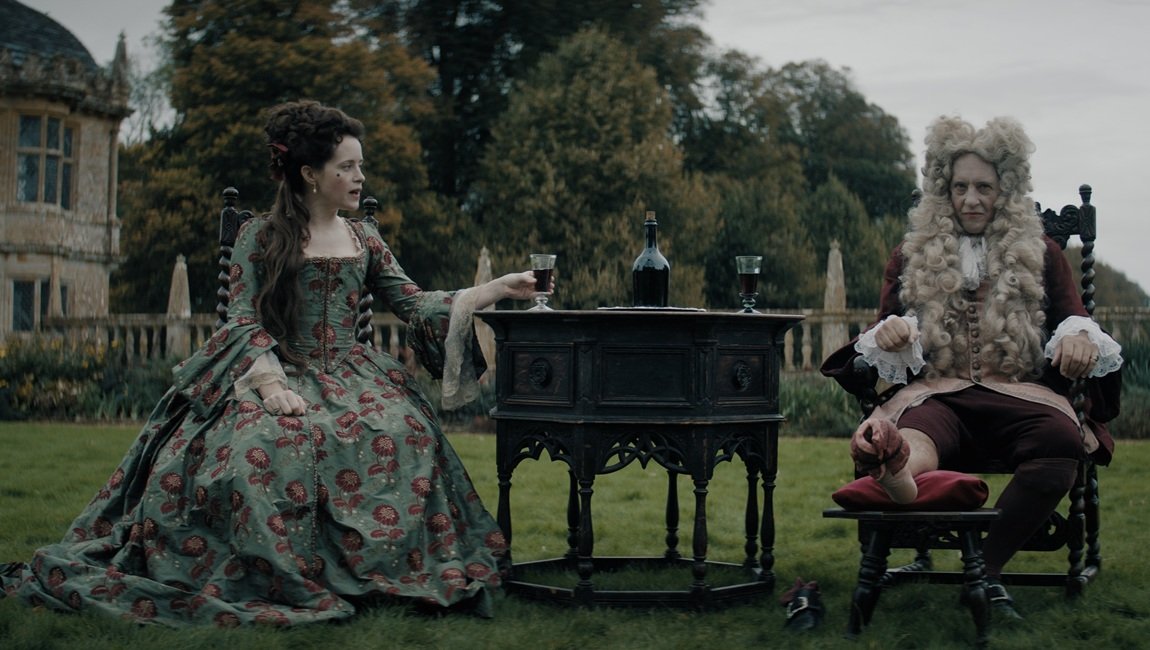
Any casual viewer of arthouse cinema from the past decade is likely to experience immediate déjà vu upon sitting down to watch Savage House: what does this profanity-laced satire of 18th-century British aristocracy, with ribald sexuality, comically frilly costumes, fishbowl-lensed shots, and an overall air of privilege gone to seed, remind them of? Even if this hypothetical viewer does not make the connection that the style, subject matter, and tone of writer-director Peter Glanz’s new film is a close approximation of Yorgos Lanthimos’ 2018 Oscar-winner The Favourite, they still may clock that Savage House plays like an accomplished facsimile of its inspirations. But while well-acted and entertaining on a scene-to-scene basis, Savage House never quite stands on its own, and loses momentum over its runtime.
Underlaid with novelistic third-person narration (delivered with sardonic panache by Robert Bathurst, who appropriately has a slew of credits as an audiobook narrator), Savage House finds its anti-heroes, Sir Chauncey Savage (Richard E. Grant) and Lady Savage (Claire Foy), in a sorry state. As the narrator explains, Chauncey was a social climber and libertine who Lady Savage, whose family name was already in decline, married for love. Decades later, Chauncey has driven them into debt, and their reputation is so poor that their only companions are their eccentric teenage daughter, their personal attendants, and a dull couple who occasionally visit for dinner. The Savages believe their fortunes have changed with the Duke and Duchess of Devonshire’s request to stay at their mansion on a tour of the countryside. Desperate to regain social standing, the Savages sell off precious heirlooms and risk their own health and relationships to prepare their dusty manor for a visit from royalty — all while pox, the Jacobite uprising, and a looming solar eclipse roil the country.
Glanz lays the pathetic state of his characters and setting on thick: the Savages are almost pitiful in their delusions of grandeur, and their environs are as filigreed and as rotted as a moldy wedding cake. Characteristic of period pieces on this scale, the detailed and admirably grotesque production and costume design by Gary Williamson and Alex Bovaird, respectively, often outshine the narrative proceedings.
Grant and Foy, for their part, dig into their desiccated characters with vigor. Grant gives a cartoonishly broad performance which seems at first to be dangerously unmodulated, but proves appropriate as Chauncey’s physical ailments and emotional instability reach near-farcical extremes. Foy’s performance could only be called subtle in comparison to Grant’s, as she indulges in her own fair share of mugging. Yet Foy expertly underplays any number of dry retorts she delivers to the hysterical Grant; as such, when the film’s humor succeeds, it does so largely because of Foy’s sharp instincts.
Glanz, who also edited the film, has a keen sense of timing, and moves the film along briskly scene-by-scene (often ending scenes with a sharp punchline). Where Glanz falters is in character and narrative development on a broader scale: he offloads too much characterization and backstory to the narration, and despite setting up a host of potential obstacles and complications to the Savages’ ambitions, he ultimately allows most of these to fade away into the background. A pair of scheming servants — played effectively by Jack Farthing and Bel Powley — at first appear to be central figures, only to quickly lose relevance in the third act, and the looming threats of pestilence and anti-government insurgency remain background noise for the film’s duration.
The ultimate question posed at the film’s climax, then, is the same as the question posed at the outset: will the Savages successfully host the Duke and Duchess, or will their social standing continue to fall? The Savages, though amusing, are archetypal rather than three-dimensional characters, so one cannot be expected to emotionally respond to their plight; besides, Glanz has so clearly telegraphed the film’s conclusion from the first that there is little suspense by the time the royals are finally expected to make their appearance. Savage House, then, ends in an anticlimax, with a much weaker satirical bite than Glanz likely intended. The largest thematic takeaway is that the trappings of titles and the aesthetics of status are often flimsy covers for moral and societal decay — and after years of eat-the-rich satires, including period pieces like Lanthimos’ aforementioned The Favourite, this proposition is not enough to hang a feature-length film on. Amusing as it often is, Savage House proves too insubstantial to leave a lasting impression.
DIRECTOR: Peter Glanz; CAST: Richard E. Grant, Claire Foy, Bel Powley, Jack Farthing; DISTRIBUTOR: Paramount/Republic Pictures; IN THEATERS: June 5; STREAMING: June 26; RUNTIME: 1 hr. 53 min.
Comments are closed.