
Hidden in a nook of the Île d’Yeu cemetery, the grave of Marshal Philippe Pétain has grown into a symbolic site of contention for the French state. Some fervent nationalists still trek to the island to lay wreaths at the resting grounds of the “Lion of Verdun,” who led the French army to victory during one of the bloodiest skirmishes of WWI. Meanwhile, others come to defile the burial site of the convicted head of the Vichy administration that oversaw the deportation of roughly 70,000 Jewish people to Nazi concentration camps. Successor Charles de Gaulle astutely captured this duality at the heart of France’s national conscience by describing Pétain’s life as “successively banal, then glorious, then deplorable, but never mediocre.”
As ironic as it is radical, French filmmaker Emmanuel Marre sculpted a relentless biopic of his great-grandfather Henri Marre, a staunch Pétainist if ever there was one. Portrayed as an overambitious and miserable sell-out by Swann Arlaud in his most striking role to date, this marginal apparatchik of the Pétain administration has “mediocre” written all over his face. With France in German hands after the Nazi occupation of 1940, the opportunistic technocrat weasels himself into a bureaucratic position in the Marshal’s puppet government, supposedly overseeing the massive unemployed labor force of the occupied territories. The real extent of his job is naturally far more damning, something that this verbose historical drama cheekily skirts around.
With its free-flowing cinematography, A Man of His Time floats through Henri Marre’s banal office culture, showing how their lethal operations were laid out in the vaguest of terms. Is it a Nazi cooperation or a collaboration? Will they be transferring, transporting, or removing the Jewish populace? Are they serving the interest of the French people or scratching the backs of German occupiers? By stubbornly ignoring the elephant in the room, Henri’s office vainly tries to keep up a pretense of normalcy, all the while morality and humanity gradually seep out of the frame. His staffers seem more concerned with optics, semantics, and the literal window dressing of their annexed office building than with the tragic outcomes of their bureaucratic efforts — an eerie corroboration of the adage that the death of one man is a tragedy, and the death of millions a statistic.
It’s then tempting to slot A Man of His Time next to Jonathan Glazer’s masterpiece The Zone of Interest (2023) in the category “banality-of-evil-dissected-by-laconic-arthouse-cinema,” but that logical connection barely scratches the surface of Marre’s remarkable solo feature debut, now screened in Karlovy Vary’s Horizons section after its world premiere in Cannes’ main competition, where Marre won the prize of Best Screenplay — another irony as Marre confessed his film didn’t rely on any traditional script to speak of. Loosely structured around archival correspondences between Henri and his estranged wife Paulette (Sandrine Blancke), Marre drags a lamentable melodrama out of his ancestors’ frustrated relationship, one that reveals how the careerist willingly exchanged familial warmth for an underwhelming ascent to the position of fascist middle manager. Even the terseness of the spouses’ increasingly colder letters underlines how compassion has vacated the building a long time ago.
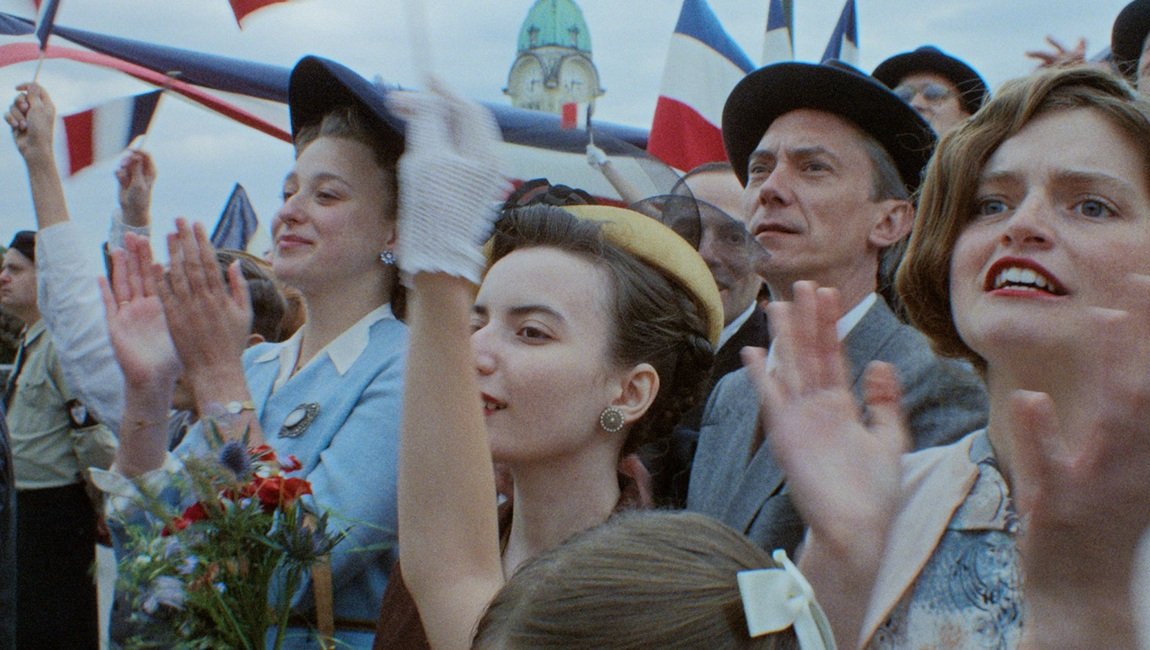
Following up on his rebellious anti-capitalist screed Zero Fucks Given, a highlight of Cannes’ Critics’ Week in 2021 co-directed by Julie Lecoustre, Marre has significantly upped his game for this vast historical reconstruction of Vichy France. Notably, the fidelity of returning cinematographer Olivier Boonjing’s imagery is undercut by Marre’s many stylistic interventions. With the flash always on, champagne parties look like they are snapped by urban paparazzi or salacious Instagram livestreamers. Popping out of their stuffy decors, you can see how the red-eyed and boozed-out French collaborators have drunk too copiously of a poison-tinged chalice that has endowed them with too much power, albeit for too briefly. Meanwhile, the regrettable fervor of swarming crowds of Pétainists is soundtracked by power pop smash hits like Opus’s 1984 “Live Is Life.” As of late, such anachronistic needle drops have been overused to the point of exhaustion, with Frauke Finsterwalder’s Sisi & I (2023) as the worst offender, but Marre manages to squeeze unusual pathos out of evil people dancing to idiosyncratic proto-digital tunes like Hot Butter’s “Popcorn.”
These ruptures of time and space ultimately serve to undercut the film’s international title, cannily acknowledging that Henri Marre could be a man of any time whatsoever. When contemporary French politicians, including Emmanuel Macron, still honor the legacy of Philippe Pétain, it’s safe to say that the ghosts of the Vichy regime linger in the corridors of present-day France. People like Henri Marre can still be found in any administration that sees to the comfort of one group of people by throwing the undesirables under the bus. Cinematically challenging the patrimony of his great-grandfather, Emmanuel Marre has crafted a roaming indictment of a moral vacancy which allows a select few to rise to the occasion, at the expense of our shared humanity.
Comments are closed.