
It was in December 1923, only months after military dictator Miguel Primo de Rivera had seized power amidst the ongoing systemic crisis of Spain’s Restoration period — the Restauración borbónica — that informalismo painter Antoni Tàpies was born in Barcelona. Throughout his lifetime, he remained a son of the “City of Counts,” an environment that, from early on, taught him to lead a life in defiance. Not so much to the Second Republic, which brought about important economic and socio-political reforms for the country and the Generalitat for Catalonia — the institutional system that granted El Principat a certain political autonomy — but to Franco’s decades-lasting dictatorship. In the early 1940s, in the aftermath of the Spanish Civil War, which, to Tàpies, was concomitant with the aftermath of a cardiac attack induced by his tuberculosis, the Catalan, still in his late teens, withdrew to a sanatorium in the mountains of Sant Quirze Safaja just outside of Barcelona. (There exist differing accounts as to how these health-related issues actually unfolded). Isolated from the outside world — from World War II, the upheavals of Francoist Spain, and, not least, from fellow youth — Tàpies devoted much of his time to philosophy and poetry. It was in this period, within the enclosed walls of the Sanatorio de Puigdolena, that Tàpies developed a serious interest in drawing and murals in particular — a penchant that would later manifest in his pintura matérica works, so-called matter painting that featured marble dust, sand, earth, and household detritus.
All this, and much more, is entailed in Albert Serra’s Faith Lacking Deed Lies Dead, a film, he says, “for the world of contemporary art,” commissioned by Barcelona’s Museu Tàpies to commemorate the painter’s centennial, and first screened at the Filmoteca de Catalunya in May 2025. Naturally, though, one wouldn’t be able to tell — no one, at least, who’s not amply familiar with Tàpies — for the Catalan auteur couldn’t be less interested in bringing his subject closer to his audience. Rather, not so dissimilar to the experience of reading a particularly challenging translation committed to retaining a sense of its own translatedness, it is up to the viewer to find their own entry into Tàpies’ work. Though this is easier said than done, for Serra’s not-quite-hour-long cinematic collage treads an almost comedic line of tension between salutation and contestation. Take the corrugated metal shutter known from Tàpies’ seminal assemblage Porta metàl·lica i violí (1956), which, in the painter’s work, salvages the exhibit’s materials in an attempt, as Manuel J. Borja-Villel puts it in his commentary, “to reveal the spirituality that exists in the lowest forms.” Serra now repurposes the corrugated metal as the matter of his central locus, a shack-sized shipping container situated in some hinterland, whose rib profile evokes Tàpies’ work and houses Serra’s regular Lluís Serrat. Does it bear mentioning that there is no semblance between Serrat and Tàpies? His impromptu acting, meanwhile, appears much more like a reaction to the subtitle chunks than an origination of them, not unlike in silent film. At the same time, Serrat’s positioning resignifies the role of the corrugated metal. Rather than evoking the possibility of the leftover material, it here features to almost suffocating effect.
As for the accompanying — the complementing? the objecting? the commenting? — subtitles, Serra boasts in a no-longer-than-necessary interview with FID Marseille, where the film observes its international premiere, that more than 2,000 of Tàpies’ paintings were scanned for his handwriting. It’s an extraordinary effort that sounds about right for someone who regularly “overshoots” up to hundreds of hours per project (as has been bruited, it was Serra’s propensity for footage amassment that ultimately kept Out of this World from premiering at this year’s Cannes). From these scans sprung a rich pool of fragmentary writing, of which, in an otherwise dialogue-free film, a fraction ended up in the sparsely used subtitles. As if to postulate Serra’s own conception of adaptation, the quoted words, incidentally, form a lineage: from “I Betrayal” (“trahir”) to “VII Freedom” (“lliberté”) — in a recent talk with Chinese director Bi Gan on AI and literary adaptation at Shanghai, Serra reasserted that any adaptation of note must betray its source material. Which is, of course, only to reinforce that for the Catalan, the age-old adage “Traduttore, traditore” has never been merely descriptive, but a career-spanning imperative.
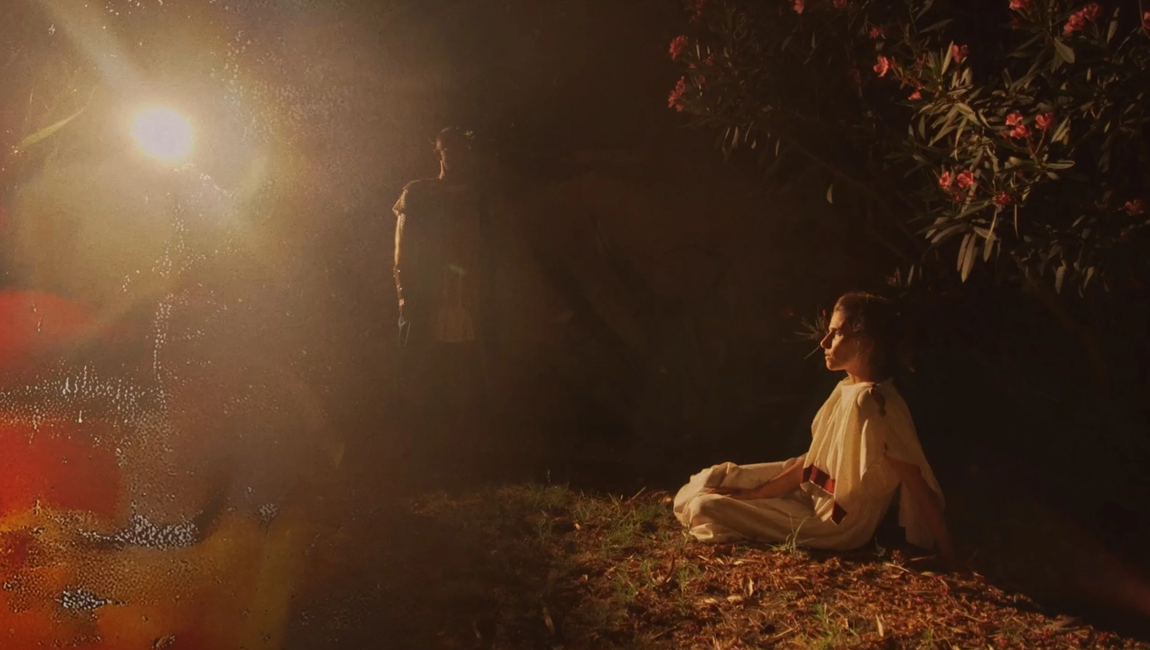
The aforementioned tension, meanwhile, is upheld throughout. Whenever elements of Tàpies’ work insinuate themselves to the fore, Serra finds a way to expand, to complement, to challenge. Most consistently, this manifests in beautiful digital superimposition that adds patterns, textures, and colors to the surfaces. When, for instance, the subtitles mention “the tree of the door,” one of Tàpies’ artworks featuring his signature material fissures is projected onto the door of Serrat’s shipping container. Later, mere panning effectively coats a dress in new colors. All the while, the camera remains in movement: sometimes through seemingly accidental movements, sometimes through very deliberate tilts that remind the viewer of the control a filmmaker exerts over the way their images are being seen. For Serra, whose words have never betrayed false modesty or humbleness — “People are stupid and grotesque: they do not know that the editor [Román Bayarri] and I understand Tàpies’s personality and work far better than the greatest academic experts; we have studied them very, very closely since we were young” — a cinematic adaptation, be it through expansion of time in Don Quixote, an unexpected encounter between Casanova and Dracula, or the gradual demise of the Sun King, commands a counterweight.
It is for that reason that calling the sixth and penultimate section of Faith Lacking Deed Lies Dead Serra’s way of showing off would be only partially correct. There, when the screen is suddenly tinged in bright and seemingly liquid colors, merging from an atomic mushroom to Tàpiesian imagery, Serra not only exhibits the possibilities of the motion picture, but also contrasts the painter’s materialism with digital fluidity. And still, while calling Serra’s cinema “generous” would not seem like an altogether natural proposition, there is something sincere in the iconoclastic impetus underlying it. If only in the attempt to meet his subjects at eye level, as equals.
Published as part of 2026 FIDMarseille — Dispatch 2.
Comments are closed.