
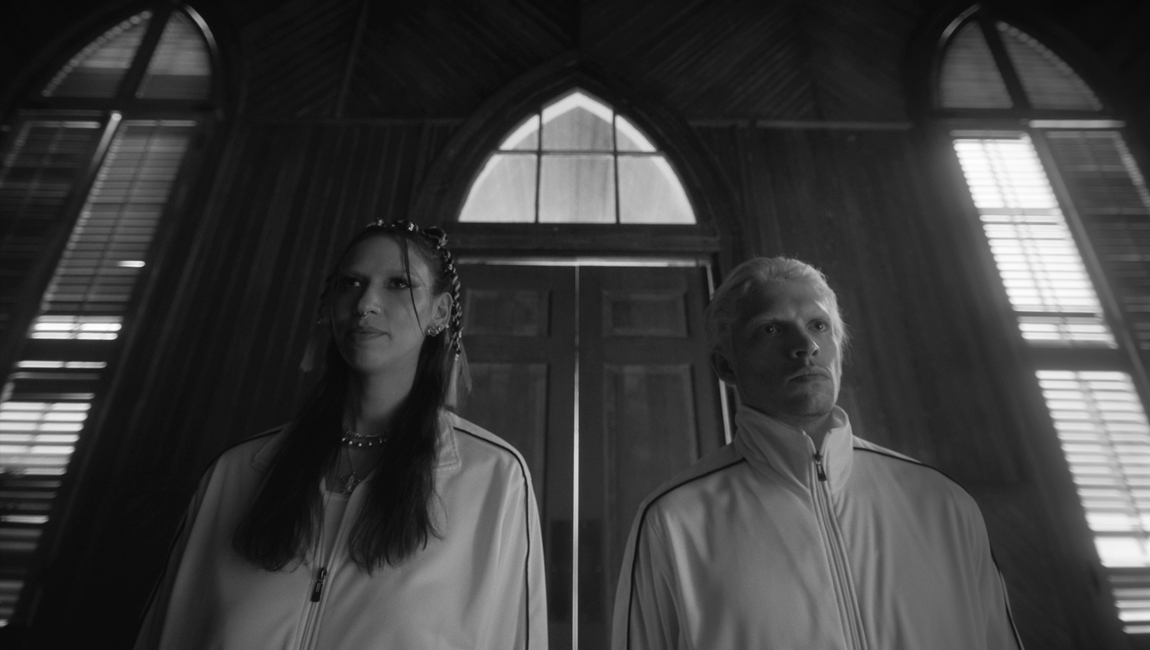
In Mark H. Rapaport’s Godhead, the world would seem to start and end between the walls of the church. In fact, this specific church commands such a presence within its small community that its priest (Al Warren) is known to his congregation simply as Father. Father keeps modest quarters for himself on the church grounds; he speaks in a meek, gentle drawl that inspires enough trust for parishioners young and old to flock to his pulpit for advice and safety. So, when two strange twins arrive at his steeple with a loaded gun, the boundaries between light and dark, sin and purity, seem as clear as the film’s cutting black-and-white photography. That is, unless, Father harbors sins of his own.
Godhead is a slim and severe chamber drama that leaves little room in its dank halls for God himself. Belief, in Rapaport’s world and in our own, casts a shadow under which power and paranoia congeal and fester. It makes for a powerful swill for Father. Before the twins arrive, we learn that Father has kept his son, Matthew (Luke Speakman), locked within the church house since birth. Father writes and performs Matthew’s universe, preaching doctored sermons and looping tape-recorded sounds of apocalypse outside his doors and windows to better sell a fear of the secular world. “What’s a strawberry?” Matthew asks when Father treats him to a bit of fruit. Matthew’s world is impossibly claustrophobic; cinematographer William Babcock’s crisp black-and-white, set to Academy ratio, renders it even tighter.
Father’s sins enjoy roots in delusion, but the mysterious twins who greet him in his parish prove a worthy match. Dressed in matching jumpsuits and styled like a Gen Z Die Antwoord, the twins approach Father with a request. They believe that one of them is the holy spirit made manifest, and Father must use his divine judgement to decide which one it is, kill them, and let their spirit ascend.
.jpg)
Godhead’s four-handed cast is evenly remarkable, but it’s Rapaport’s script that elevates the film from low-budget festival fodder to a considered, dogmatically rich text. It quickly becomes clear that the twins, who call themselves Firstborn (Sarah Coffey) and Secondborn (Kimball Farley, find a firm leader in the former. Firstborn seems at first a radical eccentric but reveals herself to be a calculated menace, countering Father’s liturgical arguments (the Holy Spirit can’t be a person, after all) with her own poisoned doctrine. And, like Father’s, that doctrine proves itself an able vehicle for control and abuse.
Rapaport’s premise is a compact foundation fertile for an examination of the ecstasy of faith and the binds of religion. Godhead isn’t unique in its plot — Bugonia leads a pack of films that similarly explore righteously deluded kidnappings — but its questions are meaty and sink deep into religious texts. When Secondborn is revealed to have been developmentally disabled in the womb, Father and Firstborn’s tête-à-tête shifts gears into a war between vessels of abuse, each equipped with their own vicious creed and sick history. Father betrays his own path to purity by tempting Secondborn with the fruits of Leviticus; Firstborn lobs evidence of Father’s lurid predilictions and admits to her own incestual control of her brother. To watch them spar is to watch an arm-linked spiral toward hell, with Secondborn and Matthew teetering perilously on the edge of the abyss.
For all its heavenly bluster, Godhead remains as sober as a priest until its third act. When it does pivot toward the divine, evoking miracles, roiling in beatific revulsion, and opening its gates toward religious horror, the assuredness of Rapaport’s otherwise muscled script loses a bit of its footing. The transition from lockjawed Kammerspielfilm to charismatic horror isn’t jarring enough for the movie to fall from grace, but it’s tempting to wonder whether Rapaport should have kept his players in the realm of the mortal. Godhead retains moments of brilliance through its weaknesses, though, and its precise craft makes even the movie’s most garish flirtations with the absurd enigmatic. In our efforts to praise God, we often ignore His awesome terrors. Godhead remembers them all and holds them close to its chest.
Published as part of Fantasia Fest 2026 — Dispatch 2.
Comments are closed.