
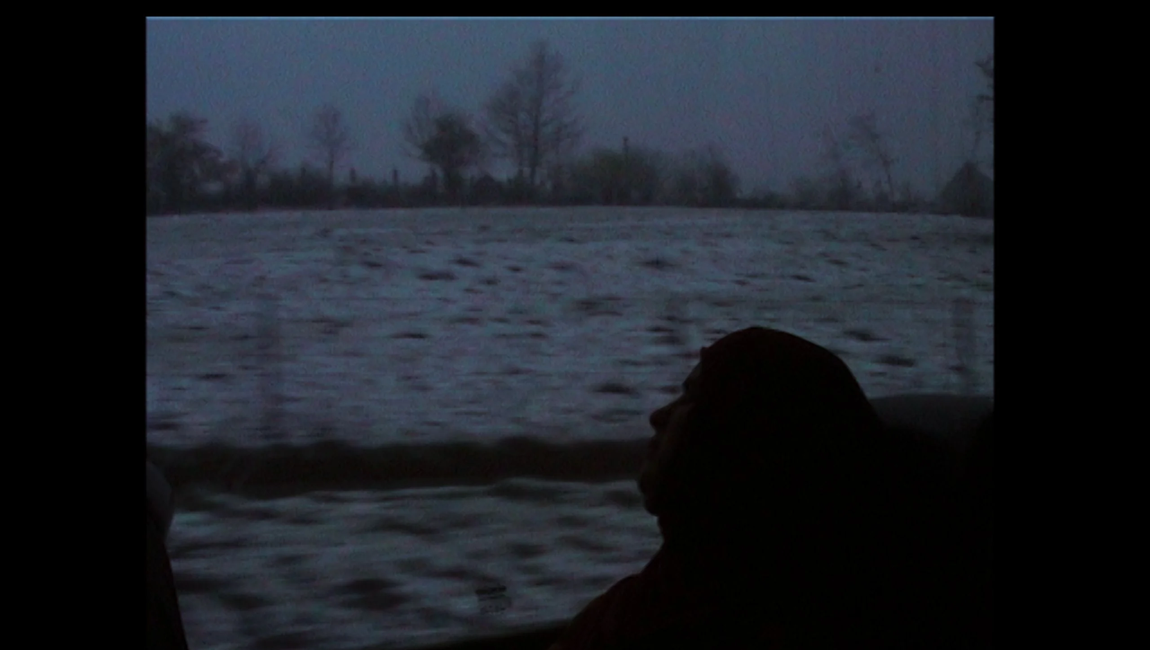
The portable camera is more accessible now than perhaps ever before, and as a result, the diary film seems to have found its footing within the canon of contemporary independent cinema. Yet in a time when digital records and self-tracking images have become more common behavior than documentary novelty, few filmmakers have been able to establish distinctiveness and ingenuity within the genre that’s being gradually diluted by excess. Somewhere located between diary film, city symphony, and politically-charged travelogue, Yaela Gottlieb’s I Couldn’t Draw You a Map (2026) emerges as a rare exception.
I Couldn’t Draw You a Map is a quiet meditation on Gottlieb’s experience traveling through Eastern Europe. She arrives in Mitrovica, Kosovo, by train, sometime during the “last days of March.” The year is purposefully ambiguous. Is the filmmaker a tourist, a drifter, a refugee? Diegetically, viewers are unaware. We are informed of tension — personal, religious, cultural, and ideological — but it is neither seen nor directly felt. Rather, the film is strongest in its subtleties.
Visually, I Couldn’t Draw You a Map is an accumulation of observational portraits, fragmenting urban Balkan life without intervention. The film oscillates between a grainy digital handycam and clear, stable footage, while its soundtrack is assembled through metropolitan traffic and environmental noise. Gottlieb’s own musings and observations, meanwhile, are entirely mediated through intertitles that document her experiences. She informs viewers of political strife at each of Kosovo’s Northern and Southern borders, and uses this context to unravel the implications of her own divided cultural identity.
Perhaps most intriguingly, I Couldn’t Draw You a Map emphasizes war statues and religious structures within an architectural landscape without a common aesthetic vernacular. This approach to documenting Kosovo’s cultural and urban instability is reminiscent of Jem Cohen’s Chains (2005) and Chantal Akerman’s D’est (1993), which leverage verité portraits of infrastructure to capture and emblematize broader urban decay. In doing so, I Couldn’t Draw You a Map displays a region that appears to be more defined by the past than the present or future. We see Kosovo, a divided nation, through Gottlieb’s eyes, yet we are reminded of a long, tense history that far-predates our gaze.
As Gottlieb wears her influences on her sleeve, I Couldn’t Draw You a Map aligns itself with the diary film’s most compelling use: to document, preserve, and politicize one’s own experience within a period of history. In this way, Gottlieb appropriately provides what a map cannot. While the film may also consist of borders and landmarks, its images are riddled with the nuances of an urban landscape only able to be captured through film.
Published as part of 2026 FIDMarseille — Dispatch 2.
Comments are closed.