
Corpus opens tantalizingly, with a modeling session in which apparently inexperienced Wren (Nuha Jes Izman) is being photographed by veteran Billie (Lily Cowles). This being a horror movie, obviously something unsettling is likely to happen, and indeed it does as Billie gently coerces her subject into doing something she’s clearly reluctant to engage in, something involving a weird wicker mask with a long beak. We’ll get back to that later.
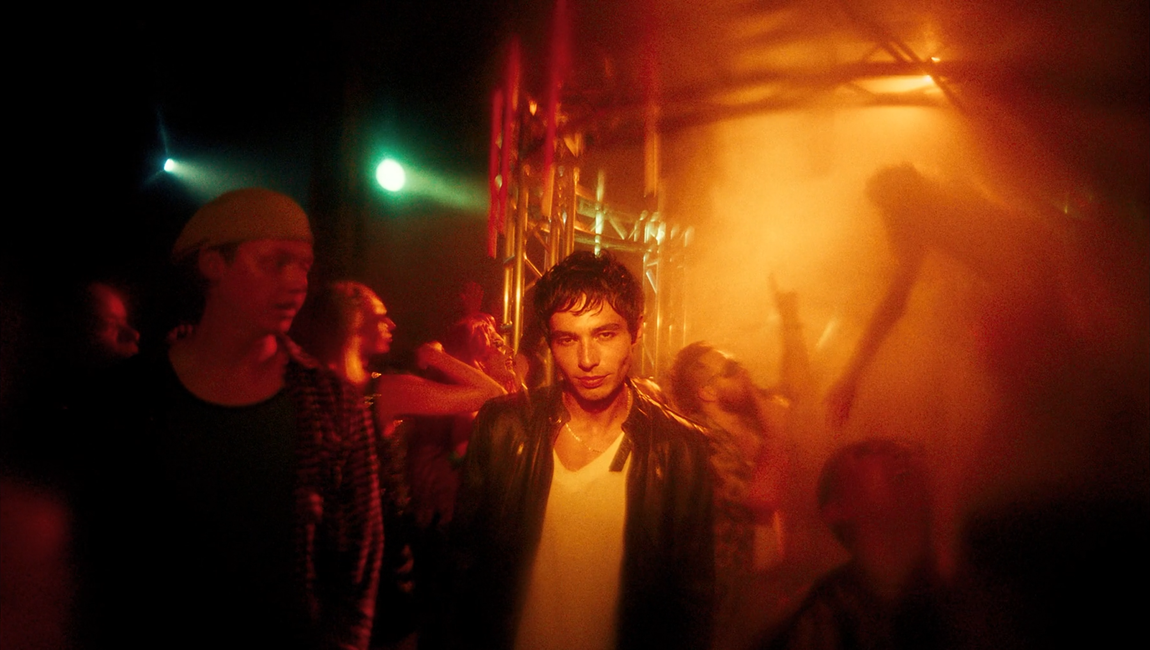
It’s 1998, and now we follow Sayo (Jeff Wahlberg), a hustler, sometime drug dealer, and aspiring photographer. He snaps picture after picture of nightlife while slinging coke at the clubs. One night he reunites with Vince (Brodie Townsend), an ex- (or maybe just on-and-off) lover who’s since become a famous model and actor. Vince invites Sayo and another mutual friend Ross (Michael Vlamis) to a retreat at a creepy castle out in the middle of nowhere for a weekend of partying. Sounds like a good idea, what could go wrong? By the time everyone’s “enjoying” a delicious meal of raw meat served by a Billie and a clearly more assertive Wren, it’s already too late.
Corpus is the kind of ambitious but obvious little indie that tends to get called “body horror” in that it explicitly deals with physical transformations and vaguely outre sex. Sayo and Vince engage in constant back and forth with regard to their unbalanced and mildly abusive relationship, with one or the other exclaiming that they can’t live without each other or that they feel like they’re trapped inside one another — seems like we might be going somewhere with all that. When the purpose of the aforementioned creepy wicker mask is revealed (in a genuinely squicky scene), the subtext becomes text and the movie decelerates. Corpus is a movie about how sex and love intertwine personalities and bodies, and how co-dependency is an inevitable byproduct and fatal trap.
If that sounds overly familiar for the 2020s horror landscape, it’s true that the film’s content isn’t particularly novel. But Corpus is undeniably gorgeous to look at. Director (and former intimacy coordinator) Corrin Evans’ feature debut is captured in silky browns, greens, and golds, punctuated by the freeze frames of Sayo’s constant picture taking. And her handling of the actors’ — especially the several effective but relatively non-explicit — sex scenes is purposeful in its reserve. This isn’t exploitation. Depending on your vantage, that might be the film’s problem, ultimately, in that it never truly kicks over into something intensely disturbing or shocking, instead settling to be a psychic chamber piece. But if that’s the endgame here, then at least it’s a productive one.
Published as part of Fantasia Fest 2026 — Dispatch 2.
Comments are closed.