
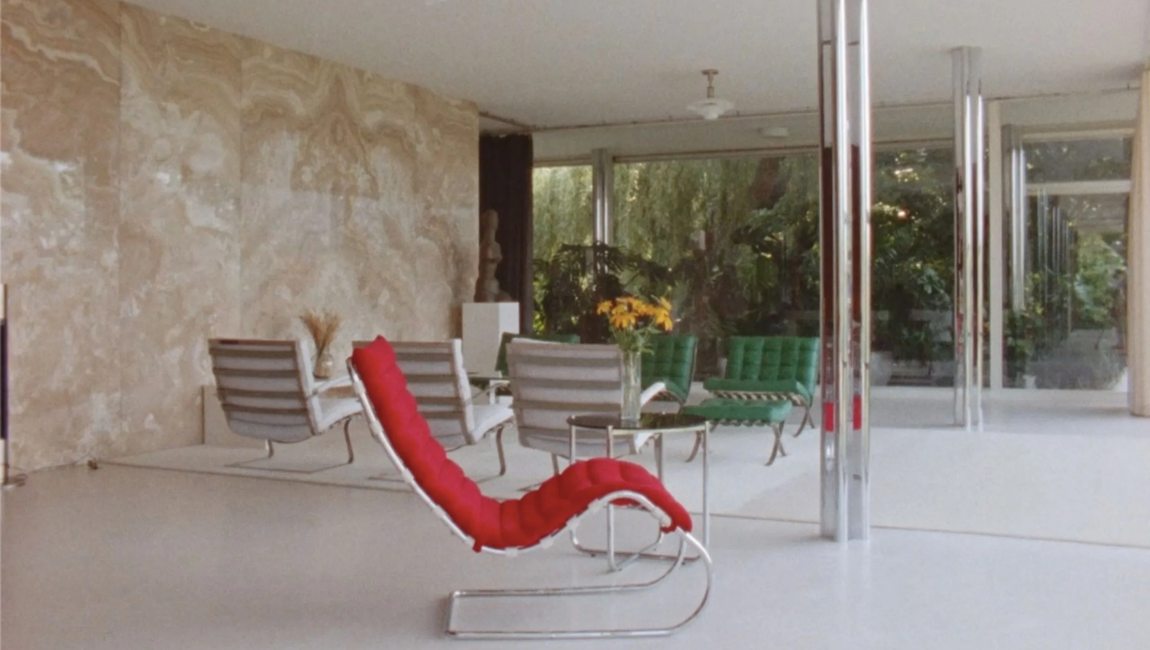
Like his 2010 film Cologne Overnight, Declan Clarke’s latest, Love and the End of Romance in Czechoslovakia, takes an instructive approach. Title cards loaded with written information about Czechoslovakian history between the two World Wars are broken up by images of the many works by the famous and not-so-famous architects who built the new inter-war nation. What emerges in this contrast of pedagogy and illustration is a portrait not only of a once mighty economic power, but a beacon of sophisticated, cutting-edge artistry.
Shot, initially, in black-and-white 16 mm, Love and the End of Romance’s static images of power plants, dams, apartment buildings, shops, and villas have a calming, contemplative quality occasionally at odds with the quasi-lecture that accompanies them. It’s clear that by intersecting a straightforward account of Czech history with filmed images of the country’s architectural achievements, Clarke seeks to equate the two in some way. Left for the viewer to infer, then, is that the hydroelectric plant and dam in Dolné Kočkovce – Ladce – Tunežice — introduced in the film’s opening images as a symbol of Czechoslovakia’s interwar economic power — should also be understood as an aesthetic achievement because it was designed by architects Václav Houdek and Jindřich Merganc.
No problem there, that logic is easy enough to square. A more complicated form to shape, though, is this idea’s inverse, which gradually unfolds over the course of the film’s 36 minutes. For Clarke, the political symbolism of a seemingly apolitical object — for example, an apartment building in Brno designed by architect Jan Hass in 1936 — is just as important to understand as the artistic qualities of a utilitarian engineering feat like the hydroelectrical plant in Dolné Kočkovce – Ladce – Tunežice. As Clarke makes clear in his careful research, Brno established itself as the epicentre of Czechoslovak architecture at the same time it established itself as an economic power. The fact that Jan Hass was deported from Brno under the ID number 59504/II on April 7, 1942, and likely murdered in a German concentration camp, necessarily politicizes its aesthetic qualities. The invigorating heights of Czech culture are followed by equally demoralizing lows.
With this knowledge, we don’t necessarily interpret the 180-degree curve of Hass’ apartment building facade, or its accompanying row of ten vertically inlaid windows as having any additional aesthetic merit, but they are imbued with a more existential weight. Clarke’s depiction of this and many other buildings as stoic monuments, isolated and cloistered within the frame, deepens and expands their symbolic power.
Published as part of 2026 FIDMarseille — Dispatch 2.
Comments are closed.