
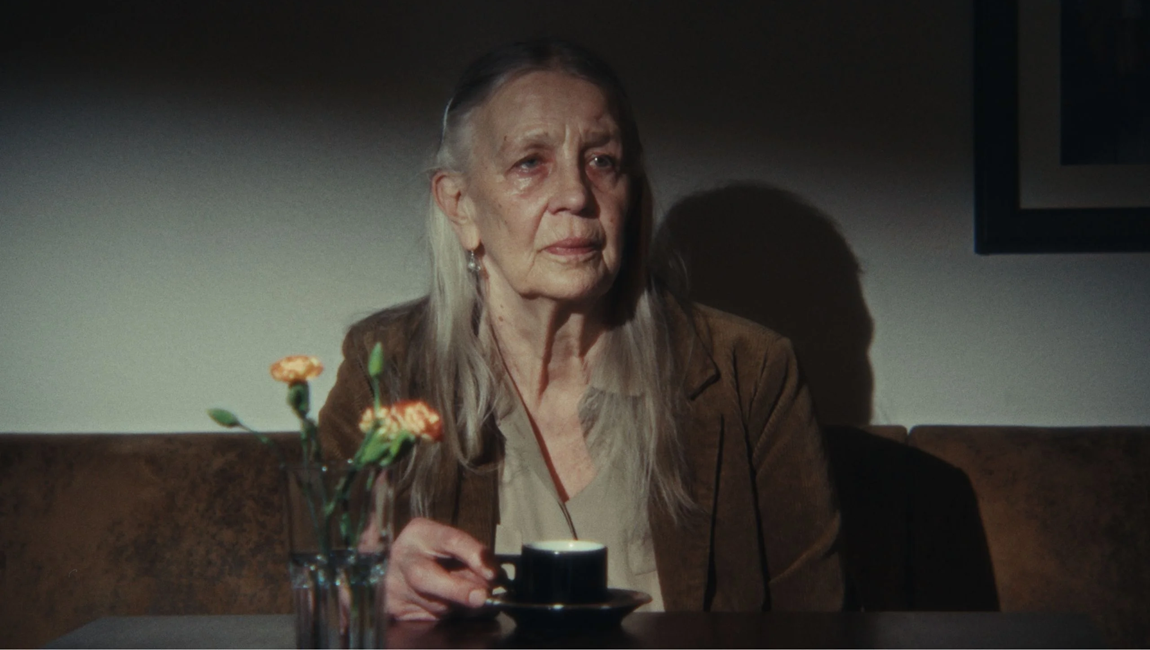
A more oblique interlocutor than Matthew McConaughey’s nihilist operative “Rust” Cohle in True Detective, Sawandi Groskind’s Staubwelt arguably dramatizes the central premise of philosophical pessimism without so much as a foot in the rhetorical door. Much of the film’s unnerving complexion is marked by negative space, whose narrative absences and ellipses come circumscribed within an underlying atmosphere, or logic, of melancholy. Where Cohle served as a conduit for the human will’s futility and the counterpoint to his partner’s dogged rejection of it, the moral strife in Groskind’s second feature — after 2024’s XXL, co-directed with Kim Ekberg — is less overt and more grounded in the interiority of its protagonist. Agnes (played by Groskind’s mother, Vivan) is a police investigator who, on her last day at work, makes the acquaintance of a man (Shamsil Balkis) she believes to be the Devil. And so, the two of them pass the time, in bouts, hand in hand, in search of a horizon to the grayish twilight called eternity.
There are several subtexts present in Staubwelt, not least one of broad metaphysical terror. The aging Agnes lives to await death; her imminent retirement is couched not in terms of comfort or creativity, but as a gnawing inertia steadily grasping at her purpose and conscience. A brother she hardly seems to meet appears only toward the end of her journey, sharing not even a frame of space onscreen. A long-standing colleague hits her up for mini-golf with the intimacy of a former lover but none of its remembered frissons. Snorting away her illicit stash of cocaine seized from police evidence, Agnes could hardly be said to harbor the decorum and penchant for inner peace. Yet it is with the Devil that she finds it. A younger, well-groomed man of Indian descent, he teleports into existence on the wintry streets of Helsinki one night, always already a photographer at the same precinct Agnes works in. While the older woman looks more certain about shuffling off her mortal coil, her younger companion, wracked by deepest sorrow and ennui, actively seeks to put an end to his own immortality.
Interpretations of Staubwelt, one suspects, might then latch onto either psychological or gnostic readings of its mysterious encounter. As an inverted Oedipal projection of Agnes’ fraught state of mind, the Devil — in all his grace and gentle sensuality — provides the alluring prospect of absolution, it is revealed, from a burden she carries. Sites of grisly murders, still unsolved, litter the surrounding Finnish wilderness, and if the Devil’s accompaniment on their nighttime walks does not proffer catharsis, it at least blunts the acute solitude of this guilt. Yet his learned disposition expresses desires both human and divine: clad in a leather jacket with the airs and musings of a philosopher (with a desk cluttered by books on art history and race relations), the staid figure teases a profound liberation from mortal limits with the promise of certain omniscience. An urn, containing the sum total of all earthly events past, present, and future — including those “actions without witnesses” — comprises the Mephistophelian reckoning Agnes is gifted and cursed with.
Groskind’s shape-shifting symphony frequently defies the genre expectations set up for it, marked by the tenderness of fellow Finn Aki Kaurismäki, even and especially as it descends into purgatorial gloam. At Agnes’ farewell reception, pointedly addressed with funereal reverence, a co-worker remarks on order and its translation into rules: “if every player follows their own rules, or cheats, there is no game.” The unspoken strictures of socialization, whether through belief or through action, abound in Staubwelt for the most part, until they don’t. If William Blake, whom Agnes cites doddering, summed up the antinomy of the soul through the feeble Lamb and fallen Tyger, the dissolution of order through her late-life tryst with the Devil threatens to damn it. For her, however, damnation might just provide the necessary release: a flattening of hierarchies, languages (Malayalam versus Finnish, mutually intelligible), and divinities; care in the face of cosmic unrest. The whispers of this unrest manifest, first in the film’s elusive, spectral soundtrack (by Michael Cedlind and Johannes Hagman) and then in its primordial return, to atoms and the void. In its title lie enigmas of great fascination, of a world, horrified by its contrivance, settling back into dust.
Published as part of 2026 FIDMarseille — Dispatch 2.
Comments are closed.