
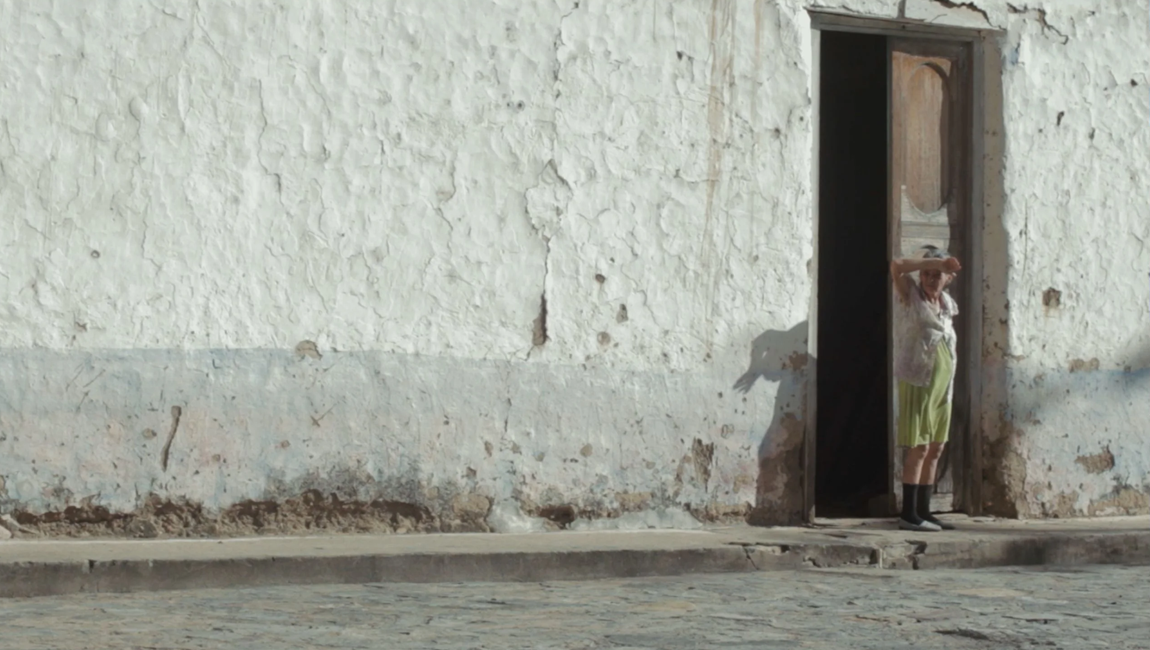
The question of how to depict violence has plagued, or in other cases not bothered, filmmakers since the medium’s inception. In Felipe Rúgeles Pineda’s new film Muchedumbre (The Crowd), a filmmaker, voiced by Pineda, happens upon a ghost town in the mountains of Colombia called Jordán, whose legacy of violence has also plagued what few inhabitants remain with a powerful collective amnesia. In a bid to uncover more details about what happened in Jordán almost 70 years ago, when a man named Roque Terreiro and his paramilitary group, the Chulavitas, invaded and installed a conservative political regime, Pinedo tries out to speak with anyone in Jordán who has something to say.
We never see Pinedo, or the loosely autobiographical character he might be playing. The only traces of his presence, though they’re substantial, are the images we see (taken at different points in time on a miniDV camera and a more modern digital one), and his disembodied voice. “What brings you to these lands?” asks a muleteer when he sees this filmmaker wandering around Jordán. Don Roque, as Terreiro was called, always carried his gun inside a camera. The historical ties between cinema and war are well documented and, to the people of Jordán, immediate, so this man’s misgivings about a filmmaker wandering around with a camera in his hand are understandable.
The act of documentation comes under increasing scrutiny throughout The Crowd. What appears to be mere information gathering — the filmmaker asks whomever he sees questions about the town’s history, eventually learning about the violent muder of a young woman who refused to vote in Terreiro’s rigged elections in 1956 — has violent historical precedence in anthropological and ethnographic filmmaking. The medium’s ability to index the real has political repercussions. In the case of The Crowd, the collective amnesia the filmmaker encounters regarding the events of 1956, both from the heirs of its victims and the heirs of its perpetrators, is not just a response to generational trauma, but also an act of denial.
Pinedo’s mix of miniDV and digital photography does not convey a distinct demarcation between the past and the present, especially when we learn that some of the miniDV footage is actually taken from behind the scenes of an abandoned film production in the same town in the 1990s. While this lost project isn’t a direct adaptation of Jordán’s tragedy, its confrontation with the violence of the 1950s, with military rebels, the church, and innocent victims caught in a storm of violence and terror, has undeniable parallels that has clearly left a lasting legacy on the town.
The footage from this lost film is disturbingly impressive. We see glimpses of the director, for example, choreographing a complicated crane shot outside the town’s church. This location footage in Jordán isn’t the only lost image from the film, though. Extensive work in studios, at times evocative of Hugo Fregonsese’s Apache Drums, suggests a film of great ambition and technical care, if not necessarily budget; noble, if misguided, intentions that mirror countless films throughout history.
Inevitably, Pinedo must confront the ethical dimensions of his own film project, the reality of necessarily uncovering decades of trauma for a project that likely won’t serve anyone but Pinedo himself. The open-ended nature of the lost film from the 1990s, whose director Pinedo was able to track down, finds a mirror in some minor re-creative efforts amongst those residents of Jordán who were willing to remember and willing to speak. The Crowd isn’t a definitive answer to the question of whether film can undo the violence it once caused, but it’s an invigorating, immersive, and challenging proposition.
Published as part of 2026 FIDMarseille — Dispatch 2.
Comments are closed.