
Pain is not a present sensation. Pain is a memory. Like all sensations, by the time information — be it visual, aural, or anything else — has reached the body, and the signals have traveled to the brain, and the brain has processed it, what we perceive as a present stimulus is, in fact, already in the past, albeit the very recent past. This is the case for physical pain, which tends to subside relatively quickly, but emotional pain can chart a much longer path before its course has been run. Some emotional wounds take just minutes to heal. Some take years. Some may never heal at all.
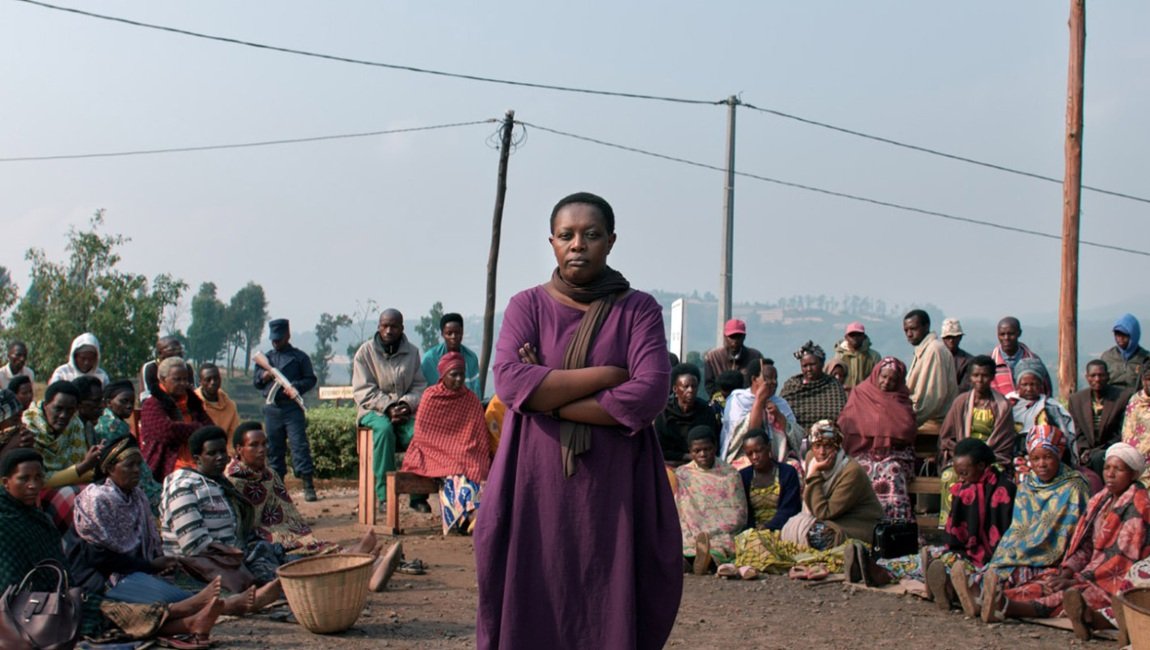
In the opening scene of Marie-Clémentine Dusabejambo’s Ben’Imana, forgiveness is granted for a crime that the audience will soon infer was a most grievous one. Once Veneranda (Clémentine U. Nyirinkindi) has given her pardon, in a public court, to a Hutu man found responsible for the deaths of her Tutsi family members in the Rwandan genocide, her sister, Suzanne (Isabelle Kabano), refutes her authority to do so on behalf of the family. For Veneranda, though, her forgiveness seems hardly heartfelt. As the crowd abandons the court, she sits down, alone, with a sullen expression on her face. The clemency she’s shown is less a representation of her true feelings than it is a choice made in spite of them.
Veneranda leads a local group dedicated to overcoming the trauma of the genocide as these public-led trials begin. Ben’Imana is set in 2012, 18 years after the violence, during which time many changes have altered the impact of said trauma on the citizens of Rwanda. But while some may be ready to discuss it, few have recovered from it. By this time, however, many have no memory of it — children born in the early and mid 1990s are graduating from school and reaching adulthood. When an announcement is made that university scholarships may now only be awarded to those who lost a parent in the killings, Tina (Kesia Kelly Nishimwe), Veneranda’s daughter, arouses cheers of support from her school cohort when she declares that their generation will accept no form of discrimination. The youth of Rwanda, it seems, see a future for their country based on conciliation, even those whose families were decimated 18 years ago.
But their elders can see no future without also seeing the past — after all, the pain they remember still festers within them. Veneranda’s group sessions, populated by women from across the region’s ethnic spectrum, are testy. An air of tense solemnity pervades recollections of the atrocities, from mass murders to rapes and maimings. Suzanne, still so furious in her grief that she’s labeled mentally unstable, bristles against the very concept of processing her pain, and admonishes others in the group for even attempting to do so. She’s particularly aggrieved at her sister, and this discontent is certainly not unfounded. Outside these sessions, Veneranda’s benevolence is far stingier. When Tina is sent home from school after her pregnancy is discovered by a teacher, and when she reveals that the baby’s father is a Tutsi, Veneranda throws her out. The pain that she’s processing evidently can’t all be dismissed with a simple word of forgiveness, and the horrible events of 1994 aren’t all that inform it. What Veneranda knows, and what Tina doesn’t know, respectively inform how they view the world, and how they seek to reshape it in their own ways.
There are what seem like several lifetimes’ worth of stories of depth and passion in Ben’Imana, such that one wonders how Dusabejambo, directing her first feature here, could ever hope to match its quality again. Fittingly for a movie in which most of the characters are female — when Veneranda asks why no men have shown up to the first session, one woman replies that all their husbands are either dead or in prison — it employs several techniques characteristic of feminine storytelling. It employs a multi-perspectival approach, where each character isn’t just richly developed, but given a quasi-protagonist status in their moments on screen. Its temporal structure may be linear, but its rhythm is not, sequenced instead like a series of circles spiraling back to the past to commence new stories that will bring it back to the present, and then back again. In Ben’Imana, time doesn’t follow a linear logic, but a cyclical one, as memories are felt and recounted.
What this means for Veneranda’s mission of overcoming is complex. Early on, her narration informs the audience that, in her region, the word for yesterday is the same as the word for tomorrow. In order to break the cycle of pain, then, how should one treat tomorrow if it’s to be the same as yesterday? Ben’Imana is full of appropriately difficult questions and momentary gestures and utterances that suggest conflict and contradiction. Narrative ellipses drop the action into the midst of scenarios, stripping the movie of the kind of context that might give us a clearer answer to these questions. But there is no answer, not to any of them, at least not one that will satisfy everyone. After all, when Veneranda bestows her forgiveness in the opening scene, she’s apparently done so only out of choice. This is a compassionate, profoundly emotionally intelligent movie, graceful in style, sincere in feeling, and generous to all its characters.
Comments are closed.