
Death is awful, but the language we use to describe death is arguably worse. Humorist Norm Macdonald, who himself died of cancer, took issue with the phrasing we sometimes use: that someone has “lost their battle” with the disease. Since the cancer dies along with you, isn’t that really a draw? As we watch civilization slide backward into superstition and euphemism, it’s almost considered bad manners to address mortality at all. The word “suicide” has become so taboo that many social media platforms flag it as offensive regardless of context, hence the advent of “unaliving yourself.” Meanwhile, M.D. Anderson Hospital, one of the leading cancer research centers in the U.S., employs a ubiquitous logo — in advertising, on their buildings, on official letterhead — that features the word “cancer” struck through in red, as if this sub-Derridean gesture of erasure were somehow deeply reassuring.
Flies is a film about death, its incomprehensibility, and the struggle to articulate its impact. Fernando Eimbcke’s films are unique in world cinema in that they adopt a humanist stance towards existence that, while sometimes fanciful, is never avoidant of sadness or tragedy; only Aki Kaurismäki comes to mind as a point of comparison. Both artists understand that there is humor lurking in the darkest moments of our lives, and that being able to laugh in the face of sorrow does not diminish its seriousness or the pain it brings. After all, there is a basic evolutionary adaptation in the human psyche that prevents us from fully remembering pain. We can recall having been in pain, and we can experience lingering sadness. But when we remember our moments of anguish, we are much more likely to recall the way someone placed a hand on our shoulder, or something awkward someone said, or a specific song that came on the radio. These are the sorts of fragments that form the core of Eimbcke’s films.
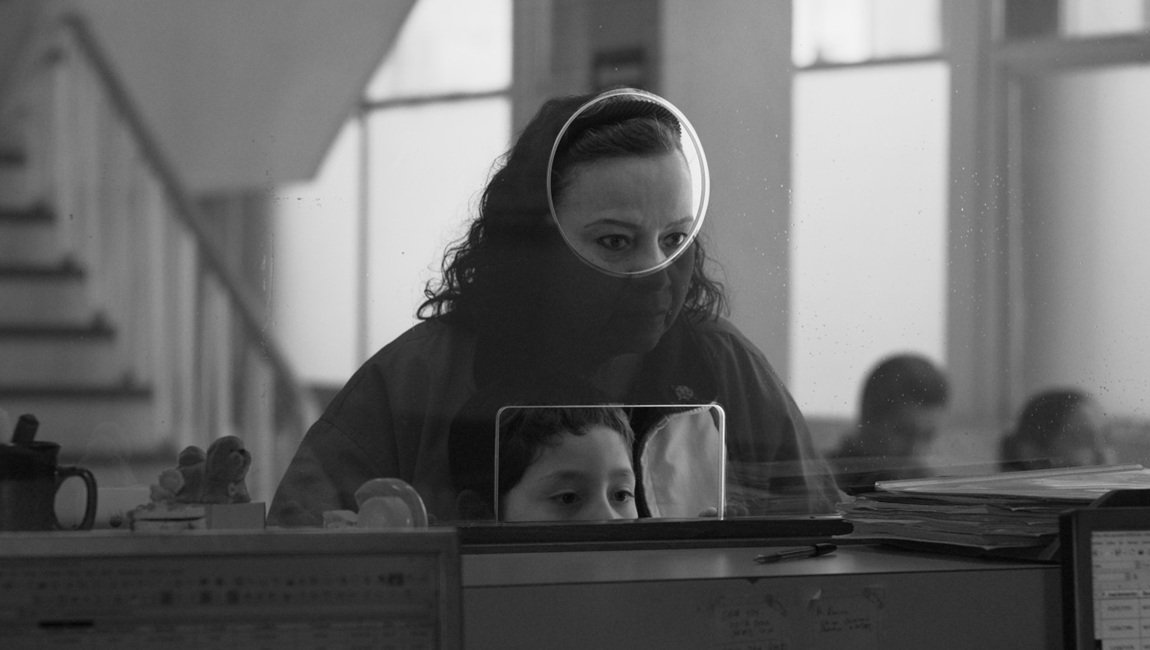
Flies adopts a familiar narrative framework while attempting to subvert it. The film opens in the apartment of Olga (Teresa Sánchez), a grumpy middle-aged woman who sits around playing sudoku on her computer and being irritated by the buzzing of a fly. She reluctantly rents a room to Tulio (Hugo Ramírez), curtly informing him of her rules and regulations. Tulio doesn’t have very much money, and so initially he conceals the fact that he is also sheltering his young son Cristian (Bastián Escobar). When Olga catches the kid, she informs Tulio that he must find another room but can stay through the week since he’s paid up.
What we eventually learn is that Olga’s apartment block is adjacent to a major hospital where Cristian’s mother is undergoing cancer treatment. We see Cristian and Tulio in the room at Olga’s, or getting lunch, or playing Cristian’s favorite arcade video game, Cosmic Invaders Pro, on a console outside a bodega. In these moments, Eimbcke frequently pans up to show the hospital’s façade in the near distance. In this way, he emphasizes just how close Cristian’s mother is, and how removed and inaccessible she is in the boy’s life. This is compounded by the fact that hospital rules forbid Cristian from visiting his mother unattended while Tulio is at work. Nevertheless, he tries to sneak past guards and orderlies, resulting in gentle, scampish humor.
In Tulio’s absence, Olga is frustrated by Cristian’s presence, but of course she eventually warms to the boy. This classic moppet vs. curmudgeon structure weakens Flies at times, as if Eimbcke didn’t trust his own seriocomic impulses and needed to signal familiarity to the viewer. Unsurprisingly, we learn why Olga is so bitter (it relates to the hospital), and when she discovers his passion for Cosmic Invaders, this sparks joyful memories of her own deceased child.
Eimbcke leans heavily on the videogame as both an audiovisual motif and a heuristic device. When Cristian asks his father what exactly is wrong with his mother, he explains that she has “invaders” in her body, cells that her immune system is trying to fight off. While this becomes the controlling metaphor for Flies, Eimbcke wisely holds back and allows it to hover in the distance. That is, until a remarkable scene in which he depicts Cristian’s mom “losing her battle” by turning the entire hospital façade into a giant game board. It is a breathtakingly original depiction of death, the most striking moment in an already impressive film.
However, Flies overall feels a bit like an aesthetic step back from the director’s previous film Olmo. Both demonstrate Eimbcke’s abiding interest in father-son relationships, but by making the father the patient, Olmo was better able to attend to the complex blend of solicitousness and frustration that comes with catastrophic illness. While Flies chooses to keep the mother’s condition mostly offscreen, it also sidelines Tulio, focusing much more attention on Olga’s evolving view of Cristian. While those moments are certainly touching, they minimize the young boy’s perspective by conflating it with the older woman’s tragic past. This detracts from the most poignant element of Flies, which is Cristian’s incomprehension of his family situation and his struggle to make sense of something the adults around him, and the culture at large, either cannot or will not. When Olga tells him that sometimes we don’t “win,” this only impels Cristian to try and play harder. Eimbcke shows that he will, in fact, have to settle for a draw.
Comments are closed.